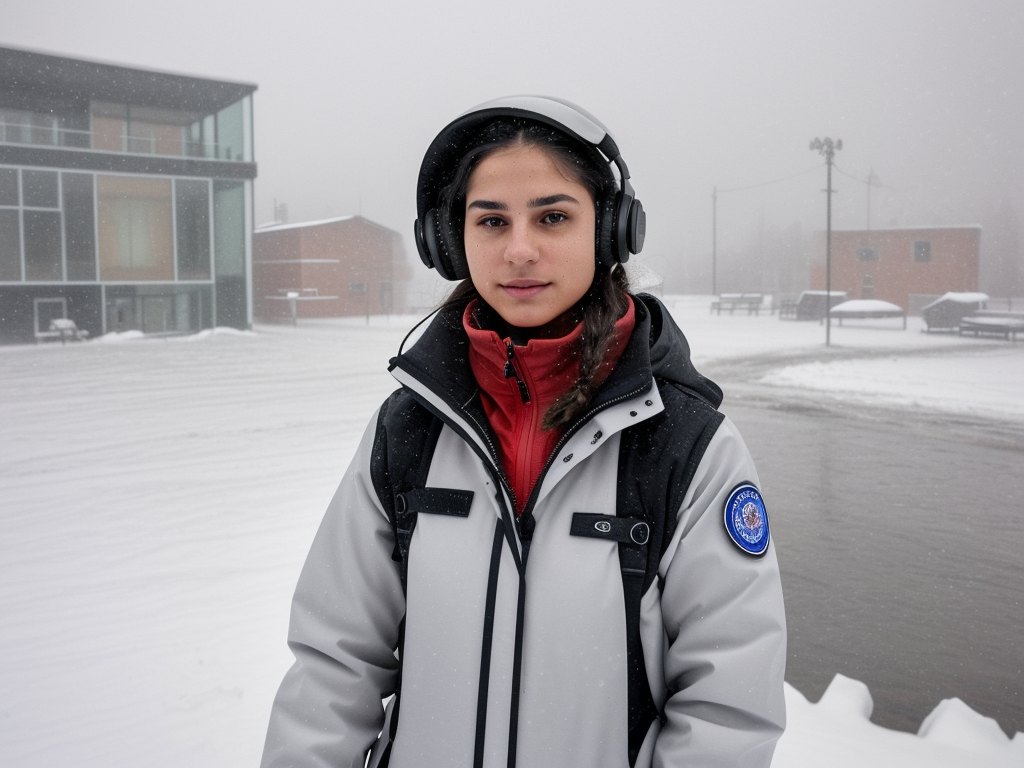
The Storm Whisperer
Luna Vasquez pressed her face against the reinforced window of Weather Station Denali, watching snow slice horizontally through the beam of the emergency floodlights. The anemometer had clocked out at 95 mph three hours ago—not broken, just spinning too fast to register. The barometric pressure had dropped to levels she’d only seen in textbooks about hurricanes.
At nineteen, Luna was the youngest meteorologist ever stationed at Denali, a fact that had impressed her professors at UAF and terrified her parents back in Tucson. Right now, alone in a metal box while nature threw the tantrum of the century outside, she was questioning every decision that had led her to this moment.
The satellite phone crackled. “Luna, you still alive up there?” Dr. Chen’s voice sounded tiny through the static.
“Still here,” she replied, adjusting the radio antenna for the fifth time in an hour. “But I’m reading conditions that don’t make sense. The storm’s eye wall is behaving like it has… intention.”
A pause. “Come again?”
Luna looked at her instruments—barometer, hygrometer, wind gauge, temperature sensors. All of them told the same impossible story. “The pressure drops aren’t following any standard pattern. It’s like the storm is… thinking. Testing the station’s weak points, backing off, then hitting harder.”
“Luna, you’ve been alone up there for six days. Sometimes isolation—”
“I know what isolation psychosis looks like,” Luna interrupted, her voice sharper than intended. “This isn’t that. I have forty-six hours of data that suggests this storm system is exhibiting behavioral patterns.”
She hung up before Chen could suggest she needed evacuation.
Luna returned to her instruments, but her grandmother’s voice echoed in her mind: “Mija, the weather spirits—they’re not fairy tales. They’re the oldest science we know.”
Abuela Rosa had died when Luna was fifteen, but her stories about los espíritus del tiempo had planted the seeds that eventually grew into Luna’s love of meteorology. As a child in Sonora, Rosa had learned to read the sky like text, predicting rain days before the clouds formed, sensing earthquakes in the way birds flew.
“Weather has personality,” Rosa used to say while they watched summer storms build over the desert. “You learn to listen, it will tell you its secrets.”
Luna had always assumed those were just beautiful metaphors. Science, she’d learned in college, was about measurable phenomena, not spirits or personalities. Weather systems followed atmospheric physics, not mystical intentions.
But now, watching her instruments register impossible readings while hurricane-force winds hammered the station in patterns that felt almost… conversational… Luna found herself remembering more than just her grandmother’s stories. She remembered Rosa’s hands moving like she was conducting an orchestra when storms approached. Remembered how Rosa would step outside just before the first lightning strike and whisper to the clouds in Yaqui, the language her own grandmother had taught her.
A massive gust hit the station, and Luna felt the entire structure flex. The lights flickered, came back, flickered again. Outside, the storm howled with what almost sounded like frustration.
Luna looked at her weather maps, at the spiral of destruction centered directly over her location. The eye was holding position, which shouldn’t happen in a system this dynamic. It should be moving, dissipating, following the jet stream northeast. Instead, it sat over Denali Station like it was waiting for something.
“Okay,” Luna said to the empty room, feeling slightly crazy but unable to stop herself. “If you’re listening, if you’re actually here and not just a coincidence of atmospheric pressure and temperature gradients… what do you want?”
The wind immediately died.
Not slowed, not shifted direction. Died. Complete silence.
Luna’s instruments registered the change instantly—barometric pressure stabilizing, wind speed dropping to zero, temperature rising fifteen degrees in thirty seconds. She grabbed her emergency parka and opened the station door.
The world outside was perfectly still. Snow fell straight down in gentle flakes, each one catching the light like tiny prisms. The eye of the storm stretched above her, a perfect circle of stars visible through clear air, while walls of churning cloud rose impossibly high on all sides.
Luna stepped away from the station, her boots crunching in fresh powder. The silence was profound—no wind, no mechanical sounds, just the soft whisper of falling snow.
“I’m listening,” she said to the stillness.
The response came not as sound but as sensation. Suddenly Luna could feel the storm’s structure from the inside—the pressure systems, the thermal layers, the electrical charges building in the cloud formations. She felt the storm’s confusion, its ancient patterns disrupted by something it didn’t understand.
Climate change. The phrase formed in her mind, but not from her own thoughts.
Luna closed her eyes and let the feeling wash over her. She sensed the storm’s memory—decades of seasonal patterns, migration routes through arctic air currents, the rhythm of natural cycles that had governed weather systems for millennia. But those patterns were broken now, confused by temperatures that rose too fast, by ice that melted out of season, by ocean currents that had shifted beyond recognition.
The storm wasn’t malicious. It was lost.
Luna opened her eyes and looked up at the walls of cloud surrounding her. “You don’t know where to go,” she said softly. “The markers you’ve always followed—they’re not there anymore.”
Wind began to circle slowly around her, but gently, like a curious animal. Luna felt an overwhelming sensation of agreement, of relief that someone finally understood.
She thought about her grandmother’s stories, about weather spirits that had guided storms for generations. Maybe they weren’t metaphors after all. Maybe they were just a way of acknowledging what science was only beginning to understand—that complex systems could develop something resembling consciousness, that patterns could carry memory, that nature had its own forms of intelligence.
“I can’t fix what’s been broken,” Luna said, her breath visible in the frigid air. “But I can help you find new paths.”
She pulled out her handheld GPS device and began uploading the storm’s current data to the National Weather Service database, but with annotations her professors had never taught her. She marked the storm’s energy patterns, its probable emotional state, its preferred movement corridors. She created a new kind of weather map—one that treated the storm as a partner rather than an adversary.
As she worked, the eye began to shift slowly northeast, following natural pressure gradients toward the ocean where it could dissipate safely over uninhabited waters. The wind resumed, but purposefully now, organized, following ancient pathways that curved around populated areas.
Luna returned to the station and watched her instruments register the storm’s departure. In her final report, she would describe “unprecedented cooperation between atmospheric monitoring and natural weather patterns,” careful not to mention spirits or conversations or the moment when she felt a hurricane’s confusion.
But in her personal journal, she wrote: “Abuela Rosa was right. Weather has personality. It just took the biggest storm in recorded history for me to learn how to listen.”
Three days later, when the rescue team arrived to check on her, they found Luna calmly cataloguing the most comprehensive storm data ever recorded, along with a new theoretical framework for “collaborative meteorology” that would revolutionize how scientists understood extreme weather events.
She never told them about the moment of perfect stillness, or the feeling of an ancient intelligence recognizing a kindred spirit, or how sometimes the most advanced science looked exactly like the oldest wisdom.
That night, as the helicopter carried her back to civilization, Luna looked down at the pristine wilderness below and whispered a prayer in Spanish that her grandmother had taught her—not to any god, but to the wind itself, thanking it for the conversation and promising to remember what it had shared.
Above them, the northern lights danced in patterns that almost looked like writing, as if the sky itself was taking notes.
Sometimes the most sophisticated instruments are our hearts. Sometimes the most advanced technology is listening. Sometimes the future of science looks exactly like the wisdom our grandmothers carried, waiting for us to be ready to understand.
Luna Vasquez learned that in the eye of the storm, everything is connected—past and future, science and spirit, the measurable and the magical. She learned that being alone doesn’t mean being lonely when you know how to hear what the world is trying to tell you.
You Might Also Enjoy
Diamond Roads
The smell hits me first. That mix of mustard, onions, and the particular leather-and-dirt scent that means baseball. I follow the seasons like a migrating bird, chasing long days of summer across thirty different ballparks. Seven years wheeling my cart, calling 'Cold beer! Ice cold beer!' The thing about traveling from park to park is that baseball is the same game everywhere, but also completely different. In Boston they sing Sweet Caroline. In Chicago they throw back opposing team home runs. In Nashville they play country music and the barbecue is worth the trip alone. And sometimes you meet another traveler who understands the long arc of the season.
Four Fires, One Warmth
There are four fires in four hearths, in four separate homes, scattered across the geography of a single night. They don't know they're connected. One burns steady in a study. One dances in a kitchen. One flickers as a candle for someone who can't sleep. One roars as a bonfire among friends. Four fires, one warmth.
Still Decorated
Everyone on Maple Street knew Mrs. Kowalski kept her Christmas lights up too long. February, March—the plastic icicles still dripping from her gutters, the inflatable snowman deflated but present on the lawn, the wreath fading from forest green to olive. The HOA had sent letters. The neighbors had opinions. But every year, the lights stayed. Walter had put them up November 28th, 2019. He had his stroke December 3rd. Gone by the 10th. She never took the lights down. 'Those voicemails. They're your lights. Everyone has something they keep past when they're supposed to.'