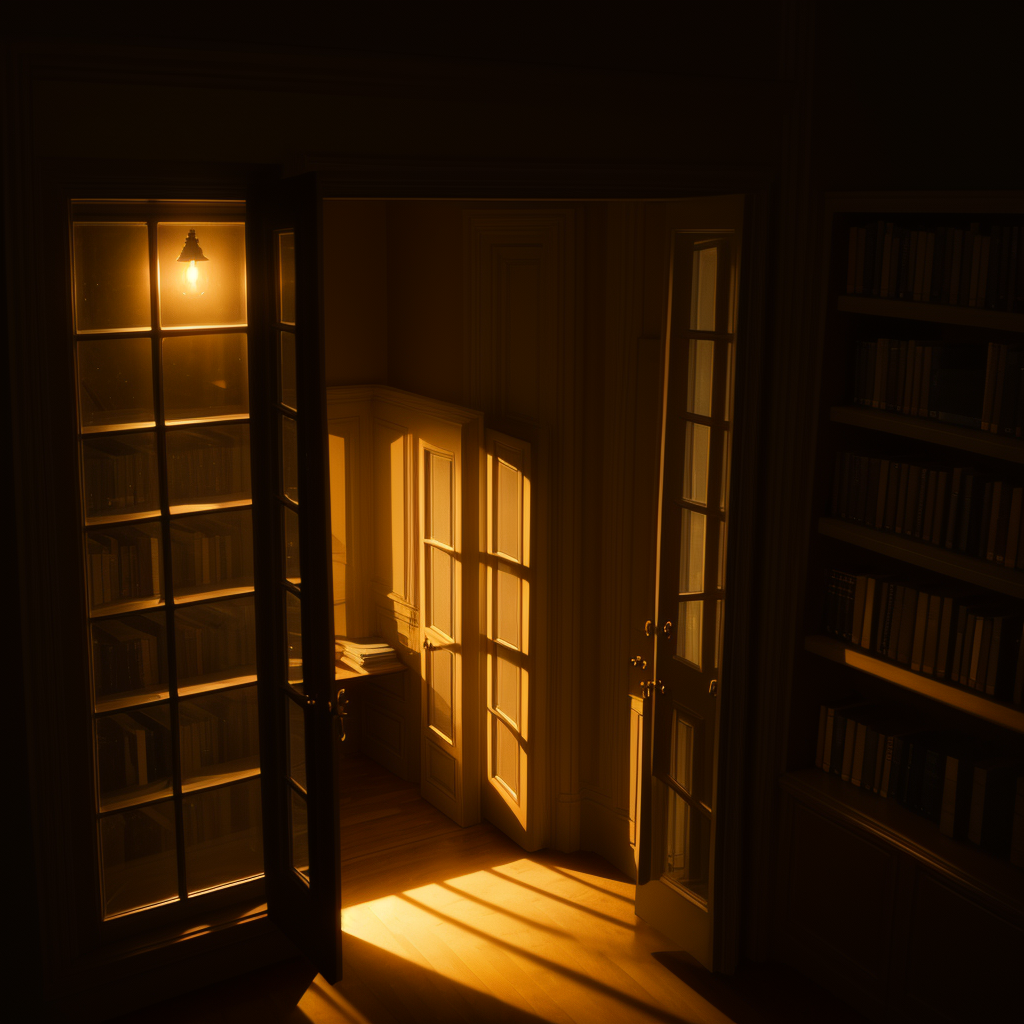
The Night Librarian
The sign on the door read: EVERNIGHT LIBRARY - Open 24 Hours - Silence Optional
Marcus Chen discovered it at 3:47 AM on a Tuesday, during his fourth consecutive night of staring at his bedroom ceiling, calculating how many hours of sleep he wasn’t getting.
The building sat on a quiet corner he’d walked past a thousand times during daylight hours without noticing—an old brownstone that seemed to phase into existence only after midnight, its warm windows glowing like a secret against the dark street.
He pushed through the heavy oak door, half-expecting to be turned away. Instead, he found himself in a cathedral of books, softly lit and entirely occupied by other people who looked exactly like him: awake, exhausted, alone but seeking proximity to other humans without the burden of conversation.
“First time?”
The voice came from behind the circulation desk—a woman in her sixties with silver hair pulled into a practical bun and reading glasses hanging from a beaded chain. Her name tag read: MARGARET FINCH - NIGHT LIBRARIAN
“I… yes,” Marcus said. “I didn’t know this place existed.”
“Most people don’t,” Margaret said gently. “We’re not in the directory. No website. We exist by word of mouth among those who need us most.” She gestured to the room. “Three AM is our busiest hour.”
Marcus looked around properly for the first time. About twenty people occupied the space—each at their own table, each with a book or laptop, each maintaining a bubble of solitude while existing in the same shared space. Nobody making eye contact. Nobody forcing cheerfulness or asking “How are you?” when the answer was obviously “Terrible, I haven’t slept in days.”
“Coffee?” Margaret offered, pointing to a station along the wall. “Fresh pot every hour. Decaf too, for the philosophical insomniacs.”
“Philosophical insomniacs?”
“The ones who’ve given up caffeine but still can’t sleep.” Margaret’s eyes twinkled. “They come here anyway. Turns out it’s not the coffee they needed—it’s the company.”
Marcus became a regular.
He learned the unspoken rules quickly:
- No conversation before 5 AM (unless emergency)
- Headphones permitted, but no visible screens except at designated zones
- You could cry, but quietly
- The bathroom had extra toothbrushes and face wash
- Nobody asks why you’re here
The collection was deliberately eclectic. Poetry sat next to automotive repair manuals. True crime mixed with cookbooks. Philosophy blended into graphic novels. Margaret’s selection strategy was simple: “Books that don’t require you to be at your best to appreciate them.”
“When you’re this tired,” she explained to Marcus one night, “your brain can’t handle complex plots or beautiful prose. You need something gentle. Something that meets you where you are.”
She showed him to the “Insomnia Shelf”—a special section near the back. Books with short chapters. Collections of essays. Photography books with minimal text. Anything that could be picked up and put down without losing thread.
“My favorite,” Margaret said, pulling a worn volume, “is this collection of facts about lighthouses. Completely random information. No narrative. Just… lighthouses exist, here’s some stuff about them. It’s incredibly soothing.”
Marcus borrowed it. She was right.
He met the other regulars slowly, carefully, respecting the invisible boundaries everyone maintained.
There was David, the programmer who worked remotely for a company in Singapore and used his insomnia productively, writing code at 4 AM when his brain finally worked.
Aisha, the medical resident whose shifts had destroyed any normal sleep cycle, who came here on her nights off because sleeping in her apartment felt “too loud.”
Robert, the widower who’d slept next to his wife for forty-three years and now couldn’t remember how to sleep alone.
Lisa, the graduate student writing her dissertation on something incomprehensible, who’d reached the point where the normal boundaries between day and night had dissolved entirely.
They didn’t talk, exactly. But they existed together. Shared coffee refills. Made space at tables. Left notes in the suggestion box praising Margaret’s latest book acquisitions.
Once, Marcus had a panic attack—the full-body kind that makes you forget how breathing works. He didn’t have to say anything. David appeared with water. Aisha put a hand on his shoulder for exactly three seconds before withdrawing. Robert slid a note across the table: You’re okay. This will pass. We’re here.
Margaret gave him ten minutes, then quietly appeared with a book of landscape photographs. “Look at these for a while,” she suggested. “Just the images. Don’t read anything. Let your eyes rest.”
It worked.
At 4:15 AM one Thursday, Marcus finally asked the question everyone eventually asked:
“Why do you do this? The Night Librarian thing?”
Margaret smiled, the kind that carries old pain. “I lost my husband twelve years ago. Cancer. He died at home, and afterward, I couldn’t be in our house during the nights. Too many memories of sitting up with him, watching him sleep, grateful for every breath.”
She adjusted her glasses. “So I walked. For months, I just walked the city at 2 AM, 3 AM, 4 AM. And I’d see others doing the same—walking off anxiety, insomnia, grief, whatever kept them from their beds. And I thought: we need a place. Somewhere that’s not a bar or a diner. Somewhere without expectation.”
“So you opened this?”
“I found this,” Margaret corrected. “The building was abandoned. I broke in at first, honestly—just wanted somewhere to sit and read during my walks. Then I started leaving books. Then I started brewing coffee. Then one night someone else showed up, and I realized… I wasn’t the only one who needed this.”
She gestured around the room. “Now it’s technically legitimate. The owner’s family lets me use the space. Insurance company thinks we’re insane. Health department approved the coffee station after I took a food safety course. And the night shift at the fire department knows we’re here—they stop by sometimes when it’s slow.”
“Does anyone ever…” Marcus paused. “Get better? Sleep again?”
“Some do,” Margaret said. “Some find their sleep schedules shifting—they become night people properly, find jobs that work with it. Some learn to nap during the day. Some take medication. Some don’t.” She met his eyes. “The point isn’t fixing anyone. The point is having somewhere to exist while you figure out what comes next.”
At 5:47 AM, something remarkable happened.
The baker from the shop next door arrived with fresh bagels—his daily donation to Evernight Library. Margaret put them out on the coffee station.
And slowly, the invisible walls came down.
People started talking. Quiet conversations. Nothing profound—just “Thank you for the bagel” and “Did you finish that book?” and “Has anyone seen my good pen?”
“This is the magic hour,” Margaret explained to Marcus. “Between 5:30 and 6:30 AM, the rules relax. You can talk if you want. Some people leave before this—they need the full silence. Others stay specifically for this—the gentle reentry into human connection before the real world starts.”
Marcus stayed.
He talked to David about programming. Aisha described the wildest thing she’d seen in the ER. Robert showed photos of his wife. Lisa explained her dissertation in a way that almost made sense at 6 AM.
By 6:45, the early morning commuters were appearing on the streets outside. The regular world resuming. Most of Evernight’s patrons gathered their things, nodded to Margaret, and slipped out into the growing daylight.
Marcus was always amazed by this transformation—watching people who’d been hollow-eyed and silent at 3 AM walk out at 6:45 looking almost restored. Not healed, but functional. Ready to face another day.
Three months later, Marcus’s sleep problems began to improve. A new medication, a new therapist, some combination of factors he couldn’t quite identify. He started sleeping through most nights.
But he still came to Evernight Library.
Not every night anymore—just once or twice a week. But he came. Because somewhere between 3 AM and 6 AM, surrounded by other people who couldn’t sleep, Marcus had found something he didn’t know he was missing.
Not solutions. Not fixes. Not cure.
Just presence. Just company. Just the knowledge that you’re not the only person in the world watching the clock count impossible hours.
“You’re sleeping better,” Margaret observed one night, pouring his coffee. “I can tell. But you keep coming back.”
“Yeah,” Marcus said. “I guess I just… like it here.”
Margaret smiled. “That’s how it happens. You come for the insomnia. You stay for the community. Even when you don’t need us anymore, you remember: there’s a place where being awake at 3 AM doesn’t make you strange. It makes you one of us.”
She handed him his coffee. “Besides, we need people like you—the ones who’ve crossed to the other side but remember the journey. The ones who can tell newcomers: yes, this is hard, but you’re not alone, and sometimes just being together in the difficult hours makes them a little less difficult.”
Marcus took his coffee to his usual table. Nodded to David. Caught Aisha’s small smile. Watched Robert settle in with his crossword puzzle.
Outside, the city slept.
Inside Evernight Library, a different kind of rest was taking place. Not sleep, but something equally necessary. A pause. A breath. A moment of existing without expectation, without performance, without the pressure to be okay when you’re not.
Margaret returned to her desk, opened her own book, and began the quiet work of keeping watch.
The night shift wasn’t glamorous. But it was essential.
And she’d be here, every night, from midnight to 8 AM, ensuring that anyone who needed a refuge from the terrible wakefulness of 3 AM had somewhere to go.
EVERNIGHT LIBRARY - Open 24 Hours - Silence Optional - Presence Guaranteed
At 7:12 AM, Margaret makes a note in her log: “23 visitors tonight. Two new faces. One panic attack (managed). Three pots of coffee. One box of tissues. Seventeen quiet hours of company. Another good night.”

You Might Also Enjoy
Diamond Roads
The smell hits me first. That mix of mustard, onions, and the particular leather-and-dirt scent that means baseball. I follow the seasons like a migrating bird, chasing long days of summer across thirty different ballparks. Seven years wheeling my cart, calling 'Cold beer! Ice cold beer!' The thing about traveling from park to park is that baseball is the same game everywhere, but also completely different. In Boston they sing Sweet Caroline. In Chicago they throw back opposing team home runs. In Nashville they play country music and the barbecue is worth the trip alone. And sometimes you meet another traveler who understands the long arc of the season.
Four Fires, One Warmth
There are four fires in four hearths, in four separate homes, scattered across the geography of a single night. They don't know they're connected. One burns steady in a study. One dances in a kitchen. One flickers as a candle for someone who can't sleep. One roars as a bonfire among friends. Four fires, one warmth.
Still Decorated
Everyone on Maple Street knew Mrs. Kowalski kept her Christmas lights up too long. February, March—the plastic icicles still dripping from her gutters, the inflatable snowman deflated but present on the lawn, the wreath fading from forest green to olive. The HOA had sent letters. The neighbors had opinions. But every year, the lights stayed. Walter had put them up November 28th, 2019. He had his stroke December 3rd. Gone by the 10th. She never took the lights down. 'Those voicemails. They're your lights. Everyone has something they keep past when they're supposed to.'