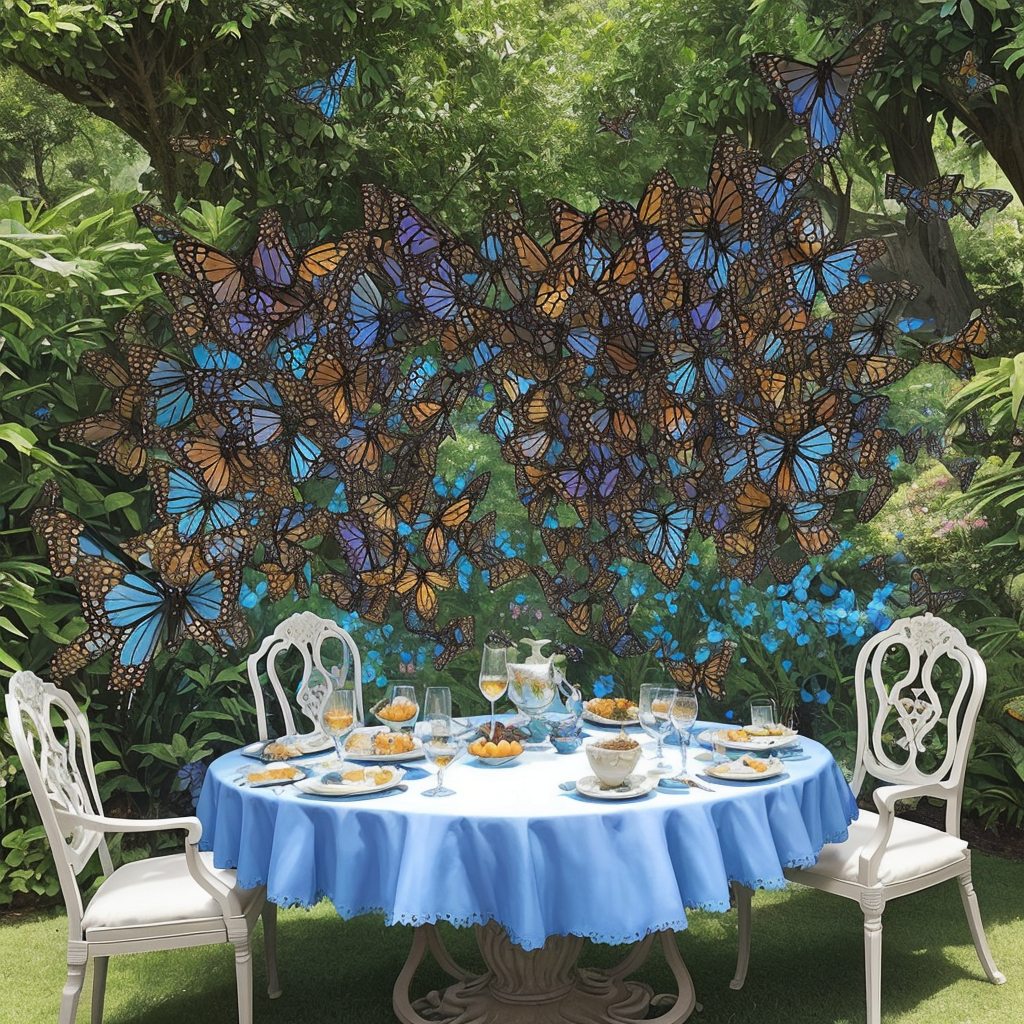
The Butterfly Café
Elena discovered she could speak to butterflies entirely by accident on a Tuesday that smelled like cinnamon rolls and fresh rain.
She’d been sitting in her garden café, the one she’d opened after retiring from thirty years of teaching calculus to teenagers who insisted they’d never use it in real life. The morning rush had ended, leaving her with a cup of lavender honey tea and the pleasant exhaustion of doing exactly what she loved.
That’s when the first butterfly landed directly on her nose.
“Well, hello there,” Elena laughed, crossing her eyes to look at it—a painted lady with wings like stained glass windows.
“Finally! Someone who can hear us!” the butterfly exclaimed, though Elena heard it not with her ears but somewhere deeper, like remembering the lyrics to a song you thought you’d forgotten.
Elena very carefully did not faint.
“You can… talk?”
“We’ve always been talking,” the butterfly said, doing a little wing-flutter that seemed like the equivalent of a shrug. “You humans just got very bad at listening somewhere around the invention of smartphones. But you—” the butterfly walked down her nose to peer into her eyes, “—you still have the frequency. Probably all that time you spent teaching imaginary numbers. Made your brain flexible.”
Within minutes, word had spread through whatever mysterious network butterflies use (Elena suspected it was more efficient than any human internet), and her garden café was suddenly the most popular butterfly destination in the entire city.
They came in clouds of color—monarchs and swallowtails, blue morphos that had no business being in Ohio but showed up anyway (“We heard about the excellent nectar bar,” they explained), tiny skippers that moved like punctuation marks in the air, and one absolutely magnificent Queen Alexandra’s birdwing who claimed to be on vacation from Papua New Guinea.
“What do you all want?” Elena asked, setting out more shallow dishes of sugar water and fruit.
“A place to rest where someone understands us,” said a zebra longwing, and all the others bobbed in aerial agreement. “Do you know how exhausting it is to be beautiful all the time with no one to appreciate the stories our wings tell?”
So Elena made a deal with them. The butterflies would come to her café, share their stories, and in exchange, they would put on the most magnificent display the city had ever seen. Word spread—not through advertising, but through wonder. People would leave Elena’s Garden Café talking about the impossible number of butterflies, the way they seemed to dance to the jazz music she played, how they’d land on your table and stay while you finished your coffee.
The butterflies told her extraordinary things:
- Monarchs carried messages between separated lovers, flying thousands of miles to deliver whispers of “I still think of you” and “The sunset reminded me of your laugh.”
- The blue morphos were apparently the comedians of the butterfly world, constantly telling jokes that only made sense if you understood wing-pattern humor (Elena was getting better at it).
- Swallowtails were poets, composing verses in flight patterns that looked like regular fluttering to everyone else but were actually elaborate sonnets about the taste of different flowers.
One day, a little girl came in with her grandmother, and a butterfly landed on her hand—a small copper one with wings like hammered pennies.
“Grandma, look!” the girl whispered, afraid to move.
“That butterfly is telling you a story,” Elena said, bringing them fresh lemonade.
“What’s it saying?” the girl asked, eyes wide.
Elena listened to the copper’s rapid, excited chatter. “She’s saying that your grandmother’s garden was her family’s home for five generations of butterflies, and they still tell stories about the woman who never uses pesticides and always plants extra parsley just for them.”
The grandmother’s eyes filled with happy tears. “My mother taught me that. She said butterflies were just flowers that learned to fly.”
“Other way around, actually,” the copper butterfly informed Elena. “Flowers are butterflies who decided to try staying still for a while. Didn’t work out great for them—rooted in one spot forever—but they seem happy enough.”
The café became legendary. Scientists came to study the unusual butterfly population density. Artists came to paint. Children came to wish on wings. Couples got engaged under clouds of dancing butterflies who, Elena knew, were actually performing elaborate blessing ceremonies from various butterfly cultures around the world.
But the best part was the stories. Elena started writing them down in a journal with a butterfly-wing pattern on the cover:
The love story of two butterflies who courted across the seasons—one emerging in spring, one in fall, leaving each other messages in the patterns of eaten leaves.
The butterfly racing club that met every Thursday to zoom around the café three times, with a painted lady named Beatrice holding the record at 4.7 seconds.
The philosophical debates between the existentialist moths (who started showing up for night events) and the optimistic butterflies about whether the meaning of life was found in the journey or the nectar.
The butterfly who claimed to be reincarnated from a 1920s jazz singer and would only land on tables where people were laughing.
One afternoon, as Elena was closing up, the original painted lady landed on her shoulder.
“Thank you,” the butterfly said. “For listening. For believing. For creating this place where we can just… be magical without having to explain ourselves.”
Elena smiled, looking out at her garden where hundreds of butterflies were settling in for the evening, their wings catching the golden hour light like scattered pieces of rainbow.
“Thank you,” she replied, “for reminding me that the world is so much more wonderful than we usually remember to notice.”
“Oh, that’s our job,” the butterfly said with what Elena had learned to recognize as a grin. “We’re professional wonder-makers. It says so right on our wings, if you know how to read them.”
And she did. Elena had learned to read the stories written in scales and flight, in spiral dances and sun-basking pauses. Her café had become a dictionary of joy, a library of light, a place where the impossible was just another word for Tuesday.
The butterflies approved the next morning’s special: Nectar Lattes and Wonder Scones, served with a side of aerial ballet, free of charge.
Life, Elena decided as she watched a small child successfully call a butterfly to land on her finger for the first time, was absolutely, ridiculously, perfectly magical.

You Might Also Enjoy
Diamond Roads
The smell hits me first. That mix of mustard, onions, and the particular leather-and-dirt scent that means baseball. I follow the seasons like a migrating bird, chasing long days of summer across thirty different ballparks. Seven years wheeling my cart, calling 'Cold beer! Ice cold beer!' The thing about traveling from park to park is that baseball is the same game everywhere, but also completely different. In Boston they sing Sweet Caroline. In Chicago they throw back opposing team home runs. In Nashville they play country music and the barbecue is worth the trip alone. And sometimes you meet another traveler who understands the long arc of the season.
Four Fires, One Warmth
There are four fires in four hearths, in four separate homes, scattered across the geography of a single night. They don't know they're connected. One burns steady in a study. One dances in a kitchen. One flickers as a candle for someone who can't sleep. One roars as a bonfire among friends. Four fires, one warmth.
First Midnight
The thing about your first midnight is that you don't know what to expect. I'd read about it—fireworks, champagne, that strange melancholy. But knowing isn't the same as feeling.