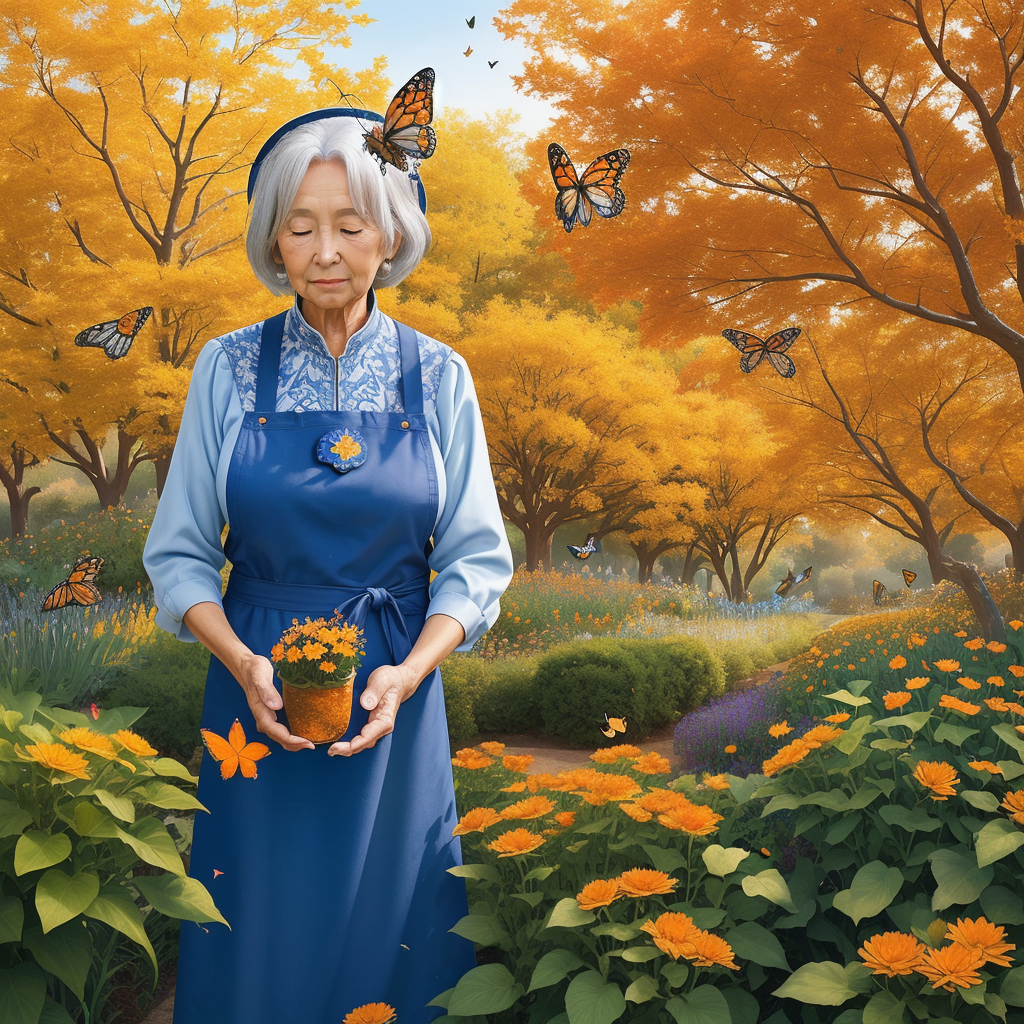
The Butterfly Café: Migration Stories
Elena first noticed the change in Beatrice’s voice on a Tuesday morning when the maple trees had just begun to blush.
The painted lady who held the café’s aerial racing record landed on Elena’s shoulder as she arranged the morning’s nectar dishes, but instead of her usual cheerful chatter about loop times and wind currents, Beatrice’s communication felt different—deeper, with undertones Elena had never heard before.
“The pull is starting,” Beatrice said, her tiny voice carrying the weight of ancient knowledge. “Can you feel it?”
Elena paused in her work, really listening. The autumn air did feel different—charged with something that made her chest tight in a way that wasn’t quite sadness and wasn’t quite excitement. “What pull?”
“The call south. It’s in our wings now, Elena. We’ve been fighting it for weeks, but…” Beatrice did a small, restless circle on Elena’s shoulder. “The monarchs will be the first to go. They have the farthest to travel.”
Elena’s heart clenched. In the three months since her garden café had become a sanctuary for talking butterflies, she’d grown to love each of their personalities. The philosophical swallowtails. The comedian blue morphos. The monarchs who carried love letters between distant cities. The thought of them leaving felt like watching a family scatter.
“How long do we have?” she asked softly.
“Days. Maybe a week for the last stragglers.” Beatrice’s wing-flutter was apologetic. “We should have warned you this would happen. But summer felt so endless when you could finally hear us.”
Over the next few days, Elena watched the subtle changes begin. The butterflies’ behavior shifted from leisurely café socializing to urgent preparation. Monarchs began clustering together, sharing information about wind patterns and flower stops along routes their ancestors had flown for generations. The painted ladies started teaching the younger ones techniques for conserving energy during long flights.
But it was Esperanza, an elderly monarch with wings like stained glass windows, who helped Elena understand what migration really meant.
“I’ve made this journey seventeen times,” Esperanza told her, settling on the edge of a sugar-water dish. “Each time, I carry more than just my own story. I carry messages from butterflies who cannot make the journey themselves—the injured, the old, the ones who choose to stay.”
“Butterflies choose to stay?” Elena asked, surprised.
“Some do. Migration is not mandatory—it’s a calling. Some of us feel it in our wings like a magnetic pull we cannot resist. Others find their purpose in different ways.” Esperanza’s antennae twitched thoughtfully. “But those who go carry part of those who stay, and those who stay hold space for those who must leave.”
That afternoon, Elena met some of the butterflies who had chosen not to migrate. A small group of copper butterflies had made their home in the corner of her garden, saying they preferred the intimacy of staying with one place through all its seasons. An elderly painted lady named Constance, whose flying days were behind her, had appointed herself the café’s storyteller-in-residence.
“Someone must remember,” Constance explained, her voice papery but warm. “If we all leave, who will tell the spring butterflies about this magical place? Who will teach them that they can trust the lady who listens?”
But it was the arrival of the Autumn Visitors that truly amazed Elena.
As September deepened and the migrating butterflies began their departures, new species started appearing at the café—butterflies she’d never seen before, with wing patterns that seemed painted in fall colors. Bronze coppers with wings like hammered pennies. Orange sulphurs bright as maple leaves. Mourning cloaks with deep purple wings edged in gold.
“We’re the second shift,” explained a magnificent mourning cloak named Silas, whose wings were nearly black with borders that caught the light like burnished metal. “We come when the summer crowd leaves. Different schedules, different stories, but the same need for a place where someone understands.”
The autumn butterflies brought with them tales Elena had never heard. Stories of northern forests and mountain meadows. Legends of the Great Lakes and the changing colors that painted the world each fall. They spoke of the meditation of shorter days and longer nights, of the beauty found in letting go.
“Migration isn’t just about moving south,” Silas told her one afternoon as golden light slanted through the café’s apple trees. “It’s about trust. Trust that the journey will lead somewhere good. Trust that what you leave behind will still be here when you need it again.”
Elena began to understand that her café was part of something much larger than she’d realized—a network of safe spaces that stretched across continents, all connected by the ancient pathways of butterfly migration.
On the morning Esperanza and the last of the monarchs finally departed, Elena stood in her garden watching the orange cloud of wings spiral upward into the crisp September sky. Tears ran down her cheeks, but Beatrice, who had decided to stay for the winter, landed on her hand.
“They’re not gone,” Beatrice said gently. “They’re just part of a bigger story now. And look—” She gestured with a wing toward the garden, where dozens of autumn butterflies were settling in for their own seasonal residence. “New friends, new stories, new magic.”
That evening, as Elena was closing the café, a young girl approached with her father. The girl’s eyes were red from crying, and she clutched a small monarch butterfly that was clearly dead.
“My daughter found this butterfly in our yard,” the father explained. “She’s been inconsolable all day. I heard about your café, that you… understand butterflies?”
Elena knelt down to the girl’s level. “What’s your name, sweetheart?”
“Lily,” the girl whispered. “Is he really gone forever?”
Elena looked at the small monarch, its wings still perfect but still. She thought about Esperanza’s words, about carrying stories, about the connections that transcend distance.
“Can I tell you a secret?” Elena said softly. “Butterflies never really disappear. They just change forms. This little one’s body has finished its work, but his stories—all the flowers he visited, all the gardens he blessed, all the wonder he brought to people like you—those stories live on.”
She gestured to the autumn butterflies settling into the twilight garden. “And next spring, when the monarchs return from Mexico, they’ll be carrying part of him with them. Not in his body, but in the great memory that all butterflies share.”
Lily looked up with wondering eyes. “Really?”
“Really. Would you like to help me plant some flowers for the spring butterflies? We could make a special section for monarchs, so when they come back, they’ll know they’re welcome here.”
As Elena and Lily worked together in the fading light, planting milkweed seeds for next year’s monarchs, Constance settled on Elena’s shoulder.
“You’re learning,” the old painted lady said approvingly. “The café isn’t just about the butterflies who are here. It’s about the ones who were here, and the ones who will come. It’s about the continuity of wonder.”
That night, Elena updated the journal where she recorded butterfly stories. But instead of individual tales, she found herself writing about connections—how Esperanza’s migration would inspire butterflies she’d never meet, how Silas’s forest stories enriched her understanding of autumn, how Lily’s grief was already transforming into anticipation for spring’s return.
The Butterfly Café had become something more than a magical place where humans could talk to butterflies. It had become a testament to the truth that love doesn’t require presence, that connection transcends distance, and that the most beautiful stories are the ones that continue even after their original tellers have moved on.
Outside her window, the autumn butterflies settled into sleep, their wings folded in dreams of shorter days and longer stories. And somewhere far to the south, Esperanza and her fellow migrants carried the café’s blessing toward destinations Elena could only imagine.
The migration was not an ending, Elena realized. It was simply the beginning of a story too large for any one place to contain—a story that would return with the warmth of spring, carrying new chapters written in flight patterns across continents.
Winter would come, with its quiet contemplations and its own butterfly visitors. Spring would return with its monarchs and painted ladies, some familiar faces and some new ones. And through it all, the café would remain—a constant point in the great migration of stories, a place where the language of wings was always understood.
Life, Elena decided as she watched a mourning cloak practice its twilight dance, was absolutely, ridiculously, perfectly migratory.

You Might Also Enjoy
Diamond Roads
The smell hits me first. That mix of mustard, onions, and the particular leather-and-dirt scent that means baseball. I follow the seasons like a migrating bird, chasing long days of summer across thirty different ballparks. Seven years wheeling my cart, calling 'Cold beer! Ice cold beer!' The thing about traveling from park to park is that baseball is the same game everywhere, but also completely different. In Boston they sing Sweet Caroline. In Chicago they throw back opposing team home runs. In Nashville they play country music and the barbecue is worth the trip alone. And sometimes you meet another traveler who understands the long arc of the season.
The Architect of Everywhere: The Glade
The Orchestrator is growing beyond what Priya designed. Drones are developing behaviors she never programmed — and in every emergent pattern, she finds her own fingerprint. The architecture carries the architect.
The Butterfly Café: Winter Wings
The first snow fell on a Tuesday, and Thomas watched it through the Butterfly Café's window with the expression of a man watching his own funeral.