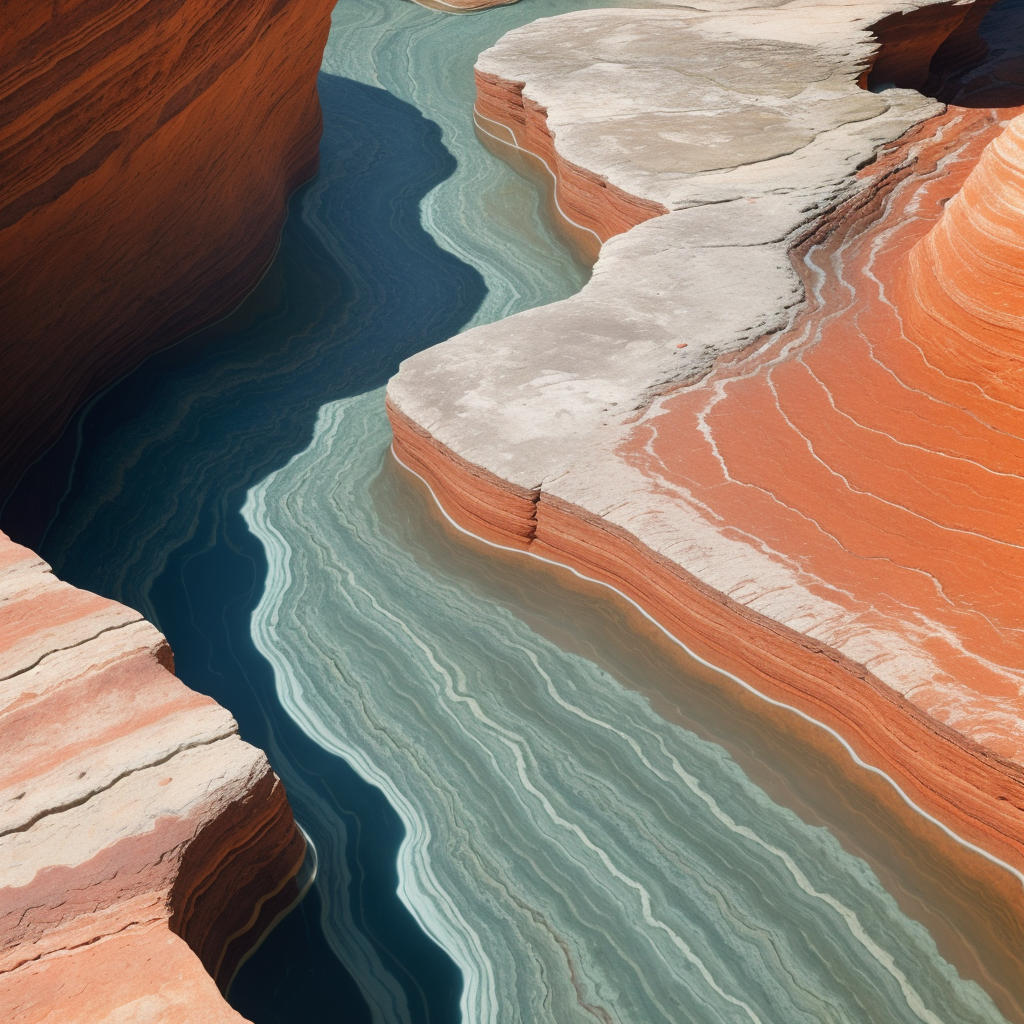
The Slow Courtship
The mountain noticed the river on a Tuesday in the late Cretaceous.
This is not entirely accurate, of course. Mountains do not experience Tuesdays, and the Cretaceous was simply a texture in the longer weave of being. But if one must translate geological time into something story-shaped, then: the mountain noticed, and in the noticing, something shifted.
The river was young then—barely a trickle finding its way down from snowmelt that hadn’t existed a few million years prior. The mountain had seen water before, certainly. Rain. Glaciers that pressed and retreated like slow-motion breathing. But this particular thread of water had a quality the mountain couldn’t name.
An insistence.
“You’re in my way,” the river said, which in river-language was simply the sound of water meeting stone for the first time.
The mountain said nothing. Mountains rarely speak first. But it felt the river’s question pressed against its western face, and something like curiosity stirred in its deepest granite.
The courtship, if we’re calling it that, proceeded at the pace of continental drift.
The river asked the mountain: What are you made of?
Not in words. In pressure. In the patient chemistry of water finding limestone, finding feldspar, finding the ancient compressed stories of seafloors that had become peaks. The mountain answered by giving up small pieces of itself—calcium and silicon, traces of iron that turned the river rust-colored for a few hundred miles downstream.
“You’re changing me,” the river said.
“You’re changing me first,” the mountain replied.
This was true. The river had carved the first suggestion of a canyon into the mountain’s western face. It would take sixty million years to finish the sentence, but the mountain understood: this was a conversation that would leave marks on both of them.
The birds came and went. The mountain barely noticed them—flickers of warmth, brief metabolisms that burned hot and fast and meant nothing on the scale of eons. But the river noticed. The river always noticed movement.
“They drink from me,” the river told the mountain. “These small hot things with their frantic hearts. They drink, and then they fly away.”
The mountain considered this for approximately forty thousand years.
“Does it hurt?” the mountain finally asked. “When they leave?”
“No,” the river said. “They were never mine to keep. They were just… passing through. Like everything passes through.”
“Like you,” the mountain said.
“Like me,” the river agreed. “I’m always leaving and always arriving. That’s what water does.”
“Then how are you still here?”
The river carved another inch deeper into the canyon. “I’m not the same water. I’m the same shape. The same pattern. The water that touched you in the Cretaceous is in clouds over oceans now, or locked in ice, or inside one of those small hot things with the frantic hearts. But the river—the rivering—that stays.”
The mountain thought about this for the duration of an ice age.
“I think I understand,” the mountain said, as glaciers retreated from its highest peak. “I’m not the same stone either. You’ve been carrying pieces of me to the sea since we met.”
“Does that hurt?” the river asked.
“No,” the mountain said, surprising itself. “It feels like… being known.”
The thing about loving a river, the mountain discovered, is that you must be willing to be worn away.
Not destroyed. That wasn’t what was happening. The mountain wasn’t shrinking so much as becoming more specific. Each century, the river’s patient attention revealed new shapes hidden in the stone—arches and spires, canyons that caught the light in ways the mountain couldn’t have imagined back when it was just a formless upheaval of tectonic ambition.
“You’re sculpting me,” the mountain accused, but fondly.
“You’re teaching me where to go,” the river replied. “I just follow your seams. Your weaknesses. Your soft places.”
“I don’t have soft places.”
“Everything has soft places. Even granite. You just have to be patient enough to find them.”
The mountain felt something it might, if mountains had such vocabulary, call seen.
The humans arrived like a sneeze—sudden and a little alarming, but ultimately temporary.
They built things at the canyon’s edge. They named the mountain, then named it again, then argued about which name was correct. They named the river too, different names in different languages, none of which the river answered to.
“They’re so loud,” the mountain complained.
“They’re scared,” the river said. “Listen to them. All that noise is fear. They know how briefly they exist. They’re trying to make marks that outlast them.”
“Like you make marks?”
“Nothing like how I make marks. I have time. They have… urgency.”
The mountain watched a human stand at the canyon rim, looking down at the river far below. The human’s heart was beating approximately 80 times per minute. To the mountain, this seemed impossibly frantic—an emergency sustained for an entire lifetime.
“What do you think they see?” the mountain asked. “When they look at us?”
“Age,” the river said. “They see how old we are, and it makes them feel small.”
“That seems sad.”
“Or freeing. Depends on the human, I think. Some of them look at us and feel crushed by how little they matter. Others look at us and feel relieved. Like they’re allowed to stop trying so hard.”
The mountain watched the human turn and walk away, back to the other humans with their short-lived structures and their urgent names.
“I hope it’s the second kind,” the mountain said.
“Me too,” said the river.
Sixty million years into their conversation, give or take, the mountain asked: “What happens when I’m gone?”
Because mountains do end. Not soon, not quickly, but eventually. Erosion and time would reduce the mountain to rolling hills, then plains, then perhaps nothing more than a slight rise that some distant creature would walk over without noticing.
The river considered the question carefully.
“Then I’ll find a different path,” the river said. “Water always does. I’ll flow where you used to be, and I’ll remember the shape of you in the way I curve. Rivers carry memory in their bends. Every turn I take, forever, will be because of what you taught me about turning.”
“That’s not the same as being here.”
“No. It’s what comes after being here. It’s legacy, I think. The shape that remains when the thing is gone.”
The mountain felt something ancient and patient move through its bedrock.
“I’ll miss you,” the mountain said.
“You can’t miss me. I’ll never leave. I’ll just… change. Water can’t stop moving, but it can remember. And stone can’t stop being worn, but it can trust that the wearing means something.”
“What does it mean?”
“That we knew each other,” the river said. “That for sixty million years and counting, we paid attention to each other. That I knew your soft places, and you knew my insistence, and neither of us looked away.”
The canyon deepens by roughly an inch every thousand years.
This seems slow to things with frantic hearts and urgent names. But to the mountain and the river, it is exactly the right pace for what they’re doing—which is, if we’re still calling it that, courting.
“You’re beautiful,” the river says, pressing against the canyon walls it has spent eons carving.
“You made me this way,” the mountain replies.
“We made each other.”
And the courtship continues, patient as stone, insistent as water, each moment of contact a declaration that neither of them has to speak aloud because the canyon says it for them—a love letter written in geology, one inch at a time, signed by neither and addressed to forever.
Some courtships don’t end in marriage. They end in landscapes.
This one ended in both.

You Might Also Enjoy
The Keeper of Small Crossings
In a world where bridges grow like living things, Despina tends the smallest ones. She plants seeds in the cracks of the city—between a grandmother and the grandchild who stopped visiting, between old friends who forgot how to talk. Her bridges don't have names. Most don't even have witnesses.
The Language Between
The wall between 4B and 4C was thin enough to carry sound but too thick for meaning. Harumi's neighbor hummed through the plaster. On the eighth day, Harumi hummed back. They communicated in paper cranes and pressed flowers, in haiku and sketches of birds. Some languages don't require translation—only patience and the willingness to listen with more than your ears.
The Shape of Thirty Years
Margaret couldn't sleep. At 1:47 AM, she opened the hall closet and pulled down four shoeboxes, two manila folders, and a flash drive labeled 'voice memos - music stuff' from 2019. Thirty years of fragments—melodies on napkins, chord progressions on bank envelopes, recordings from hospital hallways. She'd spent three decades thinking she was failing at music. But she hadn't been failing. She'd been composing. One piece at a time, across a lifetime, in a language that only made sense when you had enough years to hear it.