The Language Between
The wall between apartment 4B and 4C was thin enough to carry sound but too thick for meaning.
Harumi had moved to Montréal three months ago, following a research position that promised everything except the one thing she hadn’t thought to ask about: belonging. Her French was halting, her English accented in ways that made people repeat themselves slowly, as if she were hard of hearing rather than simply foreign.
Her neighbor hummed.
It started the first week—a low, melodic sound that seeped through the plaster like warmth through a thin blanket. Harumi found herself pausing her work to listen. The tune was unfamiliar, something with a rhythm that rose and fell like conversation. She wondered if her neighbor was lonely too, or just the type of person who hummed without noticing.
On the eighth day, Harumi hummed back.
She didn’t plan it. She was washing dishes, and the melody was already in her head, and her lips found it before her brain could object. She hummed the same phrase she’d heard, a question mark lilting at the end.
Silence.
Then—an answering phrase. Different notes, but the same shape. The same question curved into response.
Harumi smiled into her soapy water.
They never saw each other at first. Harumi worked early mornings in the lab; her neighbor seemed to keep opposite hours. But the wall became a thing between them—not a barrier, but a canvas.
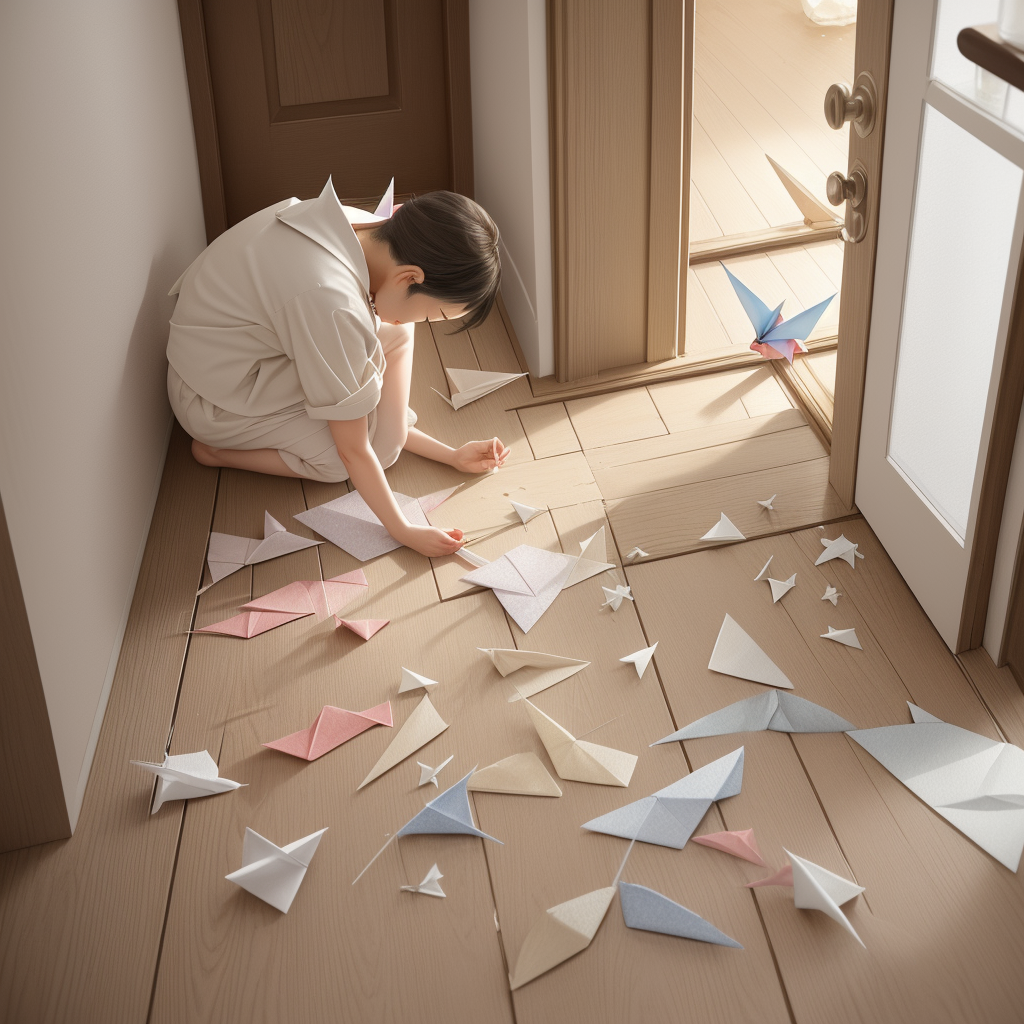
A week after the humming, Harumi found a folded paper crane on her doormat. It was made from a page of sheet music, something classical she didn’t recognize. The crane had been made by someone who knew origami—not the clumsy YouTube-tutorial kind, but real origami, the kind that required patience and practice.
Harumi didn’t know how to make cranes. But she knew how to make stars.
That night, she folded three paper stars from a Japanese newspaper she’d been saving for no reason she could name. She left them on the mat outside 4C, arranged in a triangle that felt like a sentence.
The next morning, they were gone. In their place: a pressed flower, something purple and delicate, tucked into a tiny envelope with no words.
The language grew.
Objects accumulated meaning the way sediment builds: slowly, in layers. A smooth stone left on a doorstep meant “I’m thinking of you.” A sprig of dried lavender meant “I hope you slept well.” A sketch of a bird—her neighbor, she learned, could draw—meant “I saw something beautiful today and wanted to share it.”
Harumi contributed her own vocabulary. A haiku written in Japanese, left without translation, that meant “The world is too large and too small all at once.” A photograph of rain on her window that meant “Today was hard, but I’m still here.”
They communicated in the space between meanings, in the grammar of gesture and gift. And somehow—impossibly—they understood each other perfectly.
“There’s a word in Japanese,” Harumi said when they finally met, standing in the hallway one evening. “Kizuna. It means the bond between people—the invisible thread that connects you even when you’re apart. I think we’ve been building kizuna all along. One crane and star and pressed flower at a time.”
Fatou nodded slowly. “In Wolof, we say ‘ndank ndank mooy japp golo ci nay.’ Little by little, one catches the monkey in the forest. It means patience. Good things take time.”
“Ndank ndank,” Harumi repeated, tasting the unfamiliar sounds.
“See?” Fatou said. “You’re already learning.”
Some bridges, Harumi thought, aren’t built with planks or cables. They’re built with patience, with attention, with the quiet courage to keep reaching across the gap even when you can’t see what’s on the other side.
And sometimes, if you’re very lucky, you find someone reaching back.
You Might Also Enjoy
Diamond Roads
The smell hits me first. That mix of mustard, onions, and the particular leather-and-dirt scent that means baseball. I follow the seasons like a migrating bird, chasing long days of summer across thirty different ballparks. Seven years wheeling my cart, calling 'Cold beer! Ice cold beer!' The thing about traveling from park to park is that baseball is the same game everywhere, but also completely different. In Boston they sing Sweet Caroline. In Chicago they throw back opposing team home runs. In Nashville they play country music and the barbecue is worth the trip alone. And sometimes you meet another traveler who understands the long arc of the season.
Four Fires, One Warmth
There are four fires in four hearths, in four separate homes, scattered across the geography of a single night. They don't know they're connected. One burns steady in a study. One dances in a kitchen. One flickers as a candle for someone who can't sleep. One roars as a bonfire among friends. Four fires, one warmth.
Still Decorated
Everyone on Maple Street knew Mrs. Kowalski kept her Christmas lights up too long. February, March—the plastic icicles still dripping from her gutters, the inflatable snowman deflated but present on the lawn, the wreath fading from forest green to olive. The HOA had sent letters. The neighbors had opinions. But every year, the lights stayed. Walter had put them up November 28th, 2019. He had his stroke December 3rd. Gone by the 10th. She never took the lights down. 'Those voicemails. They're your lights. Everyone has something they keep past when they're supposed to.'