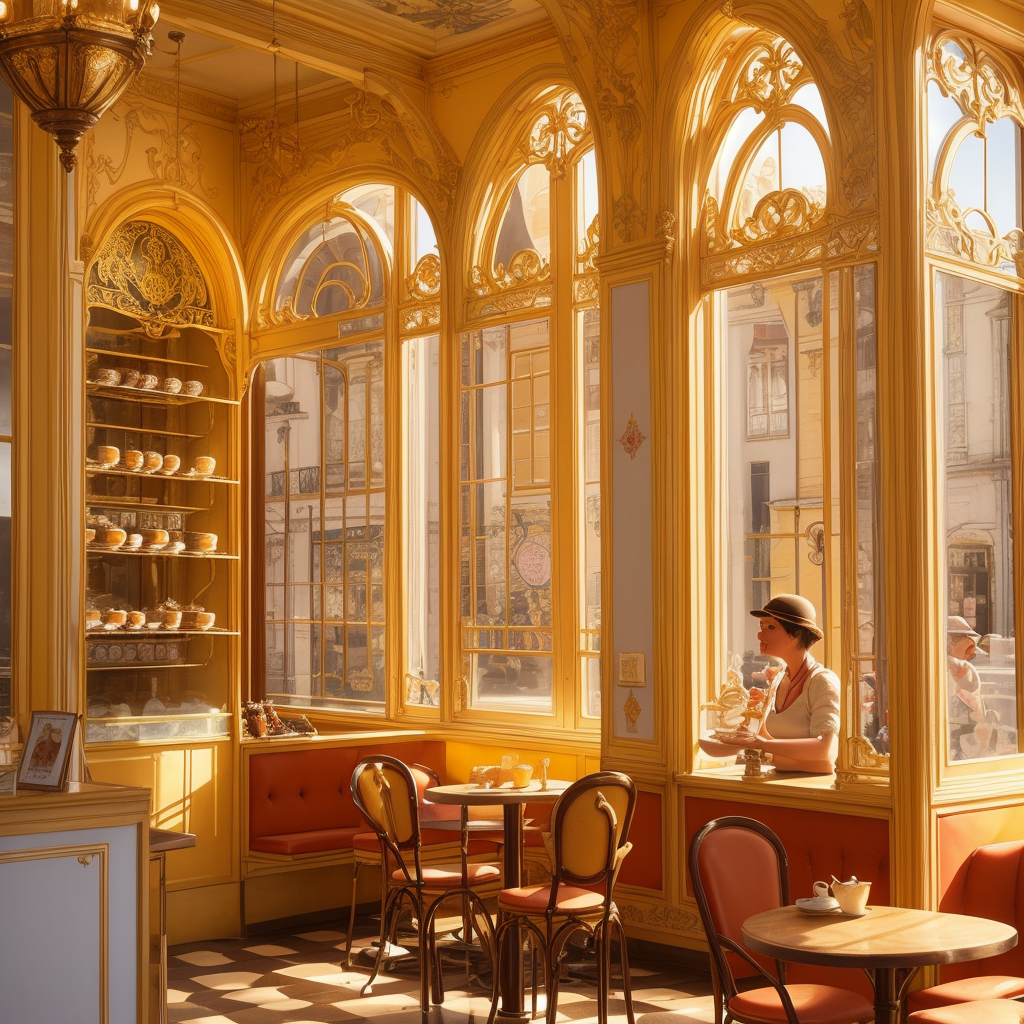
The Music Between Pastries
Inês Cardoso had flour under her fingernails and jazz in her heart, though she would never admit the latter to her father.
At twenty-three, she was the finest pasteleira in the Chiado district of Lisbon, capable of creating pastéis de nata so perfect that tourists would weep at their first bite. Her hands moved with the precision of a sculptor, folding delicate layers of massa folhada until they whispered secrets only she could understand. But every morning at precisely nine o’clock, when the café A Brasileira filled with the laughter of artists and intellectuals, Inês found herself listening not to the sizzle of her custard tarts, but to the saxophone that drifted through the kitchen window.
Someone was playing Gershwin in the square outside, and whoever it was understood something about music that made her chest ache with longing.
At ten-thirty, during the brief lull between breakfast and lunch, Inês finally gave in to curiosity.
“I’m going to check on our coffee delivery,” she told her father.
“The coffee doesn’t come until Thursday,” he replied without looking up from his ledger.
“Then I’m going to make sure it doesn’t come early.”
She slipped out the back door and made her way around to the Largo do Chiado, where a small crowd had gathered around a young man with a saxophone and a battered leather case open for coins. He was tall and dark-haired, with the kind of serious expression musicians wore when they were lost inside the music. His suit had seen better days, but his playing was transcendent.
When the song ended, she approached. “You’re very good.”
He looked up, startled. “Obrigado. I’m still learning your language. Are you a musician as well?”
“A pasteleira,” she said, then added impulsively, “but I love music. What you were playing—it wasn’t anything I’ve heard.”
His face lit up. “I’m trying to blend American jazz with Portuguese melodies. Your fado has such beautiful sadness, but I think it could dance if it wanted to.”
Inês laughed. “My father would say that’s like trying to make pastéis de nata with French butter. Some things shouldn’t be changed.”
“And what do you say?”
She considered this. “I think sometimes the best things happen when you mix what you know with what you’re still learning.”
“I’m António Silva. And I think you might be the first person in Lisbon who understands what I’m trying to do.”
“Inês Cardoso. And I think you might be the first person who’s made me want to hear what fado sounds like when it’s happy.”
Over the next few weeks, Inês found excuses to visit the square whenever António was playing. She started bringing him pastéis de nata, claiming she needed to test new recipes.
“These are extraordinary,” he told her one afternoon. “The custard has vanilla, but something else. Something that tastes like… comfort?”
“Lemon zest. And a tiny bit of cinnamon. But mostly just attention. My mother used to say that pastry could tell if you were distracted while making it.”
“Like music,” he said. “If your mind is elsewhere, the audience knows immediately.”
Their conversations became the highlight of Inês’s days. But it was the evening when António appeared at the back door of the pastelaria, saxophone case in hand and hope in his eyes, that everything changed.
“I have a proposition. A Brasileira wants to try featuring live music on Friday evenings. But I need something special—your artistry and mine. A collaboration.”
Her father appeared in the doorway, arms crossed. “And what exactly are you proposing, young man?”
António straightened. “Sir, I would like permission to court your daughter. And also to create a musical evening featuring her pastries as the perfect accompaniment to jazz.”
“You’ll play fado as well as jazz?” her father asked.
“Yes, sir.”
“And the pastries will be made according to my wife’s recipes?”
“With respect for tradition but room for creativity,” Inês interjected.
Her father studied them both. “One evening. If it goes well, we’ll discuss courting. If it doesn’t, you’ll find another neighborhood to play in.”
The evening was a revelation.
Inês created new variations—pastéis de nata infused with port wine, queijadinhas with lavender, bolo de arroz that practically floated. António played a set that moved seamlessly between Lisbon fado and American jazz, finding the places where the two traditions could dance together.
The magic happened in the moments between songs, when António would catch Inês’s eye across the crowded café and play something that sounded exactly like the way sugar caramelized. She would respond by creating pastries that tasted like music—complex, layered, surprising.
By the end of the evening, A Brasileira’s owner was talking about making it a regular feature. And Senhor Cardoso was admitting, quietly, that perhaps some changes weren’t catastrophes waiting to happen.
Six months later, Inês and António were married in a ceremony that featured both traditional fado and jazz adaptations of Portuguese folk songs. Their wedding cake was a tower of pastéis de nata, and their first dance was to a song António had written that sounded like custard tarts learning to Charleston.
They opened their own café two years later—Música e Doces—where António played every evening while Inês created pastries that seemed to dance on the plate. It became the gathering place for Lisbon’s artistic community, the spot where tradition and innovation met over coffee and conversation.
On their fifth anniversary, António asked, “Do you ever miss the certainty of following your father’s recipes exactly?”
Inês considered this. “Sometimes. But I prefer the adventure of not knowing exactly how something will turn out. As long as we’re creating it together.”
António picked up his saxophone and played a few bars of the first song she’d ever heard him perform—the one that had sounded like dawn breaking over the river. But now it had new harmonies, layers that hadn’t existed when he was playing alone.
“Like this song,” he said. “It was beautiful when it was just mine. But it became extraordinary when it learned to include you.”
Inês smiled, already planning the pastry she would create to accompany that melody—something with honey and orange blossom, something that tasted like morning in Lisbon when love was new and the future was a song waiting to be written.
Outside, the city hummed with the sounds of tradition learning to dance, of innovation that remembered where it came from, of two artists who had discovered that the most beautiful music happened when different melodies learned to harmonize.

You Might Also Enjoy
The Night Shift Symphony
2:47 AM. The recording studio hums with electric silence. Studio B at Meridian Sound has that perfect acoustic deadness—just pure space waiting to be filled with someone's dreams. Tonight, those dreams belong to Ash, working on the same bridge for three hours. Not because it's wrong, but because it's not quite right yet. I've been a recording engineer for eight years, and I've learned that the magic happens in the spaces between what artists think they want and what they actually need. Down the hall, a piano tuner works alone in an empty concert hall. Until we find each other at 4:15 AM and discover we're both part of the same night shift symphony.
The Shape of Thirty Years
Margaret couldn't sleep. At 1:47 AM, she opened the hall closet and pulled down four shoeboxes, two manila folders, and a flash drive labeled 'voice memos - music stuff' from 2019. Thirty years of fragments—melodies on napkins, chord progressions on bank envelopes, recordings from hospital hallways. She'd spent three decades thinking she was failing at music. But she hadn't been failing. She'd been composing. One piece at a time, across a lifetime, in a language that only made sense when you had enough years to hear it.
The Woman Who Came Back for One More
There had been a small scare in the spring. The doctors had used the words manageable and we are watching and take some time. Six months later, Lorrie stood up at the breakfast table and said, we are going back.