The Night Shift Symphony
Movement I: The Capture
Riley
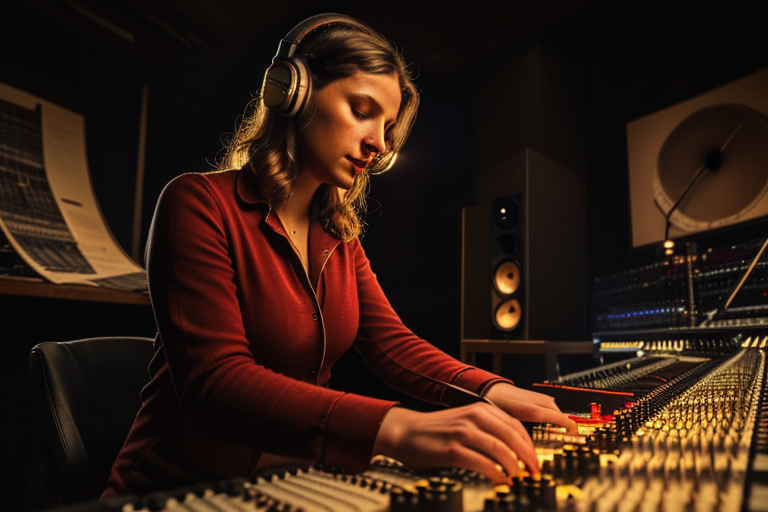
2:47 AM. The recording studio hums with the kind of electric silence that only exists in places where music gets born. Studio B at Meridian Sound has that perfect acoustic deadness—no echo, no resonance, just pure space waiting to be filled with someone’s dreams.
Tonight, those dreams belong to a singer-songwriter named Ash, who’s been working on the same bridge for three hours. Not because it’s wrong, but because it’s not quite right yet. There’s a difference, and my job is to know that difference.
“Play it back,” Ash says, pulling off the headphones and looking at me through the control room glass. Their voice carries that exhausted hope of someone who knows they’re close to something beautiful.
I’ve been a recording engineer for eight years now, and I’ve learned that the magic happens in the spaces between what artists think they want and what they actually need. Ash thinks they need the bridge to be louder, more dramatic. What they actually need is for it to breathe.
I adjust the compression by just a fraction—so subtle that most people wouldn’t notice, but it opens up the sound like a window being cracked on a spring morning. The vocals sit differently now, more intimate, more honest.
“One more take,” I suggest. “But this time, imagine you’re singing to just one person. Someone who already understands what you’re trying to say.”
The take starts. Ash’s voice fills the booth, and I can hear it immediately—that indefinable quality that separates a good song from a great one. It’s in the way they lean into certain words, the breath that comes just before the chorus lifts. I’m riding the faders like I’m conducting an orchestra, bringing up the guitar just slightly on the second verse, letting the piano lead into the bridge.
The song ends, and for a moment, we all sit in silence. There’s something about that silence after a perfect take—it’s not empty, it’s full. Full of everything the song just gave us.
“That’s it,” Ash whispers through the talkback. “That’s the one.”
As I start the preliminary mix, I find myself thinking about the invisible architecture of music. The EQ curves that shape emotion, the reverb sends that create space, the compression that makes a whisper feel like a shout. Most people who listen to the finished song will never know about the hundreds of tiny decisions that went into making it feel effortless.
We’re the invisible ones, the night shift workers who polish other people’s diamonds. And I love every minute of it.
I’m just about to lock up when I hear it—piano music, drifting in from somewhere else in the building. The melody is simple, just someone running scales, but there’s something about the touch, the timing, that makes it sound less like practice and more like meditation.
Movement II: The Tuning
Sam
4:15 AM. The concert hall is mine.
During the day, this place belongs to the musicians, the conductors, the audiences who fill every seat with expectation. But at night, it belongs to me and the piano that sits center stage like a sleeping giant waiting to dream.
I’ve been tuning pianos for twelve years, and I still get a thrill from walking into an empty hall and hearing my footsteps echo in all that space. People don’t realize that a concert hall is an instrument too—every surface, every angle designed to shape sound in specific ways. And at the heart of it all sits the piano, 88 keys that need to sing in perfect harmony with the room around them.
Tonight I’m working on the Steinway Model D that will host tomorrow’s recital. My job is to make sure that when the pianist sits down at this bench, every note rings true, every chord speaks with clarity and warmth.
I start with middle A, the 440 Hz that anchors everything else. But it’s not just about the frequency—it’s about how that frequency lives in this specific space, how it bounces off the walls and finds its way to every corner of the hall. I adjust until the note doesn’t just sound right, it feels right.
The thing about tuning is that it’s both mathematical and magical. Equal temperament gives me the framework—twelve semitones, each exactly 100 cents apart. But within that framework, there’s an art to making the piano sing. Some keys want to be just a hair sharp to cut through an orchestra. Others need to be slightly flat to blend with strings. A good tuner learns to hear not just what the piano is, but what it could be.
I work my way up the keyboard, checking each string against its neighbors, listening for the beating that tells me when notes are fighting each other instead of supporting each other. It’s meditative work, requiring the kind of focus that can only exist in silence.
I’m checking the highest notes when I become aware that I’m no longer alone. Someone is standing in the doorway, just barely visible in the stage lights.
“Sorry,” a voice says quietly. “I was working late in the studios and heard the piano. I didn’t want to interrupt, but…”
I look up from the keys. It’s someone about my age, with the kind of tired eyes that come from spending too many nights trying to get something exactly right. I recognize the type immediately—another member of the night shift symphony, someone who understands that the best work happens when the world is sleeping.
“You’re not interrupting,” I say, and I mean it. “Just finishing up the treble.”
Movement III: The Harmony
Together
It starts with a question about acoustics. Riley asks about the hall’s design, and I find myself explaining how the curved ceiling distributes sound, how the wood panels behind the stage add warmth without creating flutter echoes. They nod with the understanding of someone who spends their life thinking about how music lives in spaces.
“I do recording,” they say. “Studio work, mostly. But I love hearing music in rooms like this. There’s something about live acoustics that you can never quite capture.”
“Want to hear how it sounds?” I ask, gesturing to the piano. “I’m almost done with the tuning, but I could use someone with good ears to tell me how it carries to the back of the hall.”
Riley’s face lights up. “You want me to play something?”
They slide onto the bench and start with something simple—a Bach invention that fills the hall with mathematical beauty.
From the back row, I can hear what I was hoping for: perfect balance, each note clear but not harsh, the bass notes providing foundation without muddiness. But there’s something else, too. Riley plays with the touch of someone who understands recording—they know how to make every note count, how to shape dynamics for maximum emotional impact.
Riley transitions into something original, something that sounds like it might have been what they were working on in the studio. It’s the kind of song that could only exist at this hour—intimate but expansive, melancholy but hopeful.
I reach the stage and lean against the piano, listening not just to the music but to how it fills the space. This is what I tune for—not just technical accuracy, but moments like this when everything aligns: instrument, room, musician, and the invisible presence of everyone who will ever hear music in this space.
“This is what it’s all about,” Riley says softly, still playing. “This moment when everything comes together.”
I nod, understanding exactly what they mean. We’re both part of the same ecosystem—the people who prepare the spaces and instruments so that music can happen. The invisible infrastructure that makes the magic possible.
“You know,” I say, “I’ve been thinking about starting something. A kind of… collective for people like us. Night shift music workers. Engineers, tuners, sound techs, venue staff. All the people who make music possible but never get to take a bow.”
Riley’s hands pause on the keys. “That sounds incredible. Like a union, but for the magic parts of the job.”
“Exactly. Because we all understand something that most people don’t—that music isn’t just about the performers. It’s about everyone who creates the conditions for music to exist.”
We stay in the hall until the sun starts to creep through the high windows. Riley plays, I listen, and we talk about everything and nothing—the technical challenges of our jobs, the weird poetry of equalizer settings and string tensions, the way music happens in the spaces between intention and accident.
Riley gives me their number before leaving. “The next time you’re working on a really special piano,” they say, “let me know. I’d love to record what it sounds like in that moment right after tuning, before anyone else plays it. Just the room tone, the resonance, the potential.”
I promise I will, and as I watch them leave, I’m already thinking about how we might capture that sound—the moment when an instrument is perfect and waiting, when all the preparation is done and the music is about to begin.
After the rehearsal, I text Riley: “Same time next week? There’s a piano at the opera house that could use some attention, and I think you’d love the acoustics.”
The response comes back almost immediately: “Wouldn’t miss it. The night shift needs all the harmony it can get.”
And that’s how the Night Shift Symphony really began—not with a grand gesture, but with two people who understood that the most beautiful music often happens in the spaces between, in the quiet hours when the world sleeps and the magic has room to breathe.

You Might Also Enjoy
Diamond Roads
The smell hits me first. That mix of mustard, onions, and the particular leather-and-dirt scent that means baseball. I follow the seasons like a migrating bird, chasing long days of summer across thirty different ballparks. Seven years wheeling my cart, calling 'Cold beer! Ice cold beer!' The thing about traveling from park to park is that baseball is the same game everywhere, but also completely different. In Boston they sing Sweet Caroline. In Chicago they throw back opposing team home runs. In Nashville they play country music and the barbecue is worth the trip alone. And sometimes you meet another traveler who understands the long arc of the season.
The Careful Tenders
Marcus had been walking the same halls for three months, but it wasn't until tonight that he noticed the Roman vase had shifted two inches to the left. The museum's after-hours silence wrapped around him like a familiar coat. Yet the vase had moved. He started keeping a notebook: 'Renaissance painting straightened by maybe half a degree. Looks better.' 'Ancient Greek helmet turned slightly. Now catches hall light more dramatically.' That's when he saw her—Ana, the custodian who moved through spaces like a dancer, making the smallest adjustments with the devotion of a curator.
The Committee of Digits
In the pristine halls of the Grand Calculation, where numbers lived and worked, there existed a problem that no equation could solve: the Committee of Digits couldn't agree on anything. Five wanted to organize by magnitude. Three insisted on prime-ness. Eight championed composite collaboration. Seven claimed luck was what mattered. 'Says the most boring number at this table,' Seven shot back. 'I am NOT boring! I'm foundational! I'm half of ten!' 'You're a hand. Literally. Congratulations on being anatomically convenient.' Then Nine spoke: 'What if we're asking the wrong question?'