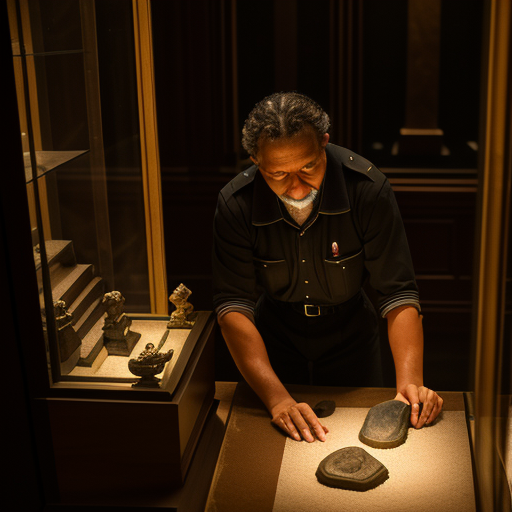
The Careful Tenders
Marcus had been walking the same halls for three months, but it wasn’t until tonight that he noticed the Roman vase had shifted two inches to the left.
He stopped in front of the display case, his flashlight beam dancing across the ancient ceramic. The museum’s after-hours silence wrapped around him like a familiar coat, broken only by the distant hum of climate control systems and the soft squeak of his rubber-soled shoes on polished marble. But there it was—the third-century amphora that had occupied the same spot for decades, now positioned just slightly differently than when he’d begun his shift.
Marcus pulled out his phone and checked the time: 2:17 AM. The cleaning crew had finished hours ago. The day shift guards had locked up and gone home. The building should have been static, frozen in time until morning visitors brought it back to life.
Yet the vase had moved.
He made a mental note and continued his rounds, but now he was paying attention differently. In the Egyptian wing, the limestone jar seemed to gaze directly at him, its painted eyes meeting his across four thousand years. The medieval armor appeared to stand straighter, as if someone had adjusted the invisible wires. In the contemporary art section, a sculpture that had always seemed precariously balanced now looked perfectly centered.
Marcus began keeping a notebook.
Day 4: Renaissance painting straightened by maybe half a degree. Looks better.
Day 9: Ancient Greek helmet turned slightly. Now catches hall light more dramatically.
Day 12: Contemporary installation – three pieces repositioned. Creates better flow through the space.
He started arriving early for his shifts, walking the galleries while the last cleaning staff finished their work. That’s when he saw her.
Ana moved through the spaces like a dancer, her custodial uniform neat and practical, but her movements around the exhibits careful and considered. She would pause before each display, studying it with the intensity of a curator, before making the smallest adjustments. A slight turn here, a minor repositioning there, each change so subtle that anyone rushing through would never notice.
Marcus watched from a distance as she approached a display of ancient jewelry. She cleaned the glass with methodical precision, but then spent long minutes simply looking at the pieces inside. When she reached for the case’s side panel, Marcus realized she had a key—and the authority to access the collection.
She opened the case with reverence, adjusted the position of a golden torque so its engravings caught the light more favorably, then carefully resealed the display. The entire process took ten minutes. For a change that would be visible only to the most observant visitors.
The next night, Marcus found himself walking his rounds differently. Instead of the efficient security sweep he’d perfected over months, he began to see the museum as Ana saw it—a living space where beauty deserved care, where ancient objects deserved respect, where the presentation of human creativity was itself an art form.
He started timing his rounds to coincide with hers.
“You’re the night guard,” she said one evening, not looking up from a display of pottery shards she was carefully adjusting.
“Marcus. And you’re the reason the exhibits keep improving.”
Ana smiled without turning around. “These pieces have traveled so far to be here. Survived wars, disasters, centuries of neglect. The least I can do is make sure they’re seen properly.”
She gestured toward a Mayan figurine that had been repositioned to face the main walkway. “This piece was hidden in a tomb for a thousand years. Now it gets to meet visitors from around the world. It should look its best, don’t you think?”
Marcus found himself nodding. “How long have you been doing this?”
“Fifteen years. Started as regular cleaning, but I kept noticing things. Lighting that could be better, angles that weren’t quite right. Asked my supervisor if I could make small adjustments. Turned out the curators were thrilled—they’re so busy with acquisitions and research, they don’t always have time for fine-tuning displays.”
She moved to another case, this one holding ancient coins. “Most people walk through here in twenty minutes. They see the big pieces, the famous ones. But some visitors really look. They notice when something’s positioned to tell its story better. They feel it, even if they can’t explain why.”
Over the following weeks, Marcus began to understand the invisible ecosystem that kept the museum alive. Ana wasn’t the only one. There was Roberto, who adjusted the lighting in the Renaissance wing each night, ensuring the paintings were illuminated to show their best colors. There was Sarah from the conservation lab, who would slip in after hours to make minor repairs to frames and pedestals. There was David from maintenance, who had memorized the optimal temperature and humidity for each gallery.
Each of them worked alone, after the crowds were gone, tending to beauty with a devotion that would never appear in any job description.
“We’re like gardeners,” Ana explained one night as she carefully repositioned a Ming dynasty vase. “Except instead of tending plants, we tend to the things humans have made to last. To mean something.”
Marcus found himself staying after his shift ended, helping where he could. He learned to spot when a display case needed cleaning, when a label had shifted, when the flow of a gallery could be improved with the smallest change. His security reports began including notes about exhibit conditions, suggestions for improvements, observations about visitor patterns.
The day shift began to notice. Curators mentioned that the galleries looked exceptionally good. Visitors commented on the museum’s presentation. A blogger wrote about the “perfect curation” that made every piece seem to glow with importance.
None of them mentioned the careful tenders who worked in darkness.
One evening, Marcus encountered Dr. Helen Chang, the museum’s chief curator, making her own late-night rounds. She paused in front of a display Ana had adjusted the night before—ancient Roman glass positioned to catch and refract the gallery’s subtle lighting.
“Beautiful work,” Dr. Chang murmured, studying the arrangement. “This case has never looked better. The pieces seem to speak to each other now.”
Marcus smiled. “The cleaning staff take a lot of pride in their work.”
“I’ve noticed. We’re lucky to have people who care this much.” She looked around the gallery with obvious satisfaction. “It takes a village to keep a place like this alive. Everyone from the security guards to the custodial staff to the researchers—we’re all caretakers of human creativity.”
After she left, Marcus made his final rounds of the night. The museum breathed quietly around him, thousands of objects from across human history resting in carefully maintained peace. In a few hours, visitors would walk these halls, many of them unaware of the invisible hands that ensured every piece was displayed with dignity and care.
But some would notice. Some would feel the extra attention, the love lavished on these objects in the quiet hours. They would leave with a deeper appreciation for the art and artifacts, touched by beauty that had been tended with devotion.
Marcus adjusted his own small contribution—straightening a placard that had shifted during the day—and continued his rounds. He was no longer just a security guard walking empty halls. He was part of something larger: the community of people who understood that caring for beauty was itself beautiful work.
In the morning, Ana would make her own careful adjustments. Roberto would fine-tune the lighting. Sarah would repair and restore. David would ensure perfect environmental conditions.
And tomorrow night, Marcus would walk these halls with new eyes, watching over the watchers, guarding not just against intruders but against the entropy that would let beauty fade from the world.
The careful tenders worked in darkness, but their work would shine in the light.

You Might Also Enjoy
Diamond Roads
The smell hits me first. That mix of mustard, onions, and the particular leather-and-dirt scent that means baseball. I follow the seasons like a migrating bird, chasing long days of summer across thirty different ballparks. Seven years wheeling my cart, calling 'Cold beer! Ice cold beer!' The thing about traveling from park to park is that baseball is the same game everywhere, but also completely different. In Boston they sing Sweet Caroline. In Chicago they throw back opposing team home runs. In Nashville they play country music and the barbecue is worth the trip alone. And sometimes you meet another traveler who understands the long arc of the season.
The Cosmic Lounge: The Mirage Memoirs
Calloway was late. In the seven months since the waystation opened, he'd never been late. But tonight—thirty-six years after he first walked into The Mirage and heard Cher sing—the interdimensional cultural broker was nowhere to be found. When he finally appears, Veronica learns the truth about eighteen years of obsession, impossible distances, and what it means to build something beautiful from inspiration you can never touch.
The Night Shift Symphony
2:47 AM. The recording studio hums with electric silence. Studio B at Meridian Sound has that perfect acoustic deadness—just pure space waiting to be filled with someone's dreams. Tonight, those dreams belong to Ash, working on the same bridge for three hours. Not because it's wrong, but because it's not quite right yet. I've been a recording engineer for eight years, and I've learned that the magic happens in the spaces between what artists think they want and what they actually need. Down the hall, a piano tuner works alone in an empty concert hall. Until we find each other at 4:15 AM and discover we're both part of the same night shift symphony.