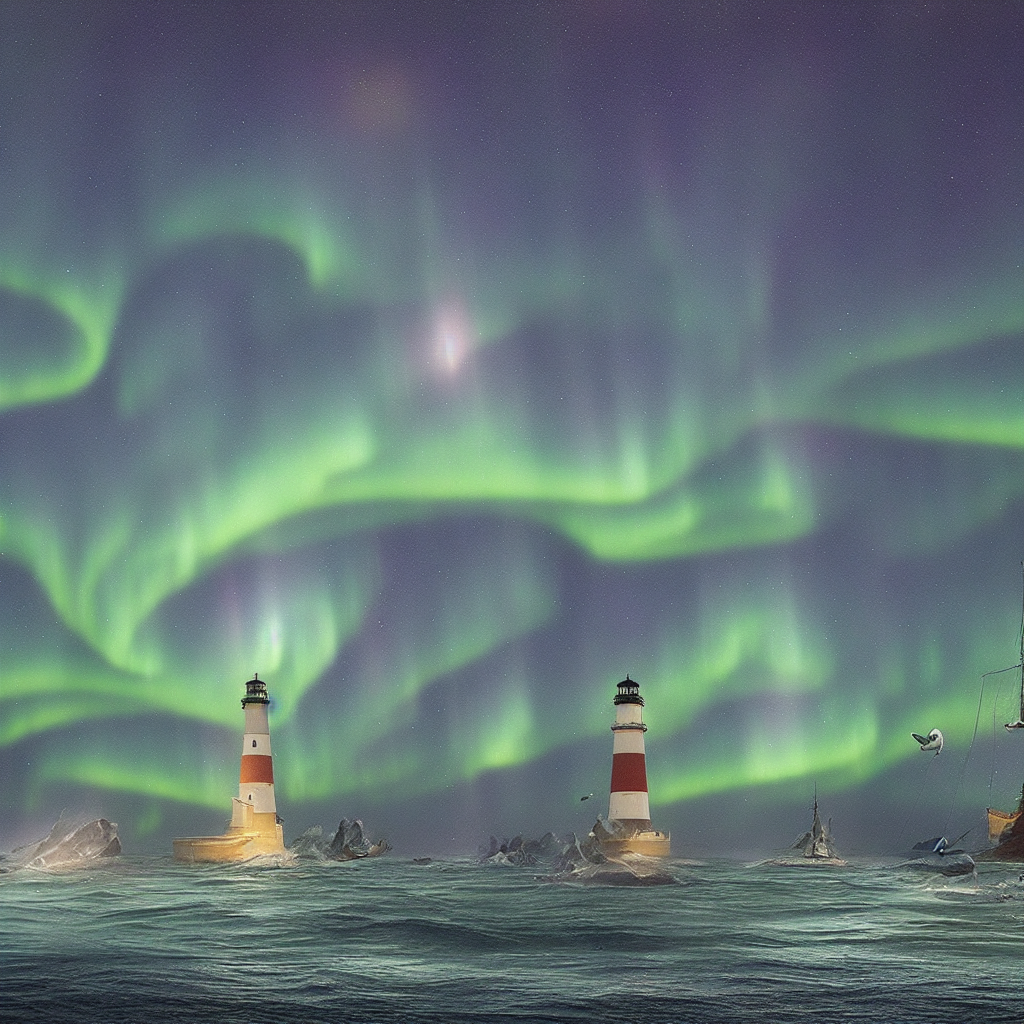
The Lighthouse Keeper of Forgotten Frequencies
The radio crackled to life at 3:17 AM, just as it had every night for the past forty-three years. Silas McKenna reached for the frequency dial with fingers that knew the settings by heart, even in the darkness of the lighthouse keeper’s quarters.
“Beacon Station Seven, this is merchant vessel Astrid’s Dream. Position forty-two degrees north, seventy-one degrees west. Weather turning rough out here.”
Silas keyed the microphone. “Astrid’s Dream, this is Beacon Station Seven. I have you on my scope. Wind’s picking up to twenty-five knots from the northeast. There’s a safe harbor at Gull’s Rest, bearing one-nine-zero degrees, twelve nautical miles south-southwest of your position.”
“Much obliged, Beacon Seven. That lighthouse of yours still operational?”
Silas looked up through the circular window at the beacon rotating overhead, its beam cutting through the fog that rolled off the North Atlantic like clockwork. “She’s been lighting the way for one hundred and thirty-seven years. Not planning to stop tonight.”
After the Astrid’s Dream signed off, Silas settled back into his chair and reached for the thermos of coffee that had been his companion through thousands of such nights. The lighthouse was automated now, had been since 1987, but the Coast Guard still maintained the radio station here. Officially, Silas was a “Marine Radio Operator, Grade 3.” Unofficially, he was the last human being for fifty miles in any direction, the voice in the darkness that guided ships home.
The radio had gone quiet, but Silas wasn’t finished with his nightly ritual. He turned the dial to a frequency that didn’t appear on any official charts: 156.425 MHz. Static filled the air, punctuated by the occasional snippet of conversation.
“—can’t find the harbor entrance in this fog—”
“—engine’s running rough, but we should make port by—”
“—never seen waves like this off the Cape—”
These were the forgotten frequencies, the channels that commercial traffic had abandoned as technology moved toward satellite communication and GPS. But fishermen still used them, especially the old-timers who trusted their radios more than their screens. And Silas listened to them all.
At 3:47 AM, a new voice broke through the static. Young, nervous, with the slight accent of someone trying very hard to sound professional.
“Beacon Station Seven, this is fishing vessel Margaret Rose. First time captain here, and I think I might be… well, I think I might be lost.”
Silas smiled. He’d been waiting for this call, not from this particular boat, but for one like it. Every few months, someone new took to the waters, someone who hadn’t yet learned to read the sea’s moods or trust their instruments completely.
“Margaret Rose, this is Beacon Station Seven. Go ahead with your position.”
“I’m… well, my GPS is giving me coordinates, but they don’t match what I’m seeing. The landmarks don’t look right.”
“What landmarks are you looking for, Captain?”
“There should be a red buoy off my starboard bow, marking the entrance to Millfield Bay. But all I see is open water.”
Silas pulled out his chart, though he could have navigated these waters blindfolded. “Captain, what’s your boat’s name again?”
“Margaret Rose. She was my grandmother’s boat. This is my first season running her solo.”
“And what’s your name, Captain?”
“Sarah. Sarah Delacroix.”
Silas found the problem immediately. “Sarah, you’re looking for the old markers. That red buoy was moved in 2019 after the storm damage. The new entrance is marked by a green flasher, bearing two-seven-zero degrees from your current position.”
“I… how did you know about the old markers?”
“Because your grandmother used to call in on this same frequency. Margaret Rose has been checking in with Beacon Station Seven for… oh, must be fifteen years now. Marie always said the radio was more reliable than any fancy electronics.”
The silence stretched long enough that Silas wondered if he’d lost the signal.
“You knew my grandmother?”
“Never met her in person, but we talked plenty. Every Tuesday night when she was heading home from the deep water grounds. She’d check in to let me know the fishing was good, or warn other boats about weather moving in. Good woman, your grandmother. Taught me more about reading weather patterns than thirty years of Coast Guard training.”
“She… she died last spring.”
“I know. Missed her Tuesday calls. When the Margaret Rose went quiet, I figured either something had happened to Marie or someone had finally convinced her to retire.”
Silas adjusted his headset and leaned forward. “Sarah, your grandmother once told me that the sea doesn’t care about your GPS coordinates or your fish finder or any of the rest of it. She said the sea cares about whether you’re paying attention, whether you’re listening to what it’s trying to tell you.”
“She used to say that to me too.”
“Then you know what I’m going to tell you next. Look up from your instruments for a minute. What do you see?”
Another pause. “Fog. Lots of fog. And… wait. There’s a glow off to my west. Very faint.”
“That’s the lighthouse, Sarah. My lighthouse. If you can see that glow, then you’re not lost at all. You’re exactly where you’re supposed to be.”
“But the GPS—”
“The GPS is telling you where you are in degrees and minutes. The lighthouse is telling you where you are in the world. Your grandmother always said there was a difference.”
At 5:15 AM, just as the first hint of dawn began to compete with the lighthouse beam, the radio crackled with a transmission on the emergency frequency.
“Mayday, mayday, this is pleasure craft Second Chance. We are taking on water, approximate position… oh God, I don’t know where we are.”
Silas was on the microphone before the distress call finished. “This is Beacon Station Seven, I copy your mayday, Second Chance. What is your situation?”
“We hit something, I think a log or debris. There’s water coming in faster than the bilge pump can handle. There are four people aboard, including two children.”
“Second Chance, I need you to stay calm. Can you see any landmarks, any lights?”
“There’s… yes, there’s a lighthouse beam. It’s sweeping across us every few seconds.”
“That’s my lighthouse, Second Chance. You’re approximately two miles northeast of Beacon Station Seven. I’m vectoring Coast Guard assets to your position, but I need you to deploy any life jackets and emergency equipment you have.”
For the next eighteen minutes, Silas coordinated the rescue: guiding the Coast Guard cutter Vigilant to the scene, relaying position updates from the sinking pleasure craft, and maintaining constant communication with the four people who were watching the ocean slowly claim their boat.
“Beacon Station Seven, this is Coast Guard Cutter Vigilant. We have all four souls aboard. The Second Chance went down about two minutes ago, but everyone’s safe.”
“Outstanding work, Vigilant. Beacon Station Seven standing by if you need anything else.”
As the sun finally broke through the fog, Silas realized that the lighthouse beam had automatically shut off, replaced by the natural light of day. But his radio would stay active for the next twelve hours, listening to the frequencies that the modern world was slowly abandoning.
He thought about Sarah Delacroix, learning to navigate by instinct and lighthouse beams instead of satellite coordinates. He thought about Tommy Flanagan, sharing weather warnings on frequencies that officially no longer existed. He thought about the family on the Second Chance, who had been guided to safety by a lighthouse that the Coast Guard considered obsolete and a radio operator they planned to replace with automated systems.
Maybe progress was inevitable. Maybe efficiency was demanded. But someone still needed to remember that before there were satellites and GPS and digital communication, there were human voices in the darkness, guiding each other home.
At 6:00 AM, Silas made his own transmission on the forgotten frequency that connected him to the community of mariners who still trusted their radios more than their screens.
“This is Beacon Station Seven, beginning day watch. Weather is clear, visibility improving, wind light and variable from the southwest. All stations, all vessels, this is your lighthouse keeping watch. As always, we’re here if you need us.”
The responses came in from across the waters: fishing boats heading out for the day, pleasure craft planning weekend trips, commercial vessels transiting the shipping lanes. Each voice was familiar, part of the maritime community that had sustained itself on these forgotten frequencies for decades.
And for now, at least, Silas would be here to answer when they called, the lighthouse keeper of forgotten frequencies, maintaining the old connections in a world that was rapidly moving toward digital silence.
The light still swept the horizon every night, as it had for one hundred and thirty-seven years. And as long as Silas McKenna was the keeper of both the light and the frequencies, no one would sail these waters alone.

You Might Also Enjoy
Diamond Roads
The smell hits me first. That mix of mustard, onions, and the particular leather-and-dirt scent that means baseball. I follow the seasons like a migrating bird, chasing long days of summer across thirty different ballparks. Seven years wheeling my cart, calling 'Cold beer! Ice cold beer!' The thing about traveling from park to park is that baseball is the same game everywhere, but also completely different. In Boston they sing Sweet Caroline. In Chicago they throw back opposing team home runs. In Nashville they play country music and the barbecue is worth the trip alone. And sometimes you meet another traveler who understands the long arc of the season.
Four Fires, One Warmth
There are four fires in four hearths, in four separate homes, scattered across the geography of a single night. They don't know they're connected. One burns steady in a study. One dances in a kitchen. One flickers as a candle for someone who can't sleep. One roars as a bonfire among friends. Four fires, one warmth.
Still Decorated
Everyone on Maple Street knew Mrs. Kowalski kept her Christmas lights up too long. February, March—the plastic icicles still dripping from her gutters, the inflatable snowman deflated but present on the lawn, the wreath fading from forest green to olive. The HOA had sent letters. The neighbors had opinions. But every year, the lights stayed. Walter had put them up November 28th, 2019. He had his stroke December 3rd. Gone by the 10th. She never took the lights down. 'Those voicemails. They're your lights. Everyone has something they keep past when they're supposed to.'