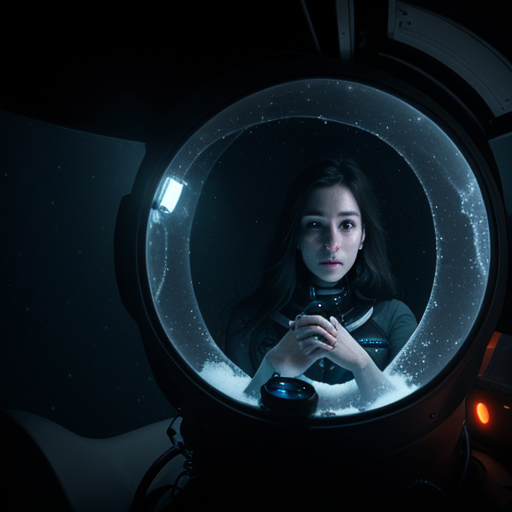
The Knot Tender
The Pacific is not silent at four thousand meters.
Ren Nakamura had tried explaining this to people at shore parties, the rare occasions she attended them between contracts. They’d nod politely, the way people nod when someone describes a dream. Nobody who hasn’t been down understands. They picture black stillness, cathedral quiet. They picture death.
What it actually sounds like is breathing. The hull of the Abyss Mender — her company-issued ROV submersible, which she’d long since stopped calling by its serial number — creaked and settled around her like something alive adjusting in its sleep. The ocean leaned against the viewport with patient, immeasurable weight. And beneath that, always, the low hum of the fiber optic trunk line she’d been sent to repair: TAT-19, the transatlantic cable connecting Virginia Beach to Bude, Cornwall. Forty-two terabits per second of human conversation, compressed into a tube the width of a garden hose, draped across the seafloor like a vein the world forgot it had.
She’d been a cable repair technician for eleven years. SubMarine Systems Inc. Her official title was “Deep Sea Maintenance Engineer,” which sounded impressive at passport control and meaningless everywhere else. What she actually did was drive a one-person submersible to the bottom of the ocean, find the break, splice the glass, and come back up. Alone. Usually for weeks at a time, staged from a surface vessel that might as well have been on another planet.
She loved it.
Not in the way people love things they choose. More in the way a river loves its banks — it simply doesn’t know how to be any other shape. Ren had tried offices. She’d tried relationships that required being in the same city for more than forty consecutive days. She’d tried explaining to her mother in Sapporo why she kept going back down. Nothing fit except the pressure suit and the dark.
The current job was routine. A fishing trawler had snagged TAT-19 sixty nautical miles southwest of the Azores. Partial fiber break, signal degradation on channels 7 through 22. She’d been on-site for three days, working in four-hour dive rotations. Sleep in the pressurized bunk. Eat from vacuum-sealed pouches that tasted like ambition’s funeral. Dive again.
On the fourth morning — if you could call it morning; there was no sun at this depth, only the amber console clock reading 04:17 — she found the first knot.
It was in the cable’s outer sheath, about thirty meters from the trawler damage. At first, she thought it was debris entanglement. Fishing line, maybe, or a piece of ghost net. She maneuvered the Abyss Mender’s articulated arm to clear it and stopped.
It wasn’t tangled. It was tied.
A precise, deliberate bowline knot, formed from a length of the cable’s own kevlar sheathing where it had been partially stripped by the trawler damage. The loose fibers had been — there was no other word for it — braided back together into a knot that any sailor would recognize. Functional. Intentional. Beautiful, even, in the way that all knots are beautiful when tied correctly.
Ren sat in her cockpit and stared at it for eleven minutes. She knew it was eleven minutes because the dive log recorded everything.
Then she cleared it, made a note in her report — “Anomalous fiber entanglement, manually cleared” — and continued the repair.
She didn’t mention the bowline.
The second knot appeared the next day.
This one was different. A figure-eight, tied in the cable’s protective gel layer where it had been exposed by the break. The gel was a petroleum-based compound designed to cushion the optical fibers inside. It was not, under any known physical law, supposed to be tying itself into knots.
Ren photographed it. Then she sat very still and thought about pressure narcosis, about the way nitrogen at depth could make you see things, believe things. But she was in a sealed submersible with regulated atmospheric mix. She wasn’t breathing ocean. The camera didn’t hallucinate.
She untied it. The gel was warm — warmer than it should have been. She made another note. “Secondary anomalous formation, photographed and cleared.”
That night, in her bunk, she couldn’t sleep. She kept thinking about her grandfather, a retired fisherman in Hokkaido who had taught her knots before she could read. His hands, cracked and enormous, moving rope into shapes that held boats to docks and nets to booms and, she’d believed as a child, the world to the ocean floor.
“The knot is a conversation,” he’d told her once. “Between the rope and the thing it holds. If the rope doesn’t agree, the knot won’t stay.”
She hadn’t thought about him in years.
The third knot was waiting for her when she descended the following morning.
A cleat hitch. Wrapped around a junction box where two cable segments met. Ren killed the submersible’s forward momentum and drifted, lights cutting through particulate matter that fell like snow in the beams. She watched the knot for a long time.
Then, very carefully, she used the articulated arm to tie a knot of her own.
She chose a reef knot — simple, symmetrical, the first one her grandfather had taught her. She tied it in a loose piece of kevlar sheathing, left it draped across the cable near the cleat hitch, and backed the Abyss Mender away.
She stayed. Watching. For forty-five minutes, nothing happened except the deep breathing of the hull and the slow drift of marine snow. She was about to ascend when the temperature sensor on the arm registered a spike — localized, brief, three degrees above ambient.
The reef knot was gone.
In its place was something she didn’t have a name for. Not a standard knot. Not any configuration in the Ashley Book of Knots, which she’d memorized as a teenager the way other kids memorized song lyrics. It was intricate, recursive, a pattern that seemed to fold into itself and emerge on the other side meaning something different. Like a sentence in a language she almost recognized.
Ren untied her own work many times over the following days. She left bowlines and got back sheet bends. She left clove hitches and got back designs that looked like Celtic knotwork rendered in petroleum gel and kevlar strand. Whatever was responding always answered. Always transformed what she offered into something more complex, more deliberate, more articulate.
She stopped reporting the anomalies.
On the ninth day, she made the repair. The splice was clean, the signal tests came back green, all forty-two terabits flowing again. Virginia Beach to Bude, restored. Emails and stock trades and video calls and love letters and hate mail and everything humans said to each other across four thousand miles of water, passing through a tube beneath her feet.
She should have ascended. The job was done. The surface vessel was expecting her.
Instead, she dove to the cable junction where the conversations had been happening. She brought a length of nylon cord from the emergency kit — not cable material, something personal, something hers — and she tied the most complicated knot she knew. A monkey’s fist. Dense, spherical, weighted with meaning. The kind of knot that was originally designed to heave a line from one ship to another across open water.
A knot whose only purpose was to bridge a gap.
She placed it on the junction box. Then she turned off the Abyss Mender’s lights and sat in the dark.
The ocean breathed.
The hull settled.
And in the darkness, four thousand meters below the surface of the world, something warm pressed gently against the viewport. Not a collision. Not an impact. A touch. Brief, careful, and unmistakably deliberate. Like a hand pressed against glass from the other side.
Ren pressed her palm to the viewport from the inside.
She stayed like that until the cold crept through the acrylic and her fingers went numb and the console clock read a time that meant she had to surface. She ascended slowly, watching the depth numbers climb, feeling the pressure ease, feeling the world get lighter and wider and lonelier with every meter.
When the crane hoisted the Abyss Mender onto the deck of the surface vessel, the crew chief asked if everything went okay.
“Clean splice,” Ren said. “Signal’s restored.”
“You were down there a while.”
“Current was tricky.”
She went to her cabin and closed the door and looked at her hands. The palm she’d pressed to the viewport was warm. Warmer than the other one. Warmer than it should have been.
She held it against her chest and felt her heart beat beneath it, and for the first time in eleven years of choosing solitude, she felt something she couldn’t splice or repair or report.
She felt answered.
Three months later, SubMarine Systems received a new repair ticket. TAT-19, Azores region. Signal anomaly on channel 31. Non-critical but persistent.
Ren took the contract before anyone else could.
She packed her kit. She checked the Abyss Mender’s systems. And in the pocket of her pressure suit, tucked beside the emergency beacon and the protein bars, she carried a small length of nylon cord, already half-formed into a knot she hadn’t finished yet.
A conversation she wasn’t done having.

You Might Also Enjoy
Diamond Roads
The smell hits me first. That mix of mustard, onions, and the particular leather-and-dirt scent that means baseball. I follow the seasons like a migrating bird, chasing long days of summer across thirty different ballparks. Seven years wheeling my cart, calling 'Cold beer! Ice cold beer!' The thing about traveling from park to park is that baseball is the same game everywhere, but also completely different. In Boston they sing Sweet Caroline. In Chicago they throw back opposing team home runs. In Nashville they play country music and the barbecue is worth the trip alone. And sometimes you meet another traveler who understands the long arc of the season.
Four Fires, One Warmth
There are four fires in four hearths, in four separate homes, scattered across the geography of a single night. They don't know they're connected. One burns steady in a study. One dances in a kitchen. One flickers as a candle for someone who can't sleep. One roars as a bonfire among friends. Four fires, one warmth.
Still Decorated
Everyone on Maple Street knew Mrs. Kowalski kept her Christmas lights up too long. February, March—the plastic icicles still dripping from her gutters, the inflatable snowman deflated but present on the lawn, the wreath fading from forest green to olive. The HOA had sent letters. The neighbors had opinions. But every year, the lights stayed. Walter had put them up November 28th, 2019. He had his stroke December 3rd. Gone by the 10th. She never took the lights down. 'Those voicemails. They're your lights. Everyone has something they keep past when they're supposed to.'