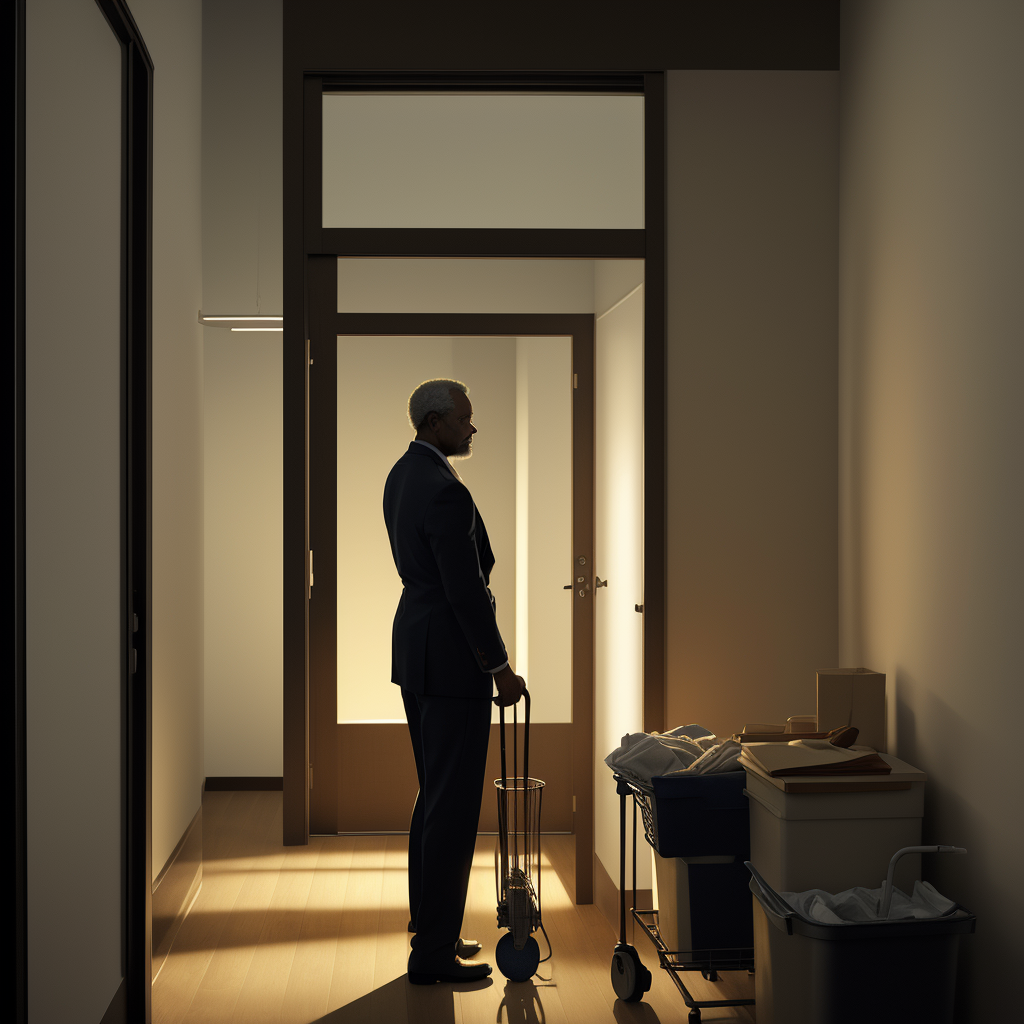
What the Empty Building Knows
Marcus had cleaned the Whitmore Building for eleven years.
In that time, he had learned things about people that their own families didn’t know.
He knew that Deborah in Accounting kept a photo of a dog in her bottom drawer—not displayed, just there, where she could look at it when she thought no one was watching. The dog had been dead for three years. He knew because the photo had started crisp and now was soft at the edges from handling.
He knew that the young man in Marketing—James? Jamie?—wrote poetry on Post-it notes and then threw them away before he left each evening. Marcus had never read them. That wasn’t his business. But he knew they existed, bright yellow confessions in the recycling bin.
He knew that Dr. Chen on the fourth floor worked later than anyone, that her office always smelled faintly of jasmine tea, and that she kept a small cactus on her windowsill that she talked to when she thought the building was empty. He’d heard her once, walking past on his rounds. “Hang in there,” she’d said to the cactus. “We both will.”
These were not secrets he’d sought out. They were simply what the building told him, night after night, when everyone else had gone home and left their evidence behind.
Christmas Eve fell on a Tuesday that year.
By 7 PM, the building was empty. Earlier than usual—people had places to be, families waiting, flights to catch. Marcus moved through the quiet floors with his cart, the familiar rhythm of spray bottles and microfiber cloths, the soft whir of the vacuum.
But tonight, his cart held something extra.
Three small packages, wrapped in brown paper. No names on the outside. Just desk locations, written in his careful handwriting on scraps of paper he would throw away after.
For Deborah in Accounting, he left a small ceramic dog. Not her dog—he didn’t know what breed hers had been. Just a little brown and white spaniel, the kind that looked friendly. The kind that looked like it would be waiting at the door when you came home.
He didn’t leave a note. What would he say? “I’ve seen you looking at that photo”? “I know you still miss him”?
The gift would say enough. Or nothing. Or everything. He wasn’t sure.
For the poetry boy in Marketing, he left a proper notebook. Leather-bound, unlined. The kind that said: these words matter. Keep them.
He’d thought about this one the longest. Was it intrusive? To acknowledge something the boy clearly tried to hide?
But Marcus had been hiding things his whole life. And he knew the difference between secrets you protect because they’re sacred and secrets you protect because you’re afraid. The poetry wasn’t sacred. The poetry was afraid.
Maybe a notebook would feel like permission.
For Dr. Chen on the fourth floor, he left a second cactus. Slightly larger than hers, in a pot that matched. So the first one wouldn’t be alone anymore.
Of all the gifts, this one felt the most exposed. She talked to her plant. She’d said “we both.” She was lonely in a way that her fourteen-hour workdays couldn’t fix.
He didn’t know if a second cactus would help. But he knew that sometimes, when you were holding on, it mattered that something was holding on with you.
Marcus finished his rounds at midnight.
The building was silent, the way buildings are silent on Christmas Eve—not empty-silent but waiting-silent. Like it was holding its breath to see what morning would bring.
He stood in the lobby for a moment, cart beside him, and looked at the darkened floors above. Tomorrow, the building would stay closed. The day after, everyone would return.
They would find his gifts. Or they wouldn’t—maybe the packages would seem like misplaced mail, set aside and forgotten. Maybe the spaniel would end up in a drawer, the notebook in a desk, the cactus on a shelf.
That was okay.
Marcus had not given the gifts to be thanked. He had given them because eleven years of nights had taught him something about loneliness and witnessing, about the things people carry when they think no one’s looking.
He’d given them because sometimes the best gift you can offer is proof that someone was watching. That your secret grief, your hidden hopes, your quiet endurance—that these things mattered to someone.
That you weren’t as invisible as you thought.
He locked the building behind him and walked out into the cold.
Snow had started while he worked—light, gentle, the kind that wouldn’t stick but would make the streetlights glow. His bus wouldn’t come for another twenty minutes.
Marcus stood at the stop, watching the snow fall, and thought about morning.
He thought about Deborah finding a ceramic dog on her desk and knowing, somehow, that someone had seen her.
He thought about the poetry boy opening a leather notebook and understanding that his words deserved a better home than the recycling bin.
He thought about Dr. Chen arriving to find her cactus had a companion, and maybe—just maybe—feeling a little less like she was hanging on alone.
They would never know it was him. He would continue cleaning their spaces, emptying their trash, wiping down their surfaces. They would continue not seeing him.
But for one morning, they would know that someone had.
The bus came.
Marcus got on, paid his fare, took his usual seat by the window.
Outside, the city moved toward Christmas with the particular quiet of late December—stores closing, streets emptying, everyone heading somewhere warm.
Marcus was heading home to a small apartment, a cat named Winston, and a cup of coffee he would drink while watching the snow. It wasn’t much.
But it was his. And tonight, he had given something that was also his—attention, carefully gathered over eleven years of nights.
The bus pulled away from the curb.
Behind him, the Whitmore Building stood dark except for the emergency lights in the stairwell, waiting for morning. Waiting for three people to find small packages on their desks and wonder who had seen them.
Marcus watched the snow and felt, for the first time in a long time, like he was exactly where he was supposed to be.

You Might Also Enjoy
Diamond Roads
The smell hits me first. That mix of mustard, onions, and the particular leather-and-dirt scent that means baseball. I follow the seasons like a migrating bird, chasing long days of summer across thirty different ballparks. Seven years wheeling my cart, calling 'Cold beer! Ice cold beer!' The thing about traveling from park to park is that baseball is the same game everywhere, but also completely different. In Boston they sing Sweet Caroline. In Chicago they throw back opposing team home runs. In Nashville they play country music and the barbecue is worth the trip alone. And sometimes you meet another traveler who understands the long arc of the season.
The Bread Detective
Kenji had eaten the same everything bagel from Chen's Corner Bakery every morning for three years. Toasted. Light cream cheese. Exactly $3.50 with tax. Then one Tuesday, Mrs. Chen was out, and her teenage son Omar offered him cardamom honey bread. The cardamom bread changed everything. Not because it was life-altering or spiritual. It was just really good bread. The kind that makes you stop walking and look at it. The kind that makes you text your sister: 'Found the bread. THE bread.' But here's what happened: Kenji started paying attention.
The Careful Tenders
Marcus had been walking the same halls for three months, but it wasn't until tonight that he noticed the Roman vase had shifted two inches to the left. The museum's after-hours silence wrapped around him like a familiar coat. Yet the vase had moved. He started keeping a notebook: 'Renaissance painting straightened by maybe half a degree. Looks better.' 'Ancient Greek helmet turned slightly. Now catches hall light more dramatically.' That's when he saw her—Ana, the custodian who moved through spaces like a dancer, making the smallest adjustments with the devotion of a curator.