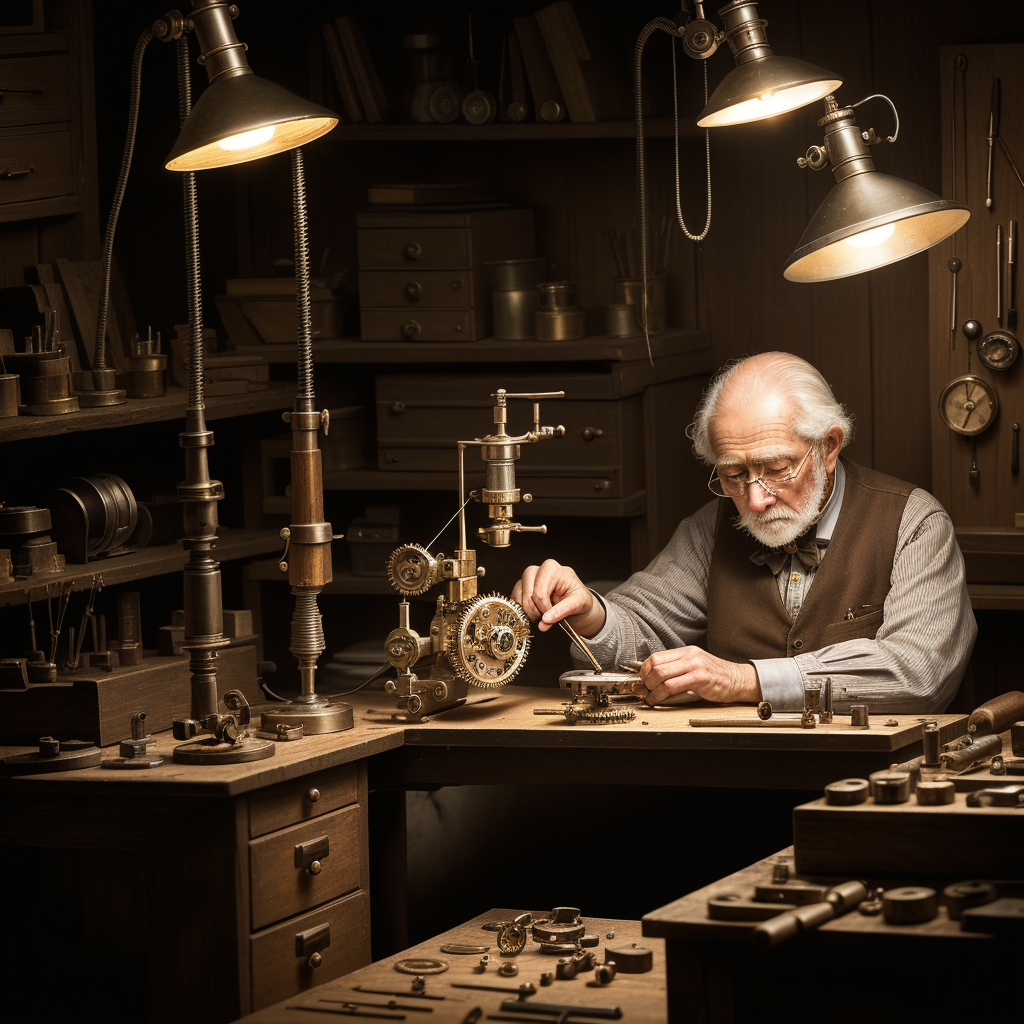
The Watchmaker's Patience
Isaac Brenner’s shop occupied a corner storefront in Portland’s Pearl District, sandwiched between a coffee roaster and a vintage bookstore. The sign above the door read simply: BRENNER HOROLOGY. Below it, in smaller letters: WATCH REPAIR & RESTORATION.
Inside, time moved differently.
The shop smelled of metal and oil and old wood. Three walls held floor-to-ceiling shelves lined with parts—springs, gears, crystals, bands—organized with obsessive precision. The fourth wall was windows, north-facing, providing steady light that didn’t shift or glare. Isaac’s workbench sat beneath those windows, positioned so he could see the street without being distracted by it.
He was sixty-three years old and had been repairing watches for forty-two of those years. He’d learned the trade from his grandfather, who’d learned it in Switzerland before immigrating in 1948. The same tools his grandfather had used—loupes, tweezers, screwdrivers sized for work measured in tenths of millimeters—sat in Isaac’s workspace, still perfectly functional, still irreplaceable.
People brought him their broken time.
A Rolex Submariner that had stopped after a swimming accident. A pocket watch from 1887 that hadn’t run since the owner’s great-grandfather carried it. A Timex that cost forty dollars new but meant everything because it was the last gift from a dying parent.
Isaac treated them all the same: with absolute attention and infinite patience.
The work required both. A mechanical watch was a small universe of interdependent parts, each one precision-engineered to tolerances most people couldn’t imagine. The balance wheel oscillated five times per second, 18,000 times per hour, 157 million times per year. A single speck of dust could throw off that rhythm. A misaligned jewel could create friction that would compound over hours into failure.
There was no way to rush it. Either you did it right, or you broke something trying.
Isaac had learned patience the hard way. At twenty-three, working on a complicated chronograph, he’d tried to force a stuck crown. Snapped the stem clean in half. Took him six weeks to source a replacement part for a watch made in 1952. The client was understanding. Isaac never forgave himself.
After that, he learned to wait. To feel when something was resisting. To step away when frustration crept in. To let the work teach him what it needed.
The young man came in on a Tuesday afternoon in October, carrying a shoebox.
“Are you Isaac Brenner?”
“I am.”
“My grandfather said you’re the only person in Oregon he’d trust with this.” The young man set the box on the counter with careful hands.
Inside was a Patek Philippe pocket watch, gold case, enamel dial, circa 1920. Beautiful. Also completely stopped, the crystal cracked, one of the hands bent.
“Where did he get this?” Isaac asked.
“It was his father’s. He carried it every day until the war. Then he put it away and never took it out again. He’s ninety-one now. He said—” The young man’s voice caught. “He said he wants to hear it tick one more time before he can’t hear anything.”
Isaac lifted the watch with both hands, feeling its weight. “When do you need it?”
“However long it takes. He said you’ll know if it can be saved.”
After the young man left, Isaac placed the watch on his bench and simply looked at it for twenty minutes.
This was part of his process: observation before intervention. Understanding what he was seeing before he tried to change it.
He spent six days bringing it back to life. Three days just cleaning. Two days fixing the hairspring—like conducting surgery on a spiderweb. Every movement deliberate, patient, precise.
On the sixth day, he wound the mainspring slowly, feeling the energy store itself in that small steel ribbon.
Then he released the click.
The watch ticked.
This was why he did this work. Not for the money, though he made enough. Not for recognition, though sometimes people thanked him with a reverence that embarrassed him. He did it because mechanical watches were one of humanity’s most beautiful arguments against obsolescence. They were built to be repaired, designed to be maintained, created with the assumption that something broken could be made whole again.
In a world increasingly full of things meant to be replaced, Isaac spent his days proving that patience and precision could resurrect time itself.
The next morning, a woman came in carrying a vintage Omega that her mother had worn for fifty years. “Someone told me you’re the person who understands these things.”
Isaac took the watch carefully. Looked at it for a long moment. Felt its weight, its history, its need.
“I’ll see what I can do,” he said.
And he meant: I will give this all the time it needs, because time is what we’re really fixing here. Not gears. Not springs. Time itself—our measurement of it, our relationship to it, our insistence that it matters enough to document with precision and care.
He set the Omega on his bench, picked up his loupe, and bent to the work.
Outside, the world rushed past at modern speed. Inside Isaac Brenner’s shop, time moved at the pace of patience, and broken things waited their turn to be whole again.

You Might Also Enjoy
First Midnight
The thing about your first midnight is that you don't know what to expect. I'd read about it—fireworks, champagne, that strange melancholy. But knowing isn't the same as feeling.
Hidden Messages
Sarah ran her fingers along the exposed wall studs, decades of paint and wallpaper finally stripped away. There, carved directly into the wood: Henry + Rose, 1952. A message meant to last.
The Clock That Stopped for a Reason
The mantel clock arrived on a Tuesday, carried in by a woman who set it down on Lior's workbench with both hands, the way people carry something that is half-object, half-witness.