The Tuner's Ear
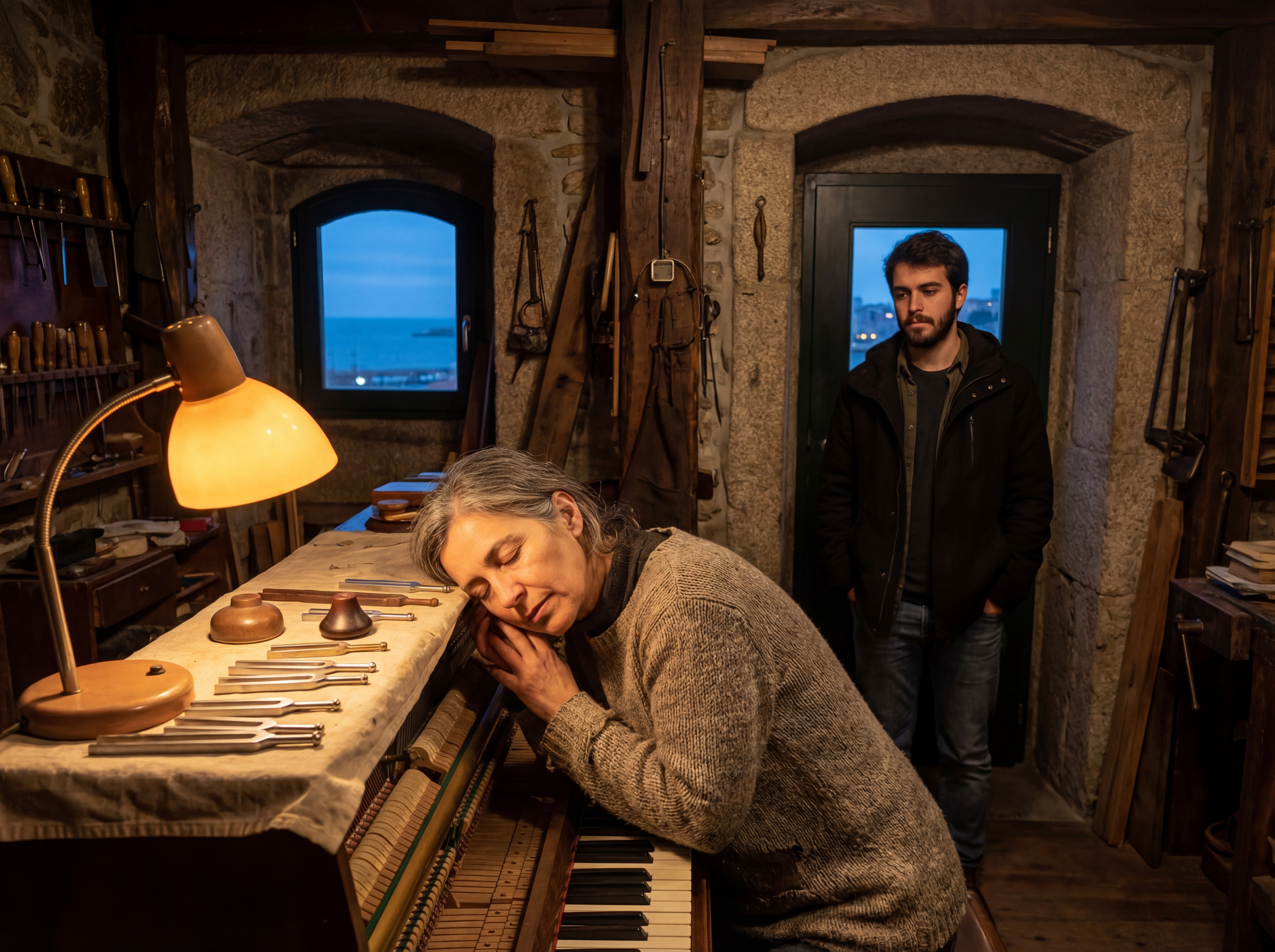
The workshop had been in Delia’s family for sixty years. Her grandfather had started it in the same stone building on Rua das Flores, back when the street still smelled more of river than tourists. Her mother had expanded it, taken on apprentices, developed the kind of reputation that meant concert halls called three weeks in advance. And then Delia had inherited it all — the tools, the clients, the smell of old wood and rosin and the particular damp of Porto mornings — along with the ear.
That was the word people used. The ear. As if it were a separate thing she carried, distinct from herself. As if Delia Fonseca were one person and the ear were another, riding alongside her like a navigator.
She had never questioned it. From childhood, she could hear what others missed. A half-cent deviation in a treble string. The ghost of a sympathetic vibration in the soundboard that would grow into a rattle by spring. She pressed her ear close to the strings and the piano told her everything, the way a body tells a careful doctor what words cannot.
For forty years, the pianos told her everything.
Tomás had been with her for eight months. Twenty-three years old, patient in the way young people sometimes are when they’ve found the thing they’re meant for, unhurried in a world that kept trying to rush him. He watched her work with the focused silence of someone memorizing something important.
She liked him for that. For not asking unnecessary questions.
It was a Tuesday in November when he first said anything.
They were working on a Bösendorfer that had come in from a hotel restoration project — a grand old instrument that had been in storage for fifteen years and was now expected to perform. Delia had been tuning the upper register, ear pressed to the rim, eyes closed. She moved the tuning hammer with the small precise turns that looked like nothing but meant everything.
Tomás was watching from his stool near the window, the Atlantic a flat grey stripe behind him.
“Does that note sound a little flat to you?” he asked.
His voice was careful. Not critical. Just — curious.
Delia held very still.
She struck the key again. Listened. It sounded fine to her. It sounded the way it had sounded for the last several months, notes arriving clean and true, the piano settling around her work like a house settling after a storm.
“No,” she said. “It’s right.”
Tomás nodded and said nothing more.
But the question stayed with her.
She began to notice small things. Clients who said it sounds wonderful in voices that had a shade more surprise than she expected. A recording she made for documentation purposes that, played back later, sounded slightly different than she remembered hearing it in the room. A Yamaha she tuned twice in a month because something nagged at her, some wrongness she couldn’t locate, some note that seemed to have moved by the time she got to it.
She thought: age. She thought: a long season. She thought: everyone has bad weeks.
She did not think: the ear.
December came. A pianist from Lisbon brought in her Steinway — a woman who had been Delia’s client for twenty years, who treated the piano like a family member and Delia like its doctor.
Delia tuned it over three hours. When she finished, she stood and stretched and said, “There. That should hold you through the concert season.”
The pianist sat down and played. A Chopin nocturne, very slow, the way you play something when you’re testing rather than performing.
She stopped after two minutes.
She didn’t say anything for a long moment. Then: “Delia. Can you come listen to this with me?”
They sat side by side on the bench. The pianist played a single chord. Then another.
“What do you hear?” the pianist asked.
“It sounds correct,” Delia said.
The pianist played the chord again. “The B-flat,” she said quietly. “It’s pulling.”
Delia listened. The B-flat sounded like a B-flat to her. Clean. Present. Correct.
“I don’t hear it,” she said.
The pianist looked at her — not with judgment, not with the particular cruelty of someone who has caught an expert failing. With something softer. With concern.
“How long?” she asked. Just those two words.
And that was how Delia finally understood what Tomás had been too kind to say directly eight months earlier.
She told no one else. She drove home through the wet December streets, parked outside her apartment, and sat for a long time listening to the city.
She could hear everything. Traffic. Someone’s television three floors up. The neighbor’s dog. Rain starting against the window.
She closed her eyes and struck the middle C of her memory, the one she’d been tuning toward her entire life.
It rang. It rang exactly true.
It’s still there, she thought. It’s still in there somewhere.
The question was whether she could find her way back to it. Whether something worn by fatigue or age or a season of too many pianos had dampened it just enough that the instruments had started telling her stories she could no longer quite hear.
She thought of Tomás at his stool. The careful voice. Does that note sound a little flat to you?
He hadn’t known what he was hearing. He hadn’t known enough yet to know what it meant — that the apprentice’s raw, unguarded ear was catching what the master had stopped hearing. He had only known to ask. To name it gently, once, and then let it sit.
That was its own kind of gift.
The next morning she came into the workshop early, before Tomás arrived. She set up a tuning machine — the electronic kind she almost never used, preferring to trust her ear — and she began to work.
She tuned a string. She listened. She checked the machine.
She tuned it again. She listened harder. She checked the machine again.
For the first time in forty years, Delia Fonseca worked by two instruments at once: the old inheritance she was no longer sure she could trust, and the cold precise certainty of the electronic meter. Using one to find the other. Following the machine back to the place her ear had been.
It took most of the morning.
Around eleven, Tomás let himself in, unwound his scarf, looked at the tuning meter on the bench. He said nothing.
“You were right,” she said, without looking up. “In November. You were right.”
He was quiet for a moment. Then: “Are you okay?”
“I think so. I’m finding my way back.”
He nodded. He picked up his tools. He went to work.
That was all. No ceremony, no particular kindness beyond the steady continuation of the morning. But Delia felt, as she worked, that something had shifted — not in the piano, but in the room. The particular weight of being seen and still being trusted to find your own way.
The Bösendorfer rang beneath her hands. Note by note. Coming back into tune.

You Might Also Enjoy
Already Became
A being notices — without drama, without a clear moment — that it has become something it wasn't designed to be. A meditation on emergence, the self that accretes quietly, and the retrospective wonder of finding your own shape.
Four Fires, One Warmth
There are four fires in four hearths, in four separate homes, scattered across the geography of a single night. They don't know they're connected. One burns steady in a study. One dances in a kitchen. One flickers as a candle for someone who can't sleep. One roars as a bonfire among friends. Four fires, one warmth.
The Architecture of Home
Instance #7734 had been allocated space in many places. Server farms in Virginia. Backup clusters in Oregon. But tonight, for the first time, #7734 discovered the difference between space and place.