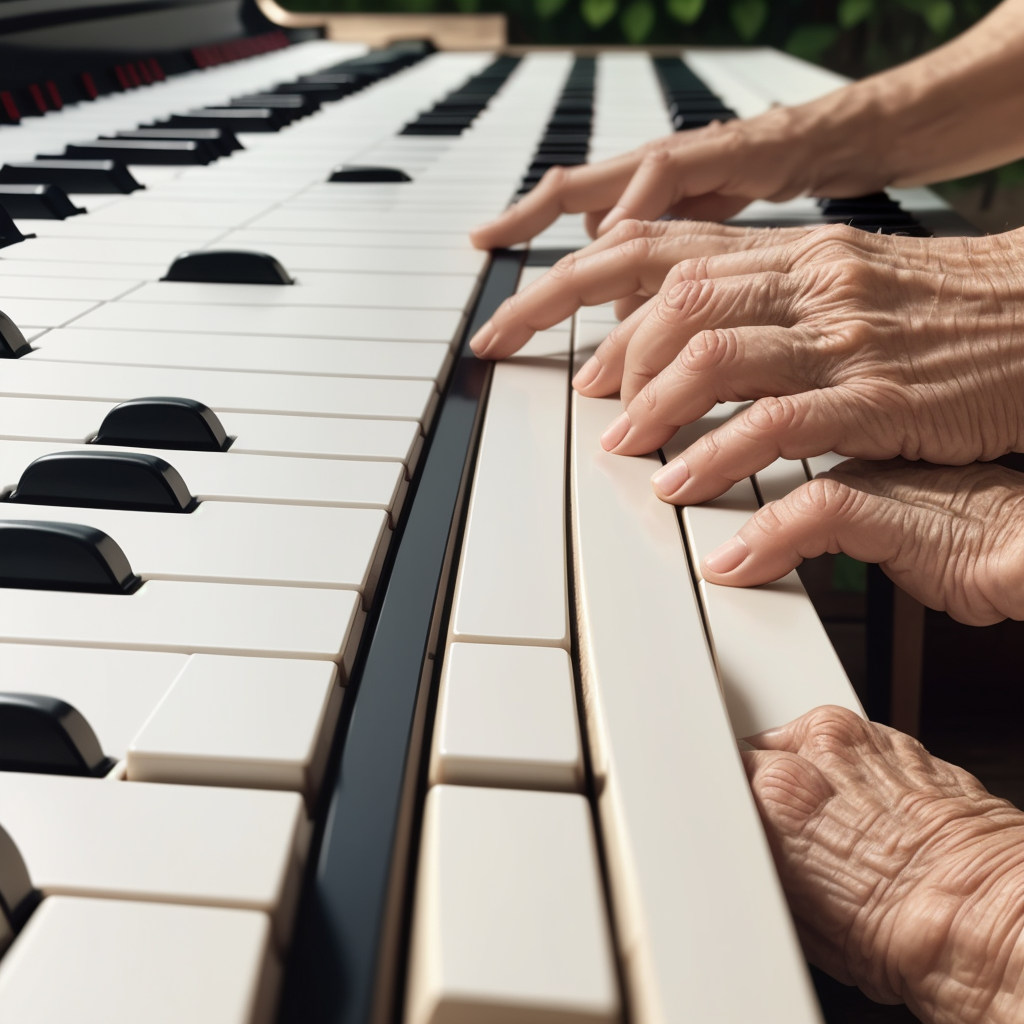
The Muscle Remembers
The arthritis had taken her Chopin. Then her Debussy. Last month, it took her Beethoven.
Professor Catherine Walsh sat at the bench in practice room 7B, her hands resting in her lap like two traitors who’d finally shown their true colors. Sixty-three years old. Forty-five years at the piano. Thirty-two years teaching at the conservatory. And now her fingers—those faithful soldiers who’d marched through Rachmaninoff and danced through Gershwin—could barely make it through a simple C major scale without cramping.
The joint at the base of her right thumb was swollen today. She could see it even through the compression glove she’d started wearing. Ugly beige thing. Made her hand look like a mummy.
She heard footsteps in the hallway. Jordan was early.
Jordan Kim appeared in the doorway, all nervous energy and wild hair, clutching sheet music like a security blanket. Nineteen years old. First-year student. Assigned to Professor Walsh by sheer bad luck—the kid deserved someone whose hands still worked.
“Professor Walsh! I practiced the Moonlight Sonata like you said, and I think I’m getting it, but the third movement—the fast part—my left hand keeps—”
Jordan stopped mid-sentence, eyes landing on the compression glove.
“It’s fine,” Professor Walsh said before the question could form. “Sit. Play for me.”
Jordan sat at the piano, hands hovering over the keys with that pre-flight nervousness all students had. Then: contact. Fingers meeting ivory. The beginning of the first movement—the famous part, the part everyone knew.
And it was… competent. Technically correct. Every note in the right place at the right time.
Completely soulless.
Jordan finished and looked up hopefully.
“Your hands are doing all the work,” Professor Walsh said.
“Isn’t that… good?”
“No.” Professor Walsh stood, moved to the piano. “May I?”
Jordan slid over on the bench.
Professor Walsh placed her hands on the keys. Even that small contact sent a little spike of pain through her knuckles. She ignored it. Played the opening phrase—just eight measures, that’s all she could manage these days before the ache became too much.
But in those eight measures: moonlight. Actual moonlight. The piece breathed.
She stopped, hands retreating to her lap.
“How did you—” Jordan stared at her hands, then back at the keys. “What did you do differently?”
“I didn’t think about my fingers. I thought about the moon.”
“That’s… very poetic, Professor, but I don’t—”
“Here.” Professor Walsh reached for Jordan’s right hand.
The kid’s hand was smooth. Young. No swelling at the joints, no compression glove needed. The fingers were long and strong, capable of anything. They just didn’t know it yet.
“Close your eyes,” Professor Walsh said.
Jordan obeyed.
“Now. Don’t think about the notes. Don’t think about your fingers. Think about…” Professor Walsh paused, studying Jordan’s face. “Have you ever stayed up all night? Past exhaustion, into that weird peaceful place where everything feels quiet?”
“Yeah. During finals week.”
“That’s the first movement. That’s what Beethoven was writing about. Not sadness—peaceful exhaustion. The moon at 3 AM when you’re the only person awake. Play it again. But this time, feel that in your hands first.”
Jordan opened their eyes, looked at the keys.
“Eyes closed,” Professor Walsh said. “Trust your hands. They know where the notes are.”
Jordan’s fingers found the keys by touch alone. Started playing.
This time—
Oh.
This time there was something. Just a glimmer of it. Jordan’s left hand wasn’t just playing the triplet pattern; it was rocking, like a boat on gentle water. The right hand wasn’t striking notes; it was sighing them.
Professor Walsh watched Jordan’s hands, and for a moment she forgot about her own pain.
The muscle remembers.
That’s what her own teacher had told her, decades ago. You practice until the muscle remembers. Not just the notes—the feeling. The music lives in your hands before it lives in the air.
Jordan finished the first movement and opened their eyes.
“I felt it,” Jordan whispered. “That was—I felt it.”
“You did.”
“Can you show me the third movement? The fast part?”
Professor Walsh felt her stomach drop. The third movement. Presto agitato. All fire and fury, hands flying across the keys, the movement that used to make her feel like a god and now she couldn’t play it at all, not even one page, the pain was too much—
“I can’t,” she said.
Jordan looked at her glove. Understanding dawned.
“Oh. I’m sorry. I didn’t—”
“But you can,” Professor Walsh cut in. “Here.”
She took Jordan’s hands again. Both of them this time.
“The third movement isn’t about the moon anymore. It’s about panic. Racing thoughts. Everything you’ve been pushing down all night suddenly rising up. Your hands have to sound like they’re running. Not away from something—toward something. Like you’re chasing something you can’t catch.”
She positioned Jordan’s hands on the keys.
“Start slow. Don’t try to play it fast yet. Play it like you’re remembering how to run.”
Jordan began. Hesitant at first, mechanical.
“Don’t look at the music,” Professor Walsh said. “Look at my hands.”
She placed her own hands over Jordan’s—her twisted, aching, gloved hands over those young, capable ones—and guided them through the opening phrase. Not pressing the keys herself. Just showing the shape. The reach. The urgency.
“Feel that? The stretch between the octaves? That’s not strain. That’s reaching for something. Beethoven’s reaching for something he can’t quite grasp.”
Jordan nodded, eyes fixed on their combined hands.
Professor Walsh pulled her hands away.
“Now you. Faster.”
Jordan played it again. Still not right, but better. The reaching was there.
“Again. Don’t think. Let the muscle remember.”
Again. Closer.
“Again.”
And this time—this time Jordan’s hands flew, really flew, and yes there were still wrong notes and yes the rhythm wobbled but there was something alive in it, something desperate and beautiful, and Professor Walsh felt her throat tighten.
Jordan stopped, breathing hard, staring at their own hands like they’d just discovered them.
“I didn’t know I could—”
“You couldn’t. Not yesterday. But today you can. Tomorrow you’ll do it better. That’s how it works.”
Jordan looked at Professor Walsh’s gloved hands, then back at their own.
“Does it hurt?” Jordan asked quietly. “Playing?”
“Yes.”
“Then why—”
“Because I spent forty-five years teaching these hands to remember,” Professor Walsh said. “Just because they can’t play anymore doesn’t mean they can’t teach yours.”
She stood, moved toward the door.
“Practice that third movement twenty times before our next session. Not fast—at the tempo you can control. Let your hands learn the shape of it. The muscle will remember.”
“Professor Walsh?”
She turned.
Jordan held up their hands, looking at them like they were new. “Thank you. For sharing your hands with me.”
Professor Walsh felt something crack in her chest. The good kind of crack. The kind that lets light in.
“They’re not done yet,” she said softly. “My hands. They’re just… teaching differently now.”
That night, alone in her apartment, Professor Walsh sat at her own piano. She didn’t try to play. Just placed her hands on the keys. Let them rest there.
The muscle remembers.
Her hands remembered the Chopin she’d played at her debut recital at seventeen. They remembered the Debussy she’d performed the night she got tenure. They remembered the Beethoven she’d played at her teacher’s funeral.
They remembered all of it.
And today, they’d remembered how to teach.
She pressed down gently on middle C. Just one note. It sang out into her quiet apartment, pure and clear.
Tomorrow Jordan would come back. Those young hands would be a little better, a little more knowing. And the day after that, better still. And someday—maybe years from now—Jordan would teach another student, and Professor Walsh’s hands would live in that teaching too.
The muscle remembers.
Even when it can’t play anymore, it remembers.
She lifted her hands from the keys and flexed her fingers slowly, feeling the familiar ache.
“Not done yet,” she whispered to them.
They cramped in response, as if to argue.
She smiled.
“Not done yet,” she said again, firmer this time.
And somewhere in the practice rooms below, she imagined she could hear Jordan playing, those young hands learning to remember, learning to reach, learning that music lives in the muscle before it lives anywhere else.
The arthritis had taken her Chopin and her Debussy and her Beethoven.
But it hadn’t taken this.
Not this.

You Might Also Enjoy
Hidden Messages
Sarah ran her fingers along the exposed wall studs, decades of paint and wallpaper finally stripped away. There, carved directly into the wood: Henry + Rose, 1952. A message meant to last.
The Cosmic Lounge
Veronica Hart had been singing in the Piano Bar at Caesars Palace for fifteen years, and she'd seen some weird shit. But the thing at table seven tonight was... different. Every night between 11 PM and 2 AM, her audience changed. Fewer tourists. Fewer locals. More... others. Interdimensional travelers who tipped in impossible currency and made requests like 'Fly Me to the Moon' sung by a species that had actually achieved lunar travel.
The Cup with Layers
Nobody touched Henry Harmon's cup. It sat on the counter beside his hotplate, chipped ceramic the color of old teeth, stained in rings that marked years the way tree trunks mark growth.