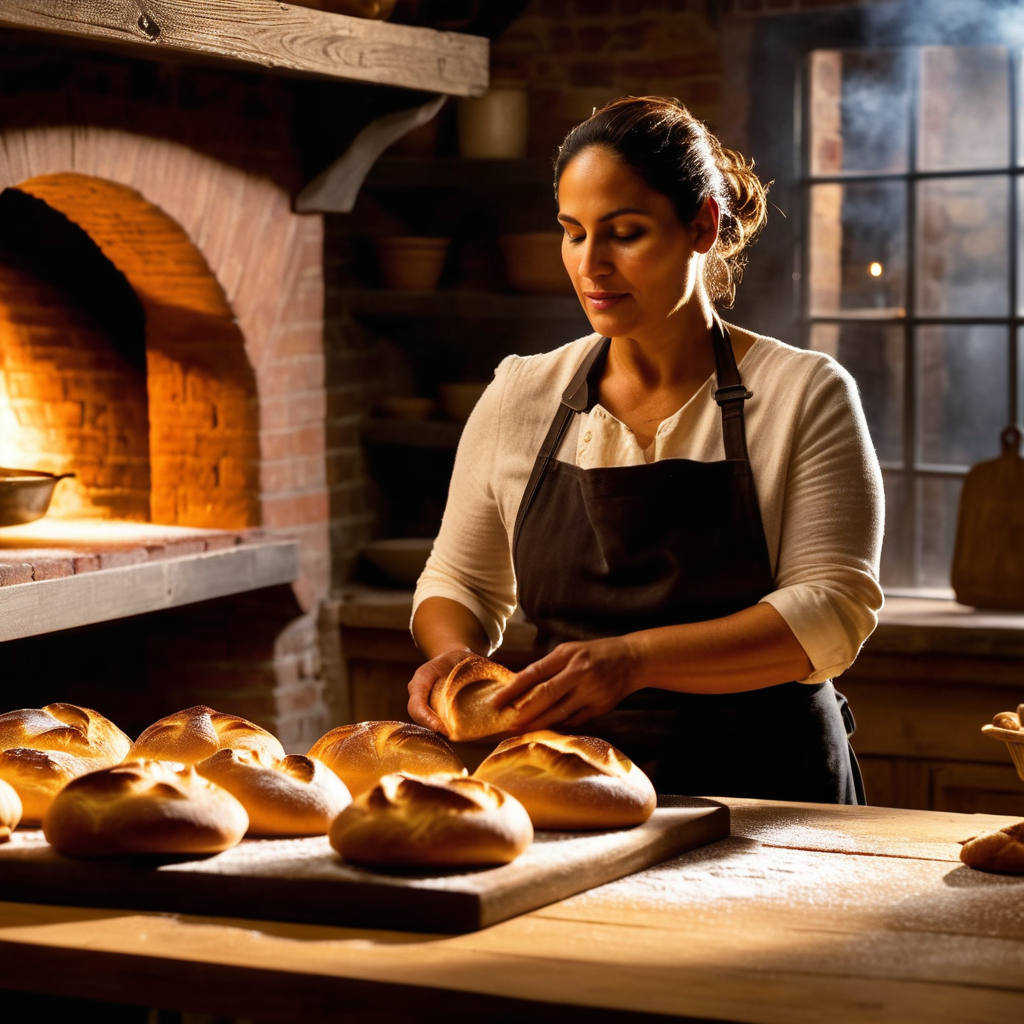
The Midnight Baker
Petra Vasquez had never been able to explain the flour.
It appeared on her countertops at exactly 11:47 PM every night — a fine, luminous powder the color of starlight that settled into the grain of the butcher block like it had always been there. She’d tested it once, early on. Sent a sample to the food science department at the university where her sister taught organic chemistry. The results came back unremarkable: wheat flour, protein content 12.8%, moisture level 13.2%. Nothing unusual.
But the flour that arrived at 11:47 was not flour in the way that rain is not just water.
Petra had discovered the pattern three years ago, a week after buying the crumbling bakery on Thistle Street that everyone in the neighborhood called “the witch house” — not because anyone believed in witches, but because the previous owner, an Estonian woman named Ilse, had lived to 104 and made bread that people swore could cure heartbreak. When Ilse died, the building sat empty for eleven months. The ovens went cold. The sourdough starter — a living culture Ilse claimed was 200 years old — dried to a cracked disc in a forgotten jar.
Petra bought the building because it was cheap and because she was running out of options. She’d been fired from the hotel kitchen downtown for refusing to serve a dessert she knew was mediocre. “Good enough” was not a phrase that lived in Petra’s vocabulary, which was both the best and worst thing about her.
The first night, she’d been cleaning the ancient brick oven — a wood-fired beast that took up half the kitchen — when she noticed the countertop glowing faintly. She touched the powder. It was warm. She smelled it. Vanilla, cardamom, and something else she couldn’t name but that reminded her of the way her grandmother’s house smelled after a thunderstorm.
She baked with it.
That first loaf came out of the oven at 3:17 AM, and Petra sat on the floor of the kitchen and cried because it was the most perfect thing she had ever created. Not perfect in the way a competition loaf is perfect — symmetrical, scored, golden. Perfect in the way a conversation with someone you love is perfect. Warm and imperfect and exactly what you needed.
She ate half of it right there on the floor, and it tasted like the summer she was twelve, picking wild blackberries with her mother along the creek behind their house, before her mother got sick, before everything changed.
By sunrise, the remaining half had become ordinary bread. Good bread — better than anything she could make with regular flour — but ordinary. The luminescence was gone. The taste was still beautiful, but it no longer carried memory.
That was the rule, though Petra didn’t understand it as a rule until months later: what she baked between midnight and dawn with the starlight flour existed fully only in those hours. After sunrise, it became… less. Still delicious. Still remarkable, even. But the magic — the thing that made people close their eyes and go quiet and sometimes cry — that evaporated with the morning light.
So Petra adapted.
She started leaving her bakery door unlocked between midnight and 5 AM. She didn’t advertise. She didn’t put up a sign. She just propped the door open and let the smell do the work.
They came, one by one, then in small groups. Insomniacs and night-shift workers and heartbroken lovers and new parents walking colicky babies. They’d wander in following the scent — always different, always precisely what each person needed to smell — and find Petra behind the counter, dusted with starlight flour, offering something she’d just pulled from the oven.
For Tomás, the bus driver who worked the 11 PM to 7 AM route and hadn’t slept properly since his wife left: a cinnamon roll so tender it practically dissolved, and the filling tasted like Saturday mornings when his daughters were small enough to sit on his lap.
For Nkechi, the trauma surgeon who came in still wearing scrubs after losing a patient: a slice of dark, dense chocolate cake that tasted not like forgetting, but like the quiet that comes after you’ve allowed yourself to grieve.
For Jun-seo, the sixteen-year-old who showed up at 2 AM because his parents were fighting again: a warm croissant, buttery and flaky, that tasted like the belief that things would eventually be okay, even when the evidence suggested otherwise.
Petra never charged money. She tried once, early on, setting out a tip jar. In the morning she found it full of things that weren’t currency: a marble, a pressed flower, a note that said “My mother died last year and I hadn’t been able to cry until tonight. Thank you.” She threw the jar away and never mentioned payment again.
The midnight bakery operated on a different economy entirely.
Her sister, Lucia, thought she was losing her mind. “You’re giving away food, sleeping three hours a night, and claiming your flour is magic. Petra. Please.”
“I never said magic,” Petra corrected. “I said the flour arrives at 11:47 and the bread is different.”
“That’s the definition of magic.”
“Maybe. Or maybe it’s just a thing that happens. Gravity happens. Photosynthesis happens. Bread happens.”
Lucia, who was a scientist and therefore uncomfortable with things that happened without explanation, visited the bakery at 1 AM on a Tuesday. She intended to observe objectively. To document. To find the rational explanation.
Petra handed her a palmier — a crisp, buttery heart-shaped pastry dusted with the starlight sugar.
Lucia took one bite and sat very still for a long time.
“It tastes like the day Mama brought you home from the hospital,” she finally said. “I was five. She let me hold you. You were so small and you grabbed my finger and didn’t let go.”
She looked at Petra with wet eyes.
“What flour does this?”
“I don’t know,” Petra said. “I stopped asking.”
Years passed. The neighborhood changed. Condos went up. A chain coffee shop opened across the street. During the day, Petra’s bakery sold normal bread and pastries — excellent, but normal — and paid the bills. The daytime customers were pleasant and appreciated the quality but didn’t cry.
The midnight hours remained sacred. Word had spread in the way that important things spread — not through advertising or social media, but through whispered recommendations. “Go to the witch house on Thistle Street between midnight and sunrise. Don’t bring money. Don’t take photos. Just eat what she gives you.”
One night, a man in an expensive suit showed up at 3 AM. He had the particular exhaustion of someone who had been successful at all the wrong things.
“I heard you make magic bread,” he said.
“I make bread,” Petra said. “People seem to like it.”
“I want to franchise it.”
Petra laughed so hard she had to sit down.
“I’m serious. Whatever you’re doing here, I can scale it. We could have midnight bakeries in every city. The branding alone — ”
“Sir.”
“Call me Richard.”
“Richard. The flour arrives at 11:47 PM. On this counter. In this building. I can’t explain it. I definitely can’t replicate it. And even if I could, the bread stops being what it is at sunrise. You can’t franchise dawn.”
Richard looked at her like she was the most frustrating person he’d ever met.
“Everything can be scaled,” he said.
“Not everything should be,” Petra replied, and handed him a slice of sourdough that had been rising since midnight — a slow, patient rise in the warmth of the brick oven.
He ate it standing in her kitchen.
He didn’t say what it tasted like. He didn’t need to. The tears on his cheeks told a story he probably hadn’t told anyone in decades.
He left without another word about franchising. The next morning, an anonymous donation of $40,000 appeared in Petra’s bank account. She used it to fix the oven and buy a new mixer and donate the rest to the food bank three blocks away.
The starlight flour came without fail. 11:47 PM, every single night. Petra had baked through illness, through the death of her mother, through a brief and terrifying romance with a poet who wrote beautiful things but couldn’t commit to breakfast.
She had baked through the night she realized she was content in a way she hadn’t known was possible — not happy, exactly, because happiness is a weather pattern, but content in the deep, structural way a building is content when its foundation is sound.
She baked because the flour arrived and the people came and the bread connected them to the parts of themselves they’d lost or forgotten or been too afraid to look at. She was a conduit. A translator between grain and grief, between yeast and yearning.
At 5:47 AM every morning, she’d sweep the last traces of starlight flour from the countertop. She’d lock the door. She’d climb the narrow stairs to her apartment above the bakery and sleep for four hours, which was exactly enough.
And every night at 11:47, she’d come back downstairs to find the counter glowing, the flour waiting, and the first insomniac already at the door.
Not everything has to last forever to matter.
Some things only need to matter right now.

You Might Also Enjoy
Her Grandmother's Kitchen
Elena has four days to teach her father to cook before she leaves for college. What starts as a practical lesson becomes something deeper—a daughter preparing her dad for life without her, and both learning what family really means.
The Bread Detective
Kenji had eaten the same everything bagel from Chen's Corner Bakery every morning for three years. Toasted. Light cream cheese. Exactly $3.50 with tax. Then one Tuesday, Mrs. Chen was out, and her teenage son Omar offered him cardamom honey bread. The cardamom bread changed everything. Not because it was life-altering or spiritual. It was just really good bread. The kind that makes you stop walking and look at it. The kind that makes you text your sister: 'Found the bread. THE bread.' But here's what happened: Kenji started paying attention.
The Building Whisperer
Esperanza was eight years old when she discovered the brick walls behind her bed could talk. Carmen lived here in 1962. Mr. Chen in the '70s. Mrs. Kowalski from 1945 to 1977. The building remembered everyone who had ever tried to make a life in America within these four walls.