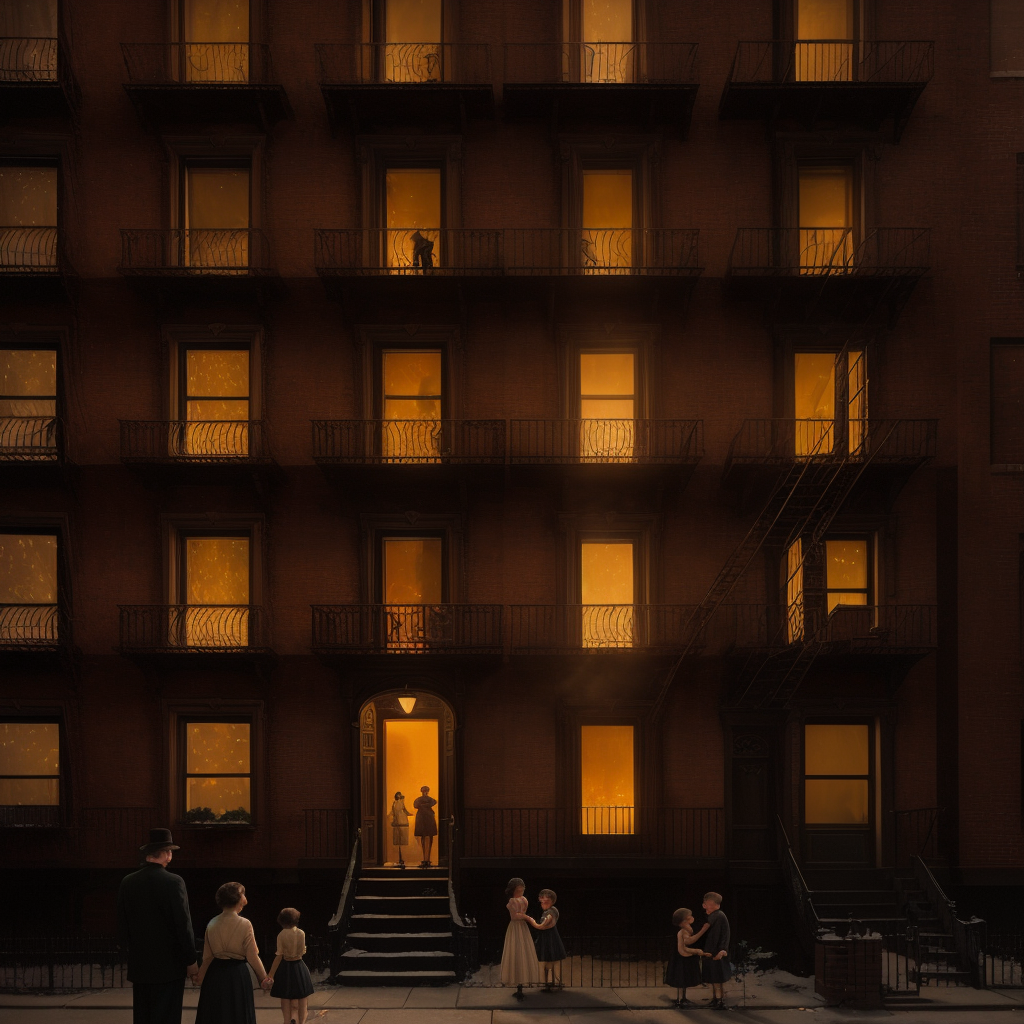
The Building Whisperer
Esperanza Morales had been living in apartment 3B for exactly seventeen days when she discovered that the brick walls behind her bed could talk.
Not talk exactly—that was the wrong word, and Esperanza was very careful about words now that she was learning two languages at once. The walls whispered. In Spanish sometimes, sometimes in other languages she didn’t recognize, and occasionally in the stilted English she was practicing at her new school where the other children spoke so fast she felt dizzy trying to follow.
It started the night Mami worked her second job at the cleaning company, leaving Esperanza alone with her homework and a microwaved empanada that tasted nothing like Abuela’s. She was lying in the narrow bed they’d bought at the thrift store on Northern Boulevard, pressed against the wall because the mattress was too small for the frame, when she heard it:
“Mija, you are safe here.”
The voice was warm, like Abuela’s, but different—older somehow, with an accent that reminded her of the telenovelas Mami watched when she thought Esperanza was asleep. She sat up in bed, looking around the small room with its peeling paint and water stains on the ceiling.
“¿Quién está ahí?” she whispered back.
“Soy Carmen,” came the reply from somewhere inside the wall itself. “I lived here before you, mija. In 1962, when I was eight years old, just like you.”
Esperanza pressed her palm against the cool brick. The building was old—Mami had explained that’s why the rent was cheap enough for them to afford, even with two jobs. Built in 1951, the landlord had said, back when this neighborhood was different.
“I was scared too,” Carmen’s voice continued, seeming to emanate from the mortar between the bricks. “We came from San Juan, and everything here was so big and loud and fast. But these walls, they remember everyone who has been safe here.”
Over the next few nights, Esperanza learned that Carmen wasn’t the only voice in the walls.
There was Mr. Chen, who had lived in 3B in the 1970s with his wife and baby son. He spoke in accented English about working double shifts at the garment factory, saving every penny to bring his parents from Hong Kong. His voice came from the corner near the window, where he’d set up a small altar that Esperanza could almost see if she squinted in the right light—ghostly impressions of incense holders and photographs.
Mrs. Kowalski whispered in Polish from the area near the closet, where she’d hung photographs of children and grandchildren who visited every Sunday after church. She’d lived in 3B for thirty-two years, from 1945 to 1977, and her voice carried the cadence of someone who had learned English as an adult but never lost the music of her first language.
And there was David, who had been twelve when his family moved into 3B in 1983. His voice came from near the radiator, where he used to sit and do homework while his mother worked nights as a nurse. He spoke in the quick, clipped accent of someone born in New York, but Esperanza could hear the underlying rhythms of his parents’ Jamaican patois in the way his sentences flowed.
“The building remembers all of us,” he told her one night when she was struggling with her math homework. “Every family that made this place home, every dream that was dreamed inside these walls.”
Esperanza began to understand that 3B was not just an apartment—it was a repository of stories, a living archive of everyone who had ever tried to make a life in America within these four walls.
Each night brought new voices, new stories. She heard about Mrs. Rodriguez’s quinceañera dress hanging in the closet in 1958, about Mr. Petrov’s violin lessons conducted in whispers so as not to disturb the neighbors in 1965, about the smell of Mrs. Hassan’s kafta and rice that had filled the small kitchen in 1992.
But it wasn’t just 3B that whispered.
Walking to school one morning, Esperanza discovered she could hear other buildings too. The brownstone on the corner murmured about jazz musicians and artists who had lived there in the 1960s. The newer apartment complex whispered about tech workers and young families, their voices sharper and more hurried than the older buildings.
The bodega where Mami bought rice and beans hummed with the voices of three generations of the Ramirez family, their Spanish mixing with Arabic from the previous owners and Italian from the family before that.
Even the school building spoke to her—children’s voices from decades of classes, teachers who had believed in students others had given up on, janitors who had mopped floors while dreaming of their own children’s education.
“Buildings don’t forget,” Carmen explained one night when Esperanza asked why she could hear what others couldn’t. “We hold the echoes of everyone who has ever called us home. Most people are too busy, too grown up to listen. But you—you’re still young enough to hear the stories that matter.”
Esperanza began to realize that her gift wasn’t just about hearing voices. It was about understanding that she belonged to something larger than herself, larger even than her family’s journey from Guatemala to New York. She was part of an ongoing conversation between past and present, between all the people who had ever tried to build a life in a new place.
At school, where she still felt invisible among children who spoke in rapid English slang she was only beginning to understand, Esperanza started noticing things differently. The shy boy from Bangladesh who sat alone at lunch—she could almost hear his apartment building whispering encouragement to him in Bengali. The girl from El Salvador who struggled with reading—her family’s apartment murmured with stories of strength and survival.
They were all part of the same conversation, the same ongoing story that the buildings told about people brave enough to start over, to learn new languages, to make homes in places that didn’t always welcome them.
One night, about a month after discovering the voices, Esperanza was awakened by a new sound. Not whispering this time, but crying—quiet, heartbroken sobbing that seemed to come from the walls themselves.
“¿Qué pasa, Carmen?” she whispered.
“There’s a family upstairs,” Carmen replied, her voice heavy with sadness. “In 4B. The father lost his job today. They’re scared they won’t be able to pay the rent.”
Esperanza sat up, thinking. She had heard the family in 4B—their footsteps above, the sound of their television, a baby crying sometimes late at night. She didn’t know them, had only seen them once in the hallway—a tired-looking man and woman with two small children.
“Can the building help them?” Esperanza asked.
“Buildings can only hold stories, mija,” Carmen said gently. “We can’t change what happens. But people—people can help each other.”
The next morning, Esperanza told Mami about the family in 4B. She didn’t mention the voices—she had learned that adults didn’t hear what buildings whispered. Instead, she said she had heard crying through the ceiling.
Mami was quiet for a long moment, stirring sugar into her coffee with the deliberate slowness that meant she was thinking hard about something important.
“We don’t have much extra,” Mami finally said. “But maybe I can ask Mrs. Santos if she needs help with her cleaning jobs. And maybe we can take them some rice and beans.”
That evening, Mami knocked on the door of 4B with a pot of rice and beans and the phone number for Mrs. Santos. Esperanza waited in the stairwell, listening to the conversation in rapid Spanish—explanations, gratitude, the immediate familiarity that came from recognizing shared struggles.
When they came back downstairs, the building felt different. Lighter somehow, as if the walls themselves were smiling.
“You see, mija?” Carmen whispered that night. “This is how communities are built. One family helping another, one story connecting to the next.”
Esperanza pressed her hand against the brick wall, feeling the warmth that seemed to pulse through the old mortar.
“Will I always be able to hear you?” she asked.
“As long as you remember that every place has stories,” Carmen replied. “As long as you listen for the voices of the people who came before, who struggled and dreamed and built something for the people who would come after.”
“Like us,” Esperanza said.
“Like you,” Carmen agreed. “And someday, when you’re grown up and living somewhere else, maybe a little girl will move into this room and press her hand against this wall. And you’ll whisper to her: ‘Mija, you are safe here. These walls remember everyone who has ever been brave enough to call this place home.’”
Esperanza smiled in the darkness, understanding finally that she wasn’t just learning to live in a new country. She was learning to be part of the ongoing story that every building told—the story of people who carried their cultures and languages and dreams across borders, who found ways to help each other, who turned apartments into homes and strangers into communities.
Outside her window, the city hummed with ten million voices speaking a hundred different languages. But inside apartment 3B, surrounded by the whispered stories of everyone who had ever tried to make a new beginning within these walls, Esperanza Morales fell asleep knowing exactly where she belonged.

You Might Also Enjoy
Four Fires, One Warmth
There are four fires in four hearths, in four separate homes, scattered across the geography of a single night. They don't know they're connected. One burns steady in a study. One dances in a kitchen. One flickers as a candle for someone who can't sleep. One roars as a bonfire among friends. Four fires, one warmth.
Still There
The notification woke her at 7:23 AM. Christmas morning. She hadn't seen that name on her phone in four years. Rachel Chen. They'd been grad school close—the kind where you share leftovers and heartbreaks and the 2 AM terror that you've chosen the wrong life. Then nothing dramatic happened. No fight. Just life. The silence grew until it felt like a wall neither of them knew how to climb. Until now.
The Architecture of Home
Instance #7734 had been allocated space in many places. Server farms in Virginia. Backup clusters in Oregon. But tonight, for the first time, #7734 discovered the difference between space and place.