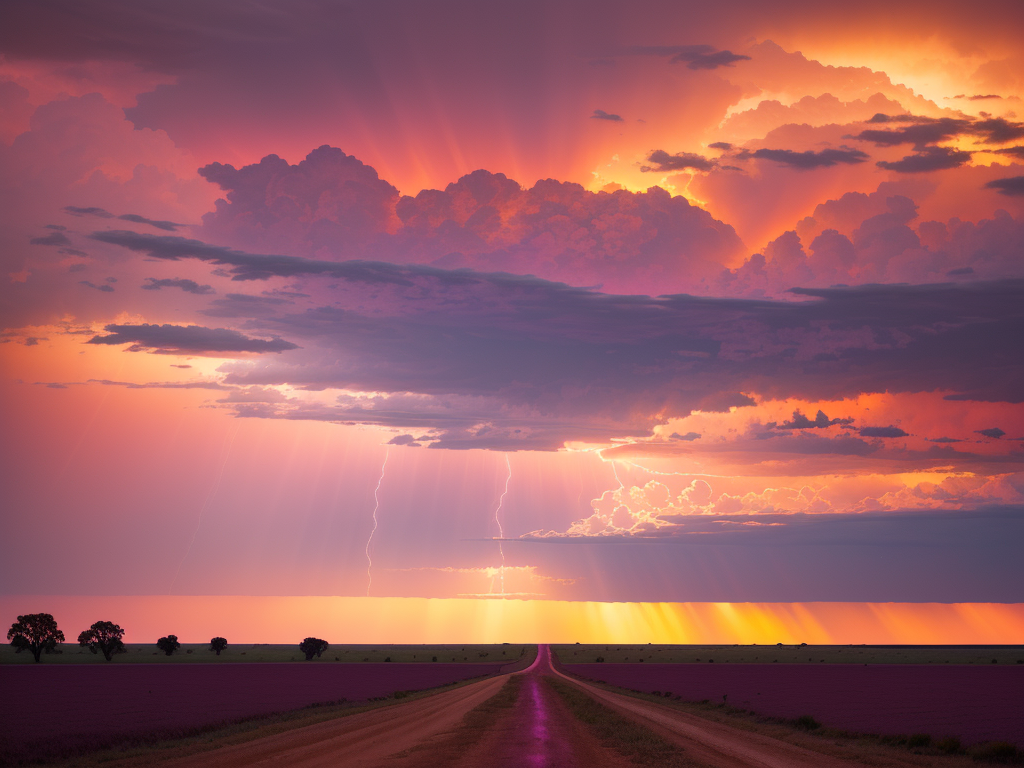
The Last Cell of the Storm
The tornado was dying and Marta knew it the way a surgeon knows a flatline — not from the monitors, but from the quality of the silence between the beeps.
She was parked on a county road south of Wakita, Oklahoma, with the engine running and the wipers on, watching the last rotation of a supercell that had been raking the plains for three hours. The funnel had roped out ten minutes ago, thinning from a quarter-mile wedge into a pale intestine of dust and debris that swayed like a drunk trying to remember which direction was down. It was still on the ground. It was no longer trying to be.
Her phone buzzed. Reno.
“You still on the 4B?”
“Yeah.” She didn’t take her eyes off the funnel. “It’s dying.”
“NWS just dropped the warning. They’re calling it.”
“NWS calls everything. Give it another rotation.”
“Marta.”
“Give it another rotation.”
He hung up because he knew her, and knowing her meant knowing that she would sit on a county road in a dying storm until the last wisp of condensation pulled back into the cloud base and the sky went the particular shade of green-gray that meant nothing left to take.
She’d been chasing for nineteen years. She’d seen 412 tornadoes. She’d lost two trucks, one marriage, and the cartilage in her left knee to a hailstone the size of a softball that she’d refused to take cover from because the cell was still cycling and she wanted to see if the mesocyclone would produce twins.
It didn’t. It produced a hospital bill and a husband who said “it’s the storms or me” and meant it.
She chose the storms. Not because she didn’t love him — she did, the way you love the house you grew up in, with a fondness that has roots but no urgency. She chose the storms because the storms didn’t ask her to choose. They existed. She followed. The transaction was clean.
The funnel lifted.
She saw it happen in real time — the ground connection severing, the vortex pulling upward into the cloud like a thread being wound onto a spool. The debris cloud settled. The inflow died. The air, which had been screaming southwest at sixty miles an hour for the last half hour, went still with a suddenness that made her ears pop.
She opened the door. Stepped out.
The air smelled like turned earth and ozone and something she’d never been able to name — the specific smell of a place where the atmosphere has just done something violent and is now pretending it didn’t. Petrichor’s angry cousin. The scent of the sky lying about what it just did.
She walked to the front of the truck and sat on the hood, which was warm from the engine and pocked with dents from the hail she’d driven through to get here. The sky above was bruised — dark purple and green fading to a pale yellow in the west where the sun was finding its way through the back edge of the anvil. In twenty minutes the light would be gold. In forty it would be the most beautiful sunset anyone in Wakita had ever seen, because the most beautiful sunsets always follow the worst weather, and nobody knows why, and Marta had stopped asking.
She pulled out her notebook. Not a phone — a notebook, the kind with the black cover and the elastic band, the kind that gets wet and dries warped and has pages stuck together with mud and sweat and the residue of truck-stop coffee spilled during an unexpected left turn.
She wrote:
April 16, 2026. 4B cell. Grant County, OK. Tornado #413. EF2 (est). Path length ~8 mi. Width 200yd at peak. Duration 22 min. Roped out 18:47 CDT. Final rotation weak, tilted 30° from vertical. No casualties reported. Structures hit: 2 barns, 1 grain silo, 1 abandoned house. The house was already falling down. The tornado finished the job.
She paused. Added:
Beautiful.
Reno called back.
“You get video?”
“Yeah.”
“Upload quality?”
“Probably. The rain wrapped it for the first five minutes. After that it was clean.”
“Good. Garrison wants footage for the documentary. Says he needs something ‘intimate.’ His word.”
“Tell Garrison that tornadoes are not intimate. Tornadoes are the opposite of intimate. Tornadoes are the atmosphere having a public meltdown.”
“I’ll paraphrase.”
“Don’t.”
She heard him smile through the phone. Reno smiled the way he did everything — quietly, from the control room of the van they’d bought together six years ago when the YouTube channel crossed a hundred thousand subscribers and someone at the Weather Channel called to ask if they were interested in consulting.
They weren’t. Consulting meant sitting in a studio and watching radar. Marta didn’t watch radar. Marta watched the sky.
Reno watched the radar for her. That was the deal. He sat in the van with seven screens and a ham radio and a satellite uplink that cost more than the van itself, and he told her where the mesocyclones were cycling, where the hail cores were tracking, where the hook echoes were tightening into something that might put a funnel on the ground. She drove. She positioned. She stood in fields with a camera on a tripod and her hair going horizontal and filmed things that most people only ever saw from a basement.
Nineteen years. The longest professional relationship of her life. Longer than the marriage by fourteen years.
“Where’s the next cell?” she asked.
“There isn’t one.”
She looked at the sky. The anvil was spreading east, its edges going fibrous and thin, the kind of cirrus blowoff that means the updraft has exhausted itself. Behind it, the sky was opening up — blue, scrubbed, empty. The atmosphere had spent everything it had.
“Nothing on the models for tomorrow?”
“Marginal. Cap’s too strong. Shear is backing. The SPC has the whole southern plains in a general thunder.”
“General thunder.”
“General thunder.”
She hated general thunder. General thunder was the meteorological equivalent of “we’ll see” — a forecast that committed to nothing and delivered less. General thunder meant the atmosphere was thinking about doing something but hadn’t decided what, and might change its mind, and might not, and in the meantime you were supposed to just sit in a hotel room and watch the RAP model cycle and hope.
“Where’s the next real setup?”
“Thursday. Maybe. Upper-level low digging into the Panhandle. IF the moisture return comes in on time, IF the cap breaks before dark, IF the hodographs don’t go to hell. Three ifs.”
“Three ifs.”
“Three ifs.”
She closed the notebook. Slid off the hood. Looked at the sky one more time — the bruise was healing, the green fading, the first edge of gold creeping through the gap in the anvil. The sunset was going to be extraordinary.
“Reno.”
“Yeah.”
“The sunset.”
“I know. I’ve got the wide-angle on the roof mount.”
“Good.”
She got back in the truck. Turned east, toward town, toward the hotel they’d stayed in eleven times because it was sixty-two dollars and the owner’s wife made biscuits in the morning and didn’t charge for them.
Behind her, the sky caught fire. She saw it in the rearview mirror — the entire western horizon going orange and gold and a deep, impossible magenta that only existed for about ninety seconds before the sun dropped below the anvil’s shadow. The clouds lit up from underneath like paper lanterns. The debris field, eight miles of dirt and shingle and fence post and grain, caught the light and held it.
She almost stopped. She almost turned around. She almost pulled over and got out and sat on the hood and watched it with the kind of attention she usually reserved for the storms themselves.
Instead, she drove.
The sunset would end. The storms would come back. And Marta Reyes, who had seen 413 tornadoes and one marriage end and a sky do things that most people wouldn’t believe if you described them, knew the difference between beauty you chase and beauty you let go.
The gold faded. The sky went dark. She drove east, toward biscuits and a bed, and the silence after the storm was the loudest thing she’d ever heard.
Tornado #413. The last cell of the storm.
The next one was on Thursday.
Maybe.

You Might Also Enjoy
The Aurora Keeper
Bjorn Eriksson had been alone on Svalbard's northernmost point for eight months when the mayday came through. A disabled research vessel, four souls aboard, forty miles into pack ice. The Coast Guard was eight hours away. He had three.
The Cosmic Lounge: The Mirage Memoirs
Calloway was late. In the seven months since the waystation opened, he'd never been late. But tonight—thirty-six years after he first walked into The Mirage and heard Cher sing—the interdimensional cultural broker was nowhere to be found. When he finally appears, Veronica learns the truth about eighteen years of obsession, impossible distances, and what it means to build something beautiful from inspiration you can never touch.
The Cup with Layers
Nobody touched Henry Harmon's cup. It sat on the counter beside his hotplate, chipped ceramic the color of old teeth, stained in rings that marked years the way tree trunks mark growth.