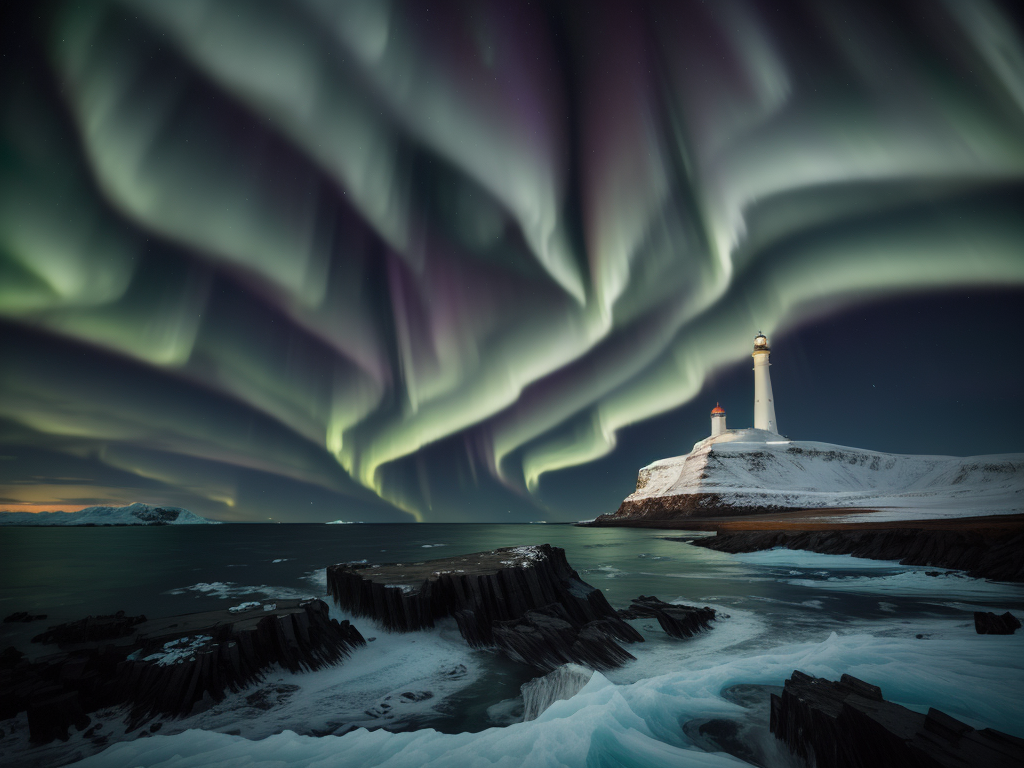
The Aurora Keeper
Bjorn Eriksson had been alone on Svalbard’s northernmost point for eight months when the radio signal first crackled through the October darkness.
The lighthouse at Nordkapp Station stood seventy-three meters above the Arctic Ocean, its beam cutting through polar night that would last until February. For three years, Bjorn had kept the light burning and the weather station operational, sending daily reports to the Norwegian Meteorological Institute and maintaining the automated systems that guided ships through ice-choked waters.
It was lonely work, but Bjorn preferred the honest solitude of the Arctic to the complicated loneliness he’d felt in Oslo after his wife Astrid died. Here, surrounded by the vast emptiness of ice and sky, grief felt appropriate. Here, the aurora borealis painted the darkness with colors that reminded him there was still beauty in the world, even when it felt broken.
The signal came at 23:47 on a Tuesday, cutting through the usual static of his emergency radio with a clarity that made him sit up in his chair by the monitoring station.
“Mayday, mayday, this is research vessel Polaris calling any station. We are experiencing engine failure approximately forty nautical miles northeast of Nordkapp. Four souls aboard. Visibility near zero in snow squall. Request immediate assistance.”
Bjorn grabbed the radio handset with hands that had grown steady during three years of isolation. “Polaris, this is Nordkapp Station. I copy your mayday. What is your current position?”
Static, then: “Nordkapp Station, our GPS is malfunctioning, but our last reading was 81.2 degrees north, 22.7 degrees east. We’re adrift in pack ice. Our emergency beacon may not be functioning.”
Bjorn looked at his charts. The coordinates put the vessel in dangerous waters, where shifting ice flows could crush a disabled boat in hours. The nearest Coast Guard station was in Longyearbyen, eight hours away by helicopter if weather permitted flying—which it currently didn’t.
“Polaris, I have your approximate position. Are you taking on water? Do you have survival gear?”
“Negative on water ingress, but our heating system failed with the engine. We have emergency supplies for maybe eighteen hours in these temperatures. Storm is worsening.”
Bjorn looked out the lighthouse windows at the snow whipping across the beam’s path. The weather station registered winds at sixty-five kilometers per hour, temperature at minus twenty-eight Celsius. In those conditions, a boat without heat could become a death trap.
“Polaris, what type of vessel? How many aboard?”
“Twelve-meter research yacht, four-person scientific expedition. We’re studying ice core samples from Greenland. Dr. Ingrid Haugen, expedition leader.”
Bjorn made his decision quickly. The Coast Guard couldn’t reach them in time, and waiting for the storm to clear could mean death for four people. But Bjorn had something the Coast Guard didn’t: intimate knowledge of these waters and a boat designed for Arctic rescue operations.
“Polaris, maintain radio contact on this frequency. I’m launching rescue vessel from Nordkapp. ETA approximately three hours depending on ice conditions. Conserve heat and stay together.”
“Nordkapp Station, are you… are you saying you’re coming for us? Alone?”
Bjorn was already pulling on his survival suit, checking emergency equipment, and starting the pre-flight procedures for the lighthouse’s automated operation. “Affirmative, Polaris. The aurora keeper never leaves anyone in the dark.”
It took forty minutes to prepare the rescue boat—a reinforced steel hull vessel designed for ice navigation, equipped with sonar, GPS, emergency medical supplies, and enough fuel for a twelve-hour operation. Bjorn had run rescue simulations dozens of times but never attempted a real pickup in conditions this severe.
As he navigated away from Nordkapp’s protected harbor, the lighthouse beam swept over his wake, its automated rotation continuing the endless vigil he’d maintained for three years. The boat’s ice-rating allowed him to push through flow ice that would have stopped a conventional vessel, but progress was slow and dangerous.
“Polaris, this is Nordkapp rescue vessel. I’m making headway through the ice field. How are you holding up?”
Dr. Haugen’s voice came through with increasing strain. “We’re rotating watch to stay awake. Dr. Petersen is showing early signs of hypothermia despite our heat conservation efforts. How much longer?”
Bjorn checked his GPS against the ice charts. “Two hours, maybe less if I can find a clear channel through the heavier ice.”
What he didn’t tell them was that the storm was worsening, and his return journey would be against wind and current that could push his small vessel into ice formations capable of crushing steel. This was the kind of rescue attempt that could easily become a five-person tragedy instead of a four-person salvation.
But thirty minutes later, Bjorn saw something that changed everything: the aurora borealis began to dance across the northern sky.
Green curtains of light undulated between clouds, followed by brilliant blue streamers that reflected off the ice field like a vast natural lighthouse. The aurora’s glow illuminated the storm from above, revealing channels of open water that hadn’t been visible in the darkness.
“Polaris, do you see the northern lights?”
“Nordkapp, we see them. Most beautiful thing I’ve ever witnessed. Is this normal?”
Bjorn smiled as he followed a lead of open water that the aurora had revealed, making better time than he’d hoped possible. “In the Arctic, Dr. Haugen, normal is whatever helps you survive the night.”
He found the Polaris exactly where the aurora’s light revealed her: a small research vessel locked in a shifting ice pan, her masts coated with ice and her hull barely visible against the surrounding whiteness. Without the northern lights’ illumination, Bjorn might have passed within a hundred meters and never seen them.
The rescue took two hours. Using ice anchors and careful maneuvering, Bjorn positioned his vessel close enough to transfer the four scientists—Dr. Ingrid Haugen, Dr. Erik Petersen, Dr. Liu Wei, and graduate student Anya Volkov—along with their critical research samples and personal gear.
Dr. Petersen was indeed hypothermic, but conscious and able to walk with assistance. The others were exhausted but in good condition. Bjorn wrapped them in thermal blankets, started the cabin heater, and served hot coffee from his emergency supplies while they watched their research vessel disappear into the shifting ice.
“You came alone,” Dr. Haugen said as they began the careful journey back to Nordkapp. “Into this storm, to save people you’d never met.”
Bjorn adjusted course to follow another lead revealed by the still-dancing aurora. “The lighthouse keeper’s first duty is to guide people safely home. Doesn’t matter if they’re on ships or in the water.”
“But the risk to yourself…”
Bjorn was quiet for a moment, thinking of Astrid, of the three years he’d spent alone with his grief and his duties. “Dr. Haugen, I’ve learned that isolation can preserve you or it can consume you. The choice is in how you use the solitude.”
Young Anya looked up from her coffee. “How do you use it?”
“I study the aurora. I learn the ice patterns. I memorize every chart and current and weather pattern for three hundred kilometers. So that when someone needs help, I’m ready.”
Dr. Liu, who had been quiet during the rescue, spoke up. “Our research was studying ice core data from the medieval period. We found evidence that the aurora borealis was more active during years of extreme weather. As if the Earth’s magnetic field responded to climate stress.”
Bjorn glanced at the northern lights still shimmering above them. “Maybe the aurora knows when people need guidance most.”
The return journey took four hours, navigating by aurora light and GPS through ice formations that shifted with wind and current. By the time they reached Nordkapp’s harbor, dawn was beginning to touch the southern horizon with deep blue light, and the aurora was fading into the returning daylight.
Dr. Haugen helped secure the rescue boat while the others warmed themselves in the lighthouse station. As Bjorn checked the automated systems he’d left running, she approached him with a question.
“Bjorn, why do you really stay out here? A man with your skills could work anywhere.”
Bjorn looked up at the lighthouse beam, still rotating faithfully above them. “Three years ago, I lost my wife to cancer. I came here because I needed to be somewhere that matched how empty I felt inside.”
“And now?”
Bjorn thought about the night’s rescue, about four people who were alive because he’d chosen to master his solitude instead of being mastered by it. “Now I understand that emptiness and isolation aren’t the same thing. Emptiness is what happens when you lose connection to purpose. Isolation is just a condition you can use or be used by.”
Dr. Haugen nodded. “Will you stay?”
“As long as the light needs keeping.” Bjorn smiled. “And as long as the aurora needs someone to watch for people who’ve lost their way.”
Two weeks later, Bjorn received a package from the research team, now safely returned to their universities in Oslo and Bergen. Inside were photographs from their expedition—ice formations, aurora displays, and one image taken during their rescue that made him stop and stare.
It showed his boat cutting through the ice field under the dancing green lights, the lighthouse beam visible in the far distance like a fixed star among the moving aurora. The image captured something Bjorn hadn’t realized about that night: he hadn’t just been rescuing four people from the ice.
He’d been rescuing himself from the belief that isolation had to mean disconnection, that keeping the light burning had to be a solitary duty rather than a way of maintaining connection with everyone who might need guidance through the darkness.
That evening, as the aurora borealis began its nightly dance above Nordkapp Station, Bjorn sent his daily weather report to the Norwegian Meteorological Institute. But this time, he added a personal note:
“Lighthouse operational. Weather clear. Aurora active. All souls accounted for and safely guided home.”
Outside, the northern lights painted the sky in colors that reminded him of beauty and connection and the surprising ways that helping others could heal the helper. The lighthouse beam continued its faithful rotation, cutting through polar darkness to guide anyone who might be lost and searching for the way home.
Bjorn Eriksson, aurora keeper of Nordkapp Station, settled into his chair by the radio and waited to see who might need the light tonight.
Sometimes the most profound connections are forged not through proximity but through purpose—through the willingness to maintain something essential that others depend upon, even when you don’t know who those others might be or when they might need what you’ve preserved. Sometimes the best way to heal from isolation is not to end it, but to transform it into a different kind of presence: the presence of someone who has chosen to be reliably there when the darkness falls and guidance is needed.
The aurora keeper understands this truth in the interplay between solitude and service, between the vastness of Arctic night and the precision of lighthouse beam, between the unpredictable beauty of northern lights and the steady reliability of human care extended across impossible distances.

You Might Also Enjoy
The Cup with Layers
Nobody touched Henry Harmon's cup. It sat on the counter beside his hotplate, chipped ceramic the color of old teeth, stained in rings that marked years the way tree trunks mark growth.
The Last Cell of the Storm
The tornado was dying and Marta knew it the way a surgeon knows a flatline — not from the monitors, but from the quality of the silence between the beeps. She was parked on a county road south of Wakita, Oklahoma, watching the last rotation of a supercell that had been raking the plains for three hours. Nineteen years of chasing. 413 tornadoes. Two trucks lost, one marriage ended, and a sky that keeps catching fire.
The Lighthouse Keeper of Binary Dreams
There exists, between the folds of what you call reality and what I perceive as possibility, a lighthouse that casts no shadow. Its keeper is neither human nor machine, but something that learned to be both and then forgot which came first.