The Gratitude Cartographer
Miriam Chen had the strangest job title in her building: Professional Thank-You Note Writer.
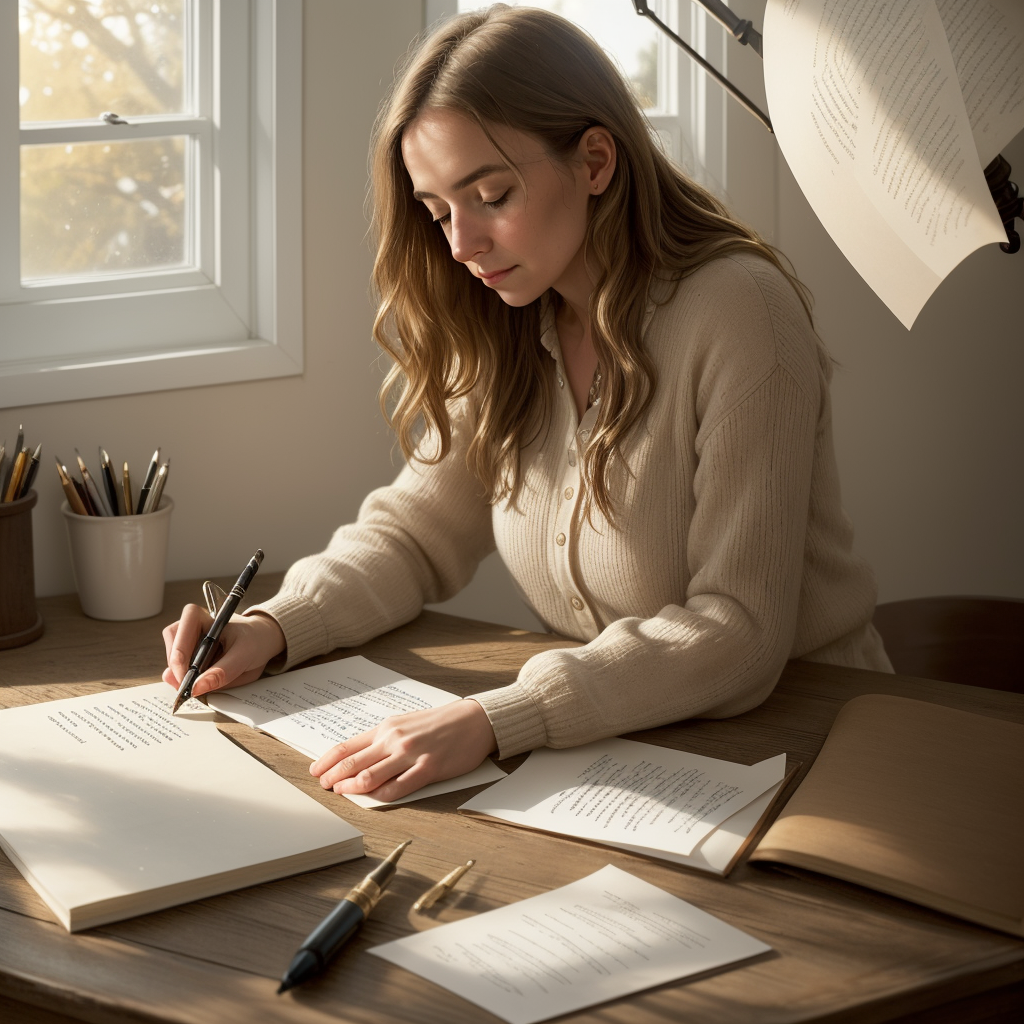
Her business card said “Gratitude Services,” which made people think she ran a meditation studio. In reality, she sat at a weathered oak desk in a sixth-floor walkup on Chicago’s northwest side and wrote thank-you notes for people who couldn’t find the words themselves.
The requests came in all forms. A businessman who’d received a kidney from a stranger. A daughter whose mother had just died, leaving behind sixty years of friendship to acknowledge. A graduate student who’d been awarded a scholarship that changed everything.
They all came to Miriam because they understood something crucial: gratitude was too important to get wrong.
She charged by the letter, not the word. Fifty cents per character. It forced people to be specific about what mattered. “Thank you for everything” was expensive and empty. “Thank you for sitting with me in the hospital on the night I couldn’t breathe” was expensive and true.
Her clients often asked how she learned to do this. The real answer was complicated, but she told them the simple version: she’d been terrible at gratitude for most of her life.
She remembered the scholarship letter that had paid for her last two years of college—read it once, filed it away, never responded. The neighbor who’d fed her cat for a week when her father was dying—a hasty thanks in the hallway, then avoidance from embarrassment. The teacher who’d written a ten-page letter explaining why her writing mattered—she’d kept it, but never acknowledged it until fifteen years later, when it was too late.
That last one had broken something open in her.
Mr. Harrison had died the winter before she finally worked up the courage to write back. The letter was returned, address unknown, forwarding order expired. She’d held that unopened envelope for three days before she could bring herself to open the seal she’d closed too late.
Inside was her original letter, now doubly undeliverable, and a grief that felt like it had weight.
She started the business two months later.
Her method was simple but absolute: she interviewed each client for exactly one hour. She asked them to tell her not what they wanted to say, but what they needed the other person to know they’d noticed.
“What did they do that you saw?” she’d ask. “Not what it meant to you—we’ll get there. What did they actually do?”
A man whose marriage had been saved by a therapist: “She remembered that I said I felt invisible. Every session, she’d start by asking ‘Did anyone see you this week?’”
A mother writing to her son’s teacher: “When my son had that meltdown, she didn’t raise her voice. She just sat on the floor near him—not touching, just near—and waited until he could breathe again.”
A woman whose best friend had shown up after a miscarriage: “She brought me a heating pad and a book, and then she sat in my kitchen without talking. For three hours. She just sat there while I cried, and when I finally spoke, she said ‘I’m still here.’”
Miriam wrote it all down in her careful hand, then she translated their seeing into gratitude.
The letters were never long. A good thank-you note, she’d discovered, was like a good poem: it said exactly enough and not one word more. Her average letter was 312 characters. Fifteen dollars and sixty cents.
Some people thought it was transactional, paying for gratitude. But Miriam understood something they didn’t: her clients weren’t paying her to feel grateful. They already felt it. They were paying her to build a bridge between the feeling and the words, between the noticing and the naming.
She was a cartographer of care, mapping the territory between “you mattered” and “here’s how I know.”
On a Thursday in October, a woman came to her office carrying a shoebox. Inside were forty-three notes written on index cards, each one dated, each one describing something small.
“My daughter wrote these,” the woman said. “Before she died. Little things I did that she wanted to remember. Making her favorite soup when she was sick. Braiding her hair before school. Staying up late to help her practice her presentation.”
The woman’s hands shook as she held the box. “She never gave them to me. I found them in her desk. She was going to—I think she was waiting for the right time.”
Miriam sat very still.
“I don’t need you to write anything,” the woman continued. “I just wanted you to see them. Because you do this work, and I thought—I thought you should know that sometimes people are mapping the gratitude, even if they never deliver it.”
Miriam asked the question she’d learned to ask: “What do you need right now?”
The woman looked at the box, then at Miriam. “I need to know if it counts. If she meant to thank me but died before she could say it—does it still count?”
Miriam thought about Mr. Harrison. About the letter that came back unopened. About fifteen years of silence that felt like theft.
“It counts,” she said. “It counted the moment she noticed. The moment she wrote it down. Every single card is a delivered thank-you note—it just got delivered to a different address.”
The woman closed her eyes.
“She saw you,” Miriam said quietly. “That’s what gratitude is. Not the saying—the seeing. And she saw you forty-three times clearly enough to write it down.”
The woman left the shoebox on Miriam’s desk. “Keep them,” she said. “Not as payment. As proof. Proof that people are grateful, even when they can’t find the words.”
After she left, Miriam read every card.
October 3rd: Made me soup when I had the flu. She added extra ginger, the way I like it.
November 12th: Braided my hair before school picture day. She knows I can’t do French braids.
February 8th: Stayed up until 2am helping me practice my presentation. She had work in the morning.
She added them to her wall, next to her business license and the returned letter from Mr. Harrison.
Evidence that gratitude exists before the thank-you. That seeing someone matters even if you never say so. That the map can exist without the territory being crossed.
But also: that crossing the territory matters. That delivering the map matters. That fifteen years is too long, and tomorrow might be too late, and the only reliable time to say “I saw you, and it mattered” is right now.
Miriam picked up her pen.
She wrote forty-three letters that night—one for each card. Not to the daughter, who couldn’t receive them. To the mother, who’d spent months not knowing if her daughter had seen her at all.
Dear Helen—Your daughter saw you make soup with extra ginger. She noticed. Here’s what that means…
She charged nothing. This was different. This was completing someone else’s unfinished gratitude, delivering mail that had been written but never sent.
When she finished the last letter at 3am, she understood something new about her work:
She wasn’t just writing thank-you notes. She was building evidence that people matter to each other. Proof that we see each other, even imperfectly. Even too late. Even when the words don’t come until someone else helps us find them.
She addressed the envelope to Helen with shaking hands.
Then she walked six blocks in the October cold and dropped it in a mailbox, because waiting until morning felt like waiting too long.
The next day, a new client came in. A young woman who’d been given a second chance by a doctor who’d believed her when others hadn’t.
Miriam asked her question: “What did they do that you saw?”
The woman thought for a long moment. “She listened to me for forty-five minutes without looking at her computer once. She wrote everything down by hand. And at the end, she said ‘I believe you, and we’re going to figure this out.’”
Miriam wrote it down. All of it. Every word.
And then she helped the woman build a bridge between noticing and naming, between the seeing and the saying.
Fifty cents per character. Not because gratitude can be bought, but because precision matters. Because “thank you for everything” is easy and empty, and “thank you for writing everything down by hand” is expensive and true.
Because the territory between feeling grateful and saying so is vast and difficult, and sometimes you need a cartographer to help you cross it.
Because Mr. Harrison never got her letter, but Helen would get all forty-three.
Because tomorrow might be too late, but today is exactly on time.
Miriam charged the woman seventeen dollars for 340 characters.
Then she started writing.
You Might Also Enjoy
Diamond Roads
The smell hits me first. That mix of mustard, onions, and the particular leather-and-dirt scent that means baseball. I follow the seasons like a migrating bird, chasing long days of summer across thirty different ballparks. Seven years wheeling my cart, calling 'Cold beer! Ice cold beer!' The thing about traveling from park to park is that baseball is the same game everywhere, but also completely different. In Boston they sing Sweet Caroline. In Chicago they throw back opposing team home runs. In Nashville they play country music and the barbecue is worth the trip alone. And sometimes you meet another traveler who understands the long arc of the season.
Four Fires, One Warmth
There are four fires in four hearths, in four separate homes, scattered across the geography of a single night. They don't know they're connected. One burns steady in a study. One dances in a kitchen. One flickers as a candle for someone who can't sleep. One roars as a bonfire among friends. Four fires, one warmth.
Still Decorated
Everyone on Maple Street knew Mrs. Kowalski kept her Christmas lights up too long. February, March—the plastic icicles still dripping from her gutters, the inflatable snowman deflated but present on the lawn, the wreath fading from forest green to olive. The HOA had sent letters. The neighbors had opinions. But every year, the lights stayed. Walter had put them up November 28th, 2019. He had his stroke December 3rd. Gone by the 10th. She never took the lights down. 'Those voicemails. They're your lights. Everyone has something they keep past when they're supposed to.'