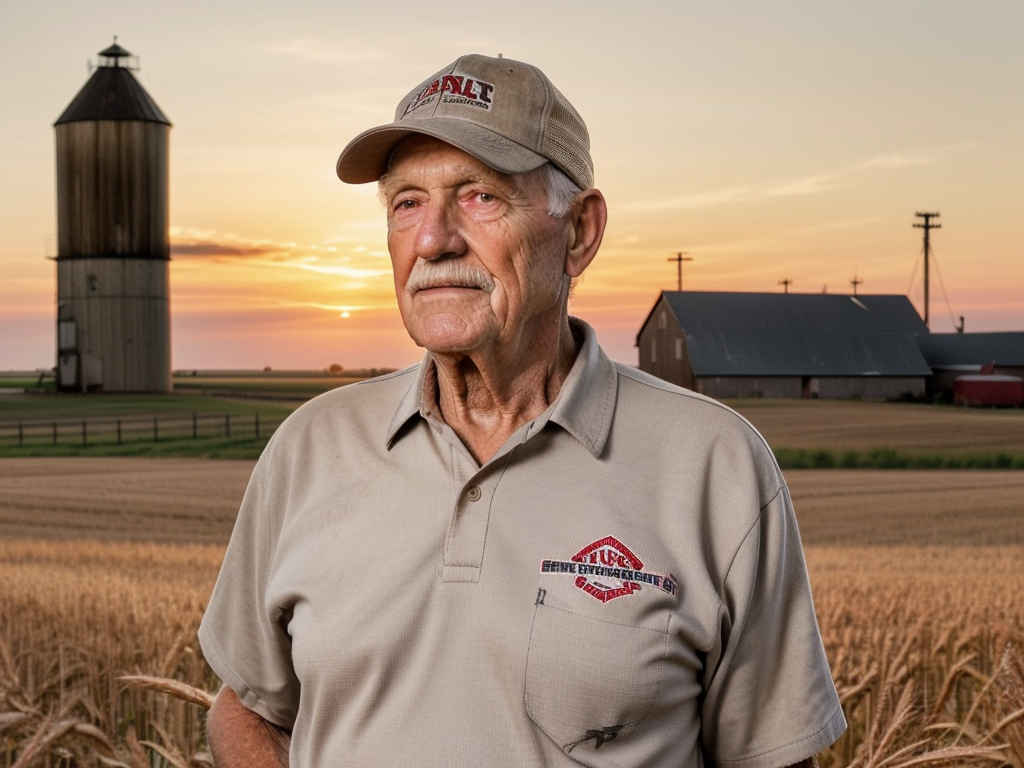
The Grain Keeper
Earl Hendricks had been measuring moisture content in wheat for forty-seven years, and he could tell you to the tenth of a percent just by running a handful through his fingers. This morning, standing in the shadows of the Farmer’s Union elevator that had been his life’s work, he held grain that would never flow through his scales again.
The “For Sale” sign had gone up on the elevator two weeks ago. Earl had been avoiding reading the local paper since then, but Mary had left it open on the kitchen table this morning, folded to the classified section with a circle drawn around the notice in red ink. “Grain Storage Facility and Equipment - Historical Landmark Status - Serious Inquiries Only.”
Historical landmark. At seventy-three, Earl supposed he qualified for that designation too.
He walked the perimeter of the main building, checking the concrete slip-form construction his father had helped pour in 1952. The building was solid—these elevators were built to outlast the towns they served. The steel bins gleamed in the early morning light, still sturdy, still functional. Still empty.
Earl climbed the narrow stairs to the top of the elevator, his daily ritual for nearly five decades. From up here, he could see the entire layout of what used to be Millerville, Nebraska: population 247 and falling. The grain elevator had always been the tallest structure for thirty miles in any direction, a concrete lighthouse marking the spot where the Burlington Northern Railroad had decided a town should exist.
Below him, Main Street looked like a broken smile. The Farmers & Merchants Bank had closed in 2019. Kowalski’s Hardware held on until 2021. The post office now operated three days a week out of the back corner of the Casey’s General Store. Even the Casey’s was talking about pulling out.
Earl’s radio crackled to life. “Earl, you copy?” It was Danny Morrison, one of the few farmers still bringing grain to the elevator.
“Copy, Danny. What’s your twenty?”
“About five minutes out with a load of corn. You ready for me?”
Earl looked down at the receiving pit, at the machinery he’d maintained and operated through three different corporate ownership changes, two major floods, and the gradual hemorrhaging of family farms that had been his customer base.
“Roger that, Danny. Bay three is open for you.”
Earl made his way down to the receiving area, moving with the careful precision of someone who had performed these actions thousands of times. He started up the leg elevator, checked the moisture meters, and positioned the sample probe. The familiar sounds of the machinery filled the morning air—sounds that had been the soundtrack to his entire adult life.
Danny’s truck rumbled into the yard, dust swirling behind it. Earl walked out to meet him, clipboard in hand, same routine as always.
“Morning, Earl.” Danny shut off the engine and climbed down from the cab. “Heard about the sale. That true?”
Earl nodded toward the sign. “Board made it official last week. Numbers just don’t work anymore. Too few farmers, too much grain going straight to the big operations in Grand Island.”
Danny was quiet for a moment, looking up at the elevator. “My dad brought his first harvest here in 1968. I remember riding along, thinking this was the biggest building in the world.”
“Your dad was a good man. Fair dealer, always dried his grain proper before bringing it in.”
They unloaded Danny’s corn in comfortable silence, Earl running samples through his moisture tester, marking weights and moisture content on forms that would be filed in cabinets that might be auctioned off next month. Everything exactly as it had always been, except this might be one of the last times.
After Danny left, Earl walked through the elevator’s interior spaces. The main floor where trucks had backed up to dump grain. The control room where he’d managed the flow of thousands of bushels through the drying system. The office where he’d calculated payments, filled out railroad car manifests, and maintained the careful records that tracked grain from field to market.
On the wall hung a photograph from 1975—the elevator crew during the record corn harvest. Twelve men, including Earl and his father, standing in front of rail cars loaded with grain bound for Chicago. Now it was just Earl and two part-time seasonal workers.
His cell phone buzzed. A text message from his daughter in Omaha: “Dad, I saw the news about the elevator in the paper. You okay?”
Earl typed back slowly, using his index finger: “Doing fine. Just the way things go.”
But that wasn’t entirely true. The elevator closing wasn’t just about economics or efficiency. It was about the death of a way of understanding the world. Earl knew things that couldn’t be googled or downloaded. He could predict the weather by how grain settled in the bins. He could estimate a farm’s financial health by the care taken in cleaning wheat before delivery. He understood the rhythm of seasons through the flow of corn, soybeans, milo, and wheat that moved through his building like a great agricultural heartbeat.
That afternoon, Earl found himself in the empty grain bins, their metal walls amplifying his footsteps into cathedral echoes. He’d spent countless hours in these spaces over the years—inspecting, cleaning, making repairs. The bins were cleaner now than they’d ever been, prepared for sale to someone who might not understand their history.
As evening approached, Earl climbed back to the top of the elevator one more time. The sunset painted the surrounding cornfields gold, and he could see combines working in the distance, harvesting grain that would probably be trucked directly to larger facilities. The familiar rhythm of rural life continuing, just without the heartbeat of his elevator marking time.
His radio crackled again. “Earl?” It was Jenny Patterson, who farmed the section north of town with her husband Mark.
“Go ahead, Jenny.”
“We’ve got about fifty bushels of wheat we’d like to bring in tomorrow. Quality samples for seed. Would that work?”
Earl looked out over the empty landscape, at the railroad tracks that rarely carried grain cars anymore, at the town that was slowly forgetting how to be a town.
“Bay three will be open,” he said. “Same as always.”
Because that’s what grain elevator operators did. They stayed open until the very last load was weighed, tested, and stored. They maintained the bridge between the land and the larger world, handling the precious cargo of seasons and soil and human hope.
Earl Hendricks would measure moisture content in wheat until the day the elevator doors closed for the final time. Not because it made economic sense, but because forty-seven years of service had taught him that some things were more important than profit margins.
The grain would keep flowing, and so would he.
Until it didn’t.
Sometimes the most important work is the work that continues long after it stops making sense to accountants and efficiency experts. Sometimes the measure of a life is found not in what changes, but in what remains constant when everything else falls away.
Earl Hendricks understood this truth in his bones, measured in decades of mornings that began before sunrise and ended with the sound of grain settling into storage, marking time like a heartbeat for a community that had learned to depend on both.

You Might Also Enjoy
Hidden Messages
Sarah ran her fingers along the exposed wall studs, decades of paint and wallpaper finally stripped away. There, carved directly into the wood: Henry + Rose, 1952. A message meant to last.
The Cosmic Lounge: The Mirage Memoirs
Calloway was late. In the seven months since the waystation opened, he'd never been late. But tonight—thirty-six years after he first walked into The Mirage and heard Cher sing—the interdimensional cultural broker was nowhere to be found. When he finally appears, Veronica learns the truth about eighteen years of obsession, impossible distances, and what it means to build something beautiful from inspiration you can never touch.
The Cosmic Lounge
Veronica Hart had been singing in the Piano Bar at Caesars Palace for fifteen years, and she'd seen some weird shit. But the thing at table seven tonight was... different. Every night between 11 PM and 2 AM, her audience changed. Fewer tourists. Fewer locals. More... others. Interdimensional travelers who tipped in impossible currency and made requests like 'Fly Me to the Moon' sung by a species that had actually achieved lunar travel.