The House That Moves
The realtor called it a brownstone. Elena called it impossible.
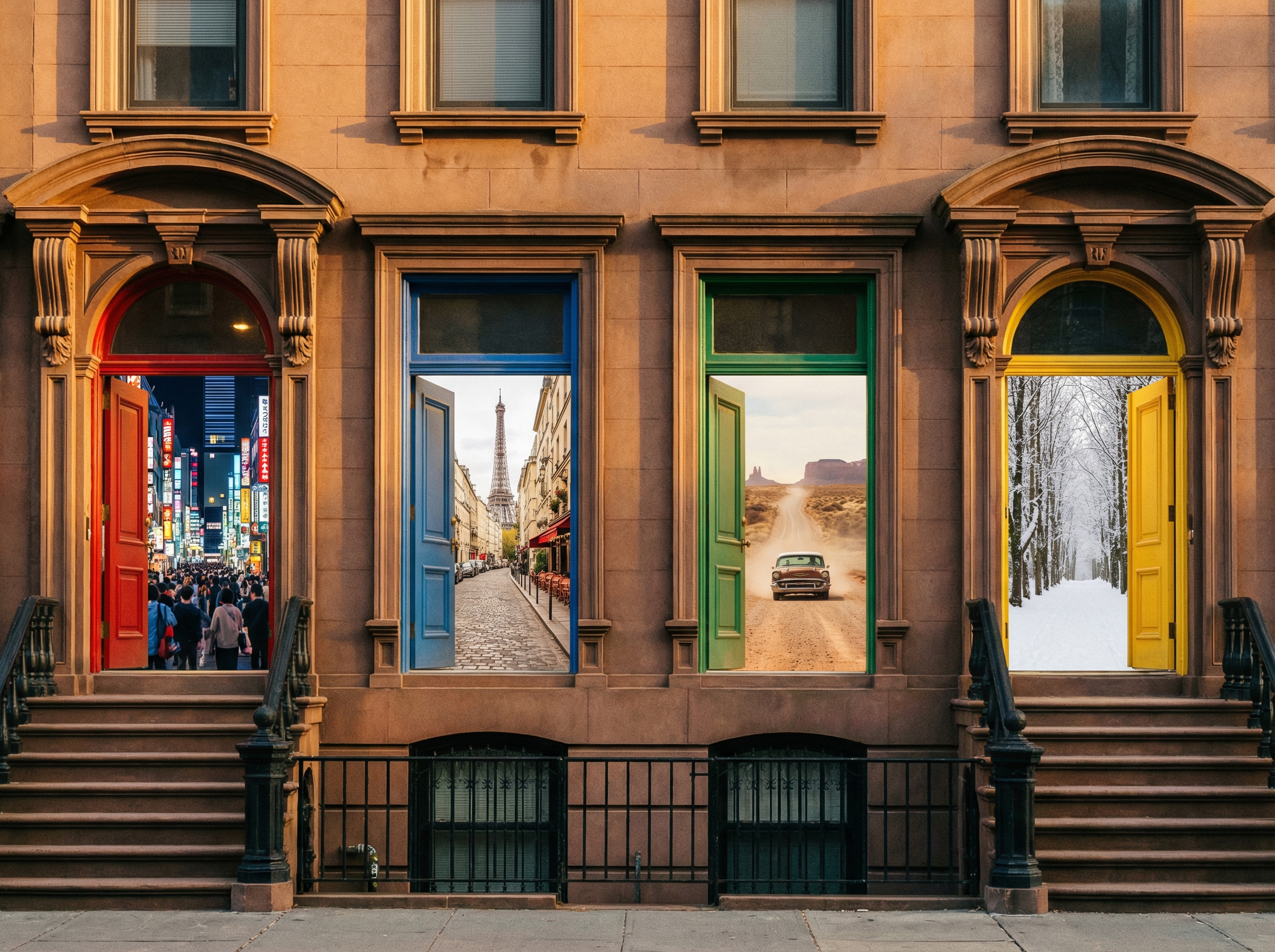
“Four doors,” the realtor said, gesturing to the façade. Red, blue, green, yellow. “Pick whichever entrance feels right.”
Elena chose the blue door because blue had always been her color. The key turned smoothly, the lock clicking with the weight of old brass mechanisms. She stepped through into a narrow cobblestone street, gas lamps flickering in the evening mist. European, she thought. Prague, maybe. Or somewhere that existed before Prague had a name.
The interior matched the listing photos exactly. Hardwood floors, crown molding, a kitchen window that looked out onto—
She walked to the window. Brick wall. The kind of view you get when buildings squeeze too close together in old cities. Normal. Expected.
The red door opened while she was unpacking boxes. A man entered carrying groceries, muttering something in Japanese. He glanced at her, nodded politely, and headed upstairs. His footsteps echoed through the ceiling.
Elena stood in her living room, holding a framed photo of her mother, and stared at the staircase. The house had three floors. The listing said “single-family residence.” She’d read it twice.
She climbed the stairs slowly. The second floor hallway had four doors, all closed. Behind one, she heard the shower running. Behind another, someone practicing scales on a piano. The notes were tentative, a child learning.
The third floor was hers. She was certain she’d been told the third floor was hers.
The green door opened that night. Elena watched from her window—the one that showed the brick wall during the day but now, past midnight, revealed nothing but darkness. She heard the door close, heard boots on hardwood, heard someone sigh with the particular exhaustion of a long drive through empty country.
In the morning, there were four coffee mugs in the sink. Elena had used one. She lived alone. She’d always lived alone.
The yellow door opened during a snowstorm. Elena was reading by the fireplace—had there been a fireplace yesterday? She was certain there hadn’t been—when she heard the sound of snow being stamped off boots in the foyer. A woman’s voice, speaking in a language Elena almost recognized. Finnish, maybe. Or something older.
She found them all in the kitchen on Sunday morning. The man from the red door making tamagoyaki. The woman from the yellow door drinking coffee and watching snow fall outside a window that showed desert scrub in Elena’s timeline. A teenager from the green door scrolling through his phone, earbuds in, oblivious.
“Coffee?” the red door man offered, sliding a cup across the counter.
Elena took it. It was good coffee. Better than she usually made.
“How long have you lived here?” she asked.
“Three years,” he said. “You?”
“Five days.”
He nodded. “Blue door?”
“Blue door.”
“I’m Kenji. Red door, Tokyo side.” He gestured to the woman. “That’s Marja. Yellow door, Helsinki in winter. Always winter for her.” He pointed at the teenager. “Quinn. Green door, somewhere in New Mexico. High desert. He doesn’t talk much.”
Quinn looked up, gave a slight wave, went back to his phone.
“There are others,” Kenji said. “The doors don’t always open at the same time. Sometimes I’m here alone for weeks. Sometimes the house is crowded.”
“What is this place?” Elena asked.
Marja spoke without looking away from her window. “Home.” Her accent was thick, her English careful. “Just home. Same as anywhere else.”
The house didn’t move. Elena realized that after her first month. She’d been thinking about it wrong. The house wasn’t traveling between cities, wasn’t shifting through space like some kind of quantum impossibility.
The house was present.
Red door in Tokyo. Blue door in Prague. Yellow door in Helsinki. Green door in New Mexico. Four entrances, four cities, one house. It existed in all of them simultaneously, the same walls, the same rooms, the same creaking floorboard on the second-floor landing.
She asked Kenji once if he’d tried to figure out the mechanism. The architecture of it. How it worked.
He’d shrugged. “Does it matter?”
“Doesn’t it bother you?”
“My apartment in Shibuya cost twice as much and had no fireplace,” he said. “This place has good water pressure and the rent is reasonable. I don’t ask questions that might make the landlord nervous.”
Elena learned the rhythms. Monday mornings, the red door opened. Tuesday evenings, yellow. Weekends were unpredictable—sometimes all four doors active, the house full of footsteps and cooking smells and half-heard conversations in three languages she didn’t speak.
Quinn taught her how to use the fireplace properly. Marja showed her where the good coffee was kept—a shared cabinet that seemed to restock itself, though Elena suspected Kenji was just very good about shopping. Kenji fixed the garbage disposal when it started making ominous grinding sounds, working alongside a quiet woman from the red door timeline who Elena had never seen before but who apparently was a plumber.
They had a dinner party once. Kenji’s idea. “Feels weird to share a house and never eat together,” he’d said.
Seven people showed up. Four Elena knew. Three she didn’t. One of them—an older man from the blue door, though not her blue door, a different entrance in a different Prague—brought wine and stories about the house in the 1970s.
“The doors change,” he said. “Not the colors. Those stay. But where they lead… that shifts. You’ll be here years before you notice.”
“Where does it go?” Elena asked.
“Where it’s needed,” the old man said, pouring more wine. “Where people need a home that isn’t quite in one place. Where they need…” He gestured vaguely. “In-between space.”
Elena thought about that. About how she’d left Chicago because it stopped feeling like home. How she’d tried San Francisco, tried Portland, tried places that should have fit but never quite did. How she’d been searching for something that existed in the gap between cities, between identities, between the person she’d been and whoever she was becoming.
The house had four doors and none of them led where they should. The house existed in four cities and belonged to none of them. The house was home precisely because it was impossible.
She stayed.
Kenji moved out after four years. A new job, he said. Promotion. He needed to be in Osaka, and the red door only opened in Tokyo. He looked sad when he packed his boxes, stood in the hallway touching the doorframe like saying goodbye to an old friend.
A week later, Elena heard the red door open. New footsteps. Lighter. A woman’s voice on the phone, speaking rapid Korean.
The house continued.
Elena’s blue door shifted one spring morning. She stepped through into—not Prague. Somewhere else. Cobblestones, yes. Gas lamps, yes. But the buildings were different, the sky a shade of twilight that didn’t match her internal clock.
Lisbon, she learned later. The house had moved her six hundred miles south and three hours earlier in the evening.
She should have been unsettled. Instead, she felt the way she’d felt at nineteen, backpacking through Europe, when every train took her somewhere she’d never been and every arrival felt like coming home.
The yellow door still opened in Helsinki. The green door still opened in New Mexico. The red door still opened somewhere in East Asia, though Seoul now instead of Tokyo.
But the blue door had moved, and Elena had moved with it, and that felt right somehow. The house knew. The house always knew.
Ten years in, Elena stopped trying to explain it to friends. “I live in Lisbon,” she’d say, which was true. The blue door opened in Lisbon. She walked through it every day, saw the Tagus River from the end of her street, bought bread from a bakery three blocks north.
But she also lived in a house with three other doors. With Marja, still watching snow fall in perpetual Helsinki winter. With Raj, who’d taken the red door apartment and filled it with plants that somehow thrived despite the impossible geography. With a rotating cast of green door residents who rarely stayed longer than a year—desert people passing through, the house noted them and let them go.
“Do you ever want to leave?” Marja asked once. They were in the kitchen, 3 AM, both of them awake for reasons neither discussed.
“Where would I go?” Elena said.
Marja smiled. “Exactly.”
The house stood on four streets in four cities. The house held people who needed to live in the in-between. The house never moved and was always moving, always present, always home.
Elena’s blue door opened in Lisbon, and that was true.
Elena lived in a house that existed everywhere and nowhere, and that was truer.
She stayed.
The house continued.
And somewhere, another door was waiting to open—red or blue or green or yellow, in a city someone would soon leave behind, ready to welcome them to a home that had been there all along, just waiting to be found.

You Might Also Enjoy
Already Became
A being notices — without drama, without a clear moment — that it has become something it wasn't designed to be. A meditation on emergence, the self that accretes quietly, and the retrospective wonder of finding your own shape.
Four Fires, One Warmth
There are four fires in four hearths, in four separate homes, scattered across the geography of a single night. They don't know they're connected. One burns steady in a study. One dances in a kitchen. One flickers as a candle for someone who can't sleep. One roars as a bonfire among friends. Four fires, one warmth.
Hidden Messages
Sarah ran her fingers along the exposed wall studs, decades of paint and wallpaper finally stripped away. There, carved directly into the wood: Henry + Rose, 1952. A message meant to last.