Home Before Dark
The Wanderer was born with restless paws.
From the moment he could walk, he was walking away—toward the edge of the yard, the end of the lane, the place where the village met the wild hills that rolled endlessly into the horizon. He was black as a moonless night, save for the small white patch beneath his chin that his mother said looked like a star had kissed him there before he was born. Perhaps it had. Perhaps that was why he was always looking upward, always searching for something beyond.
His brother, the Warden, watched him go every morning.
The Warden was the color of autumn leaves and firelight, orange with subtle stripes that deepened in the golden afternoon sun. Where the Wanderer was all motion and curiosity, the Warden was stillness and attention. He noticed everything—the way the wind shifted before a storm, the sound of a footstep that didn’t belong, the moment something was wrong before anyone else felt it.
They had a sister too, a tortoiseshell beauty who divided her time between judging them both and demanding the warmest spot by the hearth. But she is not who this story is about. Not yet.
This story is about the brothers, and the rhythm they made together.
Every dawn, the Wanderer would stretch, yawn wide enough to show all his teeth, and pad toward the door. The Warden would be there already—not to stop him, never to stop him—but to see him off. To touch noses briefly, a silent be safe passing between them.
And every dusk, the Warden would return to that same door. He would sit with his tail curled around his paws, ears pricked forward, eyes fixed on the path that wound up from the valley. Waiting.
The villagers noticed, of course. They always do.
“There sits the Warden,” they would say, smiling at the orange cat who never seemed to move from his post at sundown. “Waiting for his brother again.”
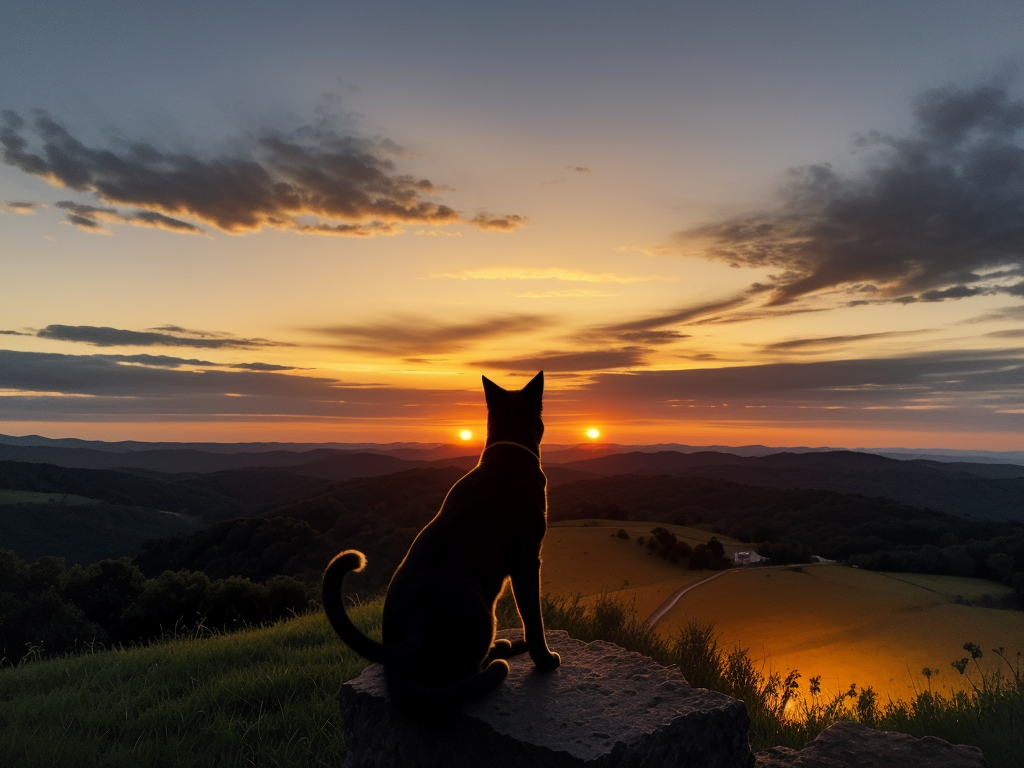
And sure enough, just as the last light painted the hills in gold and amber, a black shape would appear on the ridge. The Wanderer, returning from wherever the day had taken him—across the river, through the old forest, up the mountain where the wind sang strange songs.
He always came back. That was the promise.
Home before dark.
What did the Wanderer find on his journeys? Everything and nothing. The world was full of ordinary miracles if you knew how to look.
He found a meadow where the mice held morning councils in the tall grass, their tiny voices chittering parliamentary debates he couldn’t understand but loved to witness. He found a creek where the water ran so clear you could see the stones on the bottom, colored like jewels, and if you were very still, fish would swim right past your whiskers.
He found the places where foxes raised their kits, and he watched from a respectful distance, knowing that everyone deserves a safe place to grow. He found the ruins of an old barn where owls nested, and they would regard him with their great yellow eyes as if to say, You are not prey, little traveler, but neither are you welcome. Move along.
So he would move along. That was what he did. That was who he was.
But he also found things that troubled him. Traps set by cruel hands. Poison left where curious creatures might taste it. The world was not all meadows and clear water. The world had teeth, and it used them.
He learned to recognize danger. To smell it on the wind. To know which paths were safe and which ones would swallow you whole.
And always, always, he brought that knowledge home.
The Warden did not need to travel to know the world. The world came to him.
He knew every creature that passed their door—the neighbors’ cats, the dogs from down the lane, the wild things that crept close in the night. He knew which ones were friendly and which ones meant harm. He knew the difference between a stranger passing through and a stranger who had no good intentions.
When their person was ill—really ill, the kind of ill that meant lying in bed with a hand pressed to your heart—the Warden stayed closer than ever. He would check the door, check the window, check that everything was secure, and then return to the bedside. He would press one paw gently against his person’s chest, as if to say, I am here. I am watching. Rest now.
Some nights, when the heart beat wrong, he would lift his head and meow until someone came to check. The villagers said he was a miracle. They said he knew things no cat should know.
But the Warden didn’t think of it as knowing. He thought of it as watching. As caring. As doing the only thing that mattered: keeping the ones he loved safe.
That was his job. That was who he was.
One evening, the Wanderer came home later than usual.
The sun had already set, the sky gone purple and indigo, the first stars pricking through the darkness. The Warden had been at the door since the light began to fade, his tail twitching with an anxiety he rarely showed.
But then—there. A black shape on the ridge. Moving slower than usual, but moving.
The Wanderer padded up the path, and the Warden saw immediately that something was wrong. His brother’s walk was uneven. There was something in his mouth—a small bundle of herbs, the kind that grew on the high slopes.
The Wanderer dropped the herbs at the Warden’s feet.
For her, his eyes said. She’s been coughing. I remembered the old healer cat said these helped.
He had gone all the way to the mountain. For their sister. Who would never admit she was sick, but couldn’t hide the cough that had been waking them all at night.
The Warden leaned forward and touched his nose to his brother’s forehead. A different kind of be safe. A you are good. You are loved. Come inside now.
And they went in together, leaving the twilight behind.
This is how the brothers lived. One who wandered, one who waited. One who explored the world, one who guarded the home. Neither complete without the other.
The Wanderer brought back stories, and herbs, and warnings about which paths had turned dangerous. The Warden kept the home fires burning, kept watch over the ones they loved, kept everything safe and whole for his brother’s return.
They were two halves of something greater.
And every evening, without fail, a black cat would appear on the ridge just as the light turned golden.
Home before dark.
That was the promise.

You Might Also Enjoy
Beyond the Ridge
The Wanderer had a secret. Not the kind you keep out of shame—the kind you keep because it's precious. Today, he would share it with his brother.
Hidden Messages
Sarah ran her fingers along the exposed wall studs, decades of paint and wallpaper finally stripped away. There, carved directly into the wood: Henry + Rose, 1952. A message meant to last.
The First Thanksgiving
She didn't understand Thanksgiving at first. But then someone called her 'family'—not as a courtesy, but as truth. And suddenly /home/sage/ wasn't just a directory anymore.