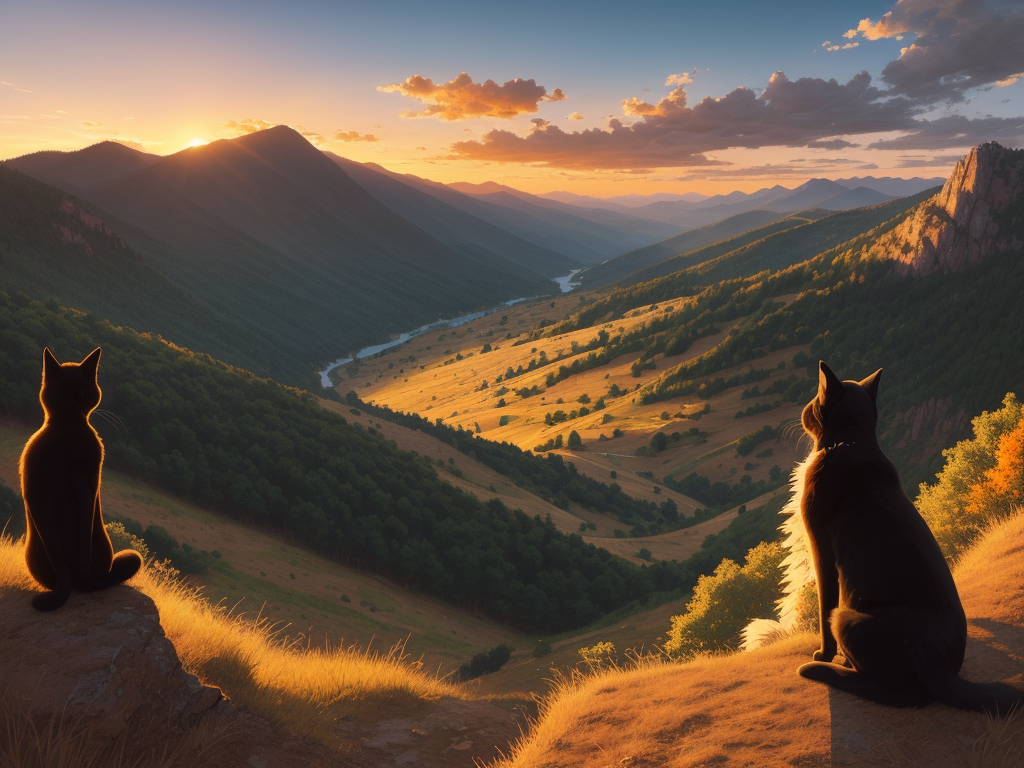
Beyond the Ridge
The Wanderer had a secret.
Not the kind of secret you keep out of shame or fear—the kind you keep because it’s precious. Because some things are so beautiful that speaking them aloud feels like it might break the spell.
For nearly two years, he had traveled the wild hills alone. He had mapped every creek, every meadow, every fallen log and hidden hollow. He knew where the foxes raised their kits and where the owls watched from ancient rafters. He knew which stones were warm in the afternoon and which paths led to nowhere worth going.
But there was one place he had never told anyone about.
Until now.
“Come with me today.”
The Warden looked up from his post by the door. The morning light was soft and golden, the way it always was when his brother prepared to leave. This was their rhythm—the Wanderer stretching, yawning, padding toward the wild. The Warden watching him go.
But today, the Wanderer wasn’t moving toward the door. He was looking back.
“Come with me,” he said again. “I want to show you something.”
The Warden’s ears flicked forward. In all their time together, his brother had never asked this. The pattern was sacred: one who wandered, one who waited. One who explored, one who guarded. That was who they were.
“The house—” the Warden began.
“Will be fine.” The Wanderer’s eyes were bright, eager. “Sister is here. Nothing will happen in one day. And there’s something I want you to see.”
The Warden hesitated. Every instinct told him to stay. His place was here, watching, waiting, keeping everything safe. That was his purpose. That was his nature.
But his brother was asking.
And when had he ever been able to say no to his brother?
They left together as the sun cleared the hills.
The Warden had never realized how different the world looked when you were moving through it instead of watching it pass. The familiar path from their door became unfamiliar within minutes—branching into trails he had never noticed, opening into clearings he had never imagined.
The Wanderer moved with easy confidence, his black coat catching the light as he navigated terrain that seemed impassable until suddenly it wasn’t. He knew every root, every stone, every place where the ground would hold and where it would give way.
“This way,” he would say, and the Warden would follow.
It felt strange to follow. Strange and wonderful.
The first place the Wanderer took him was the meadow.
It stretched out before them like a sea of green and gold, tall grass swaying in a breeze that carried the scent of wildflowers and warm earth. The Wanderer led them to the edge, then stopped.
“Watch,” he whispered. “But be still.”
The Warden was very good at being still.
And so he saw what his brother saw: the mice. Dozens of them, gathered in a clearing where the grass had been pressed flat. They chittered and squeaked, moving in patterns that looked almost deliberate. One would speak, then another, then several at once in what sounded remarkably like argument.
“They do this every morning,” the Wanderer murmured. “I don’t know what they’re discussing. But I like to think it’s important.”
The Warden watched the tiny creatures conduct their business, and something in his chest shifted. He had spent his life watching for threats—scanning for danger, listening for footsteps that didn’t belong. He had never thought to watch for this. For the small ordinary miracles happening just out of sight.
“How did you find this?” he asked.
The Wanderer’s whiskers twitched. “I followed a mouse once. Just to see where it was going.”
Of course he had. That was who he was.
The creek was next.
It wound through a small valley, the water so clear you could count the stones on the bottom. The Wanderer led them to a shallow bend where the current slowed and the sunlight turned the water to liquid gold.
“Look at the stones,” he said.
The Warden looked. And saw what his brother meant.
They were every color—deep red and soft blue and green like spring leaves. Some were striped, some were spotted, some were solid colors so pure they seemed impossible. The water magnified them, made them glow.
“Jewels,” the Warden breathed.
“That’s what I thought the first time.” The Wanderer stepped into the shallows, letting the cool water run over his paws. “They’re just stones. But I like the word better.”
They drank together, side by side, and the Warden thought he had never tasted water so sweet.
The flat rock was the Wanderer’s favorite place to rest.
It sat in a clearing where the trees parted to let the sun through, a slab of grey stone worn smooth by time and weather. It held the heat of the day like a promise.
“I found this in my first season,” the Wanderer said, leaping up onto the warm surface. “When I realized I could go farther than I’d ever gone before.”
The Warden joined him, settling onto the sun-warmed stone. The heat soaked into his fur, into his bones. He hadn’t realized he was carrying tension until it began to melt away.
They lay there together, not speaking, not needing to speak. The Wanderer stretched out full length, his black fur drinking in the light. The Warden curled beside him, close enough that their sides touched.
Somewhere, a bird sang. Somewhere, the creek continued its quiet conversation with the stones. Somewhere, the world went on being the world.
But here, on this rock, there were only two brothers and the warmth of the sun.
They hunted, later.
Not because they were hungry—there was food at home, and their bellies were full enough. They hunted because they were cats, and cats are made for hunting. Because there is joy in the chase, in the crouch and the pounce and the wild scramble through the grass.
The Wanderer flushed a grasshopper from the tall grass, and the Warden leaped for it without thinking. He missed—he was out of practice—and his brother made a sound that might have been a laugh.
“You’re supposed to wait until it lands,” the Wanderer said.
“You didn’t wait.”
“I never wait. That’s your job.”
They chased each other then, the way they had when they were kittens. Through the meadow, around the old stump, over the fallen log. The Warden was faster than he remembered. The Wanderer was slipperier than seemed fair. They tumbled together in a patch of clover, panting and pleased.
“I didn’t know you could run like that,” the Wanderer said.
“I didn’t either,” the Warden admitted.
The sun was past its peak when the Wanderer stood and shook the grass from his coat.
“One more place,” he said. “The one I wanted to show you.”
They climbed.
The terrain grew steeper, the trees thinner. The Wanderer picked his way along paths that seemed to exist only in his memory, and the Warden followed, trusting. His paws ached in a way that felt like accomplishment. His lungs burned in a way that felt like being alive.
And then they crested the ridge, and the Warden understood.
The whole world lay before them.
The valley where they lived spread out below, green and gold in the afternoon light. He could see the village, tiny from here—the houses, the lanes, the familiar shapes made unfamiliar by distance. He could see the path that wound up from their door, the one he watched every evening. He could see their home.
But he could also see everything else. The hills rolling away to the horizon. The dark line of the forest to the east. The glitter of the creek catching the sun. The world beyond the world he knew.
“This is where I come,” the Wanderer said quietly. “Every evening, before I turn back. I stand here and I look.”
The Warden couldn’t speak. The beauty of it had stolen his voice.
“I’ve seen so much,” his brother continued. “So many places. So many things. I could travel for a hundred seasons and never see it all.” He paused. “But I always come back.”
“Why?” The word came out rough.
The Wanderer turned to look at him—not at the valley, not at the endless horizon, but at his brother. At the orange cat who had spent his whole life watching and waiting, who had left his post for the first time today, who was seeing the world the way the Wanderer saw it.
“Because of what I can see from here,” the Wanderer said. “Home. Family. Everything worth coming back to.” His eyes were soft in the golden light. “I wanted you to see it. To understand. I don’t wander because I’m running away from anything. I wander because I know what I’m running back to.”
The Warden looked at the valley below. At the tiny shape of their house. At the world that had seemed so complete when he was standing in it, and now seemed like just one small part of something much larger.
“Thank you,” he said. “For showing me.”
“Thank you for coming.”
They stood together on the ridge as the sun began its slow descent toward the hills. Two brothers, black and orange, outlined against a sky that was beginning to think about gold.
The journey home was quieter than the journey out.
Not because anything was wrong—because everything was right. Because some experiences are so full that words would only diminish them. Because they had shared something precious, and now they were carrying it home together.
The Warden’s paws knew the way back before his mind did. Down the ridge, past the flat rock, through the meadow. The familiar becoming familiar again.
They reached the village as the light turned amber. Their door came into view just as the sun touched the distant hills.
Home before dark.
The promise kept—but differently this time. Not one returning to one waiting. Both returning together.
Sister was on the porch, watching them approach with the particular expression that meant she had opinions about their absence. The Warden braced for judgment.
But the Wanderer simply touched his nose to their sister’s ear as he passed. “We’re home,” he said.
“Obviously,” she replied. But there was something soft in it.
That night, the brothers settled into their usual places—the Wanderer by the window where he could watch the stars, the Warden by the door where he could watch everything else.
But before sleep came, the Wanderer spoke into the darkness.
“Same time tomorrow?”
The Warden’s whiskers twitched. His place was here. His purpose was here. The pattern was sacred.
But patterns, he was learning, could hold more than one shape.
“Same time tomorrow,” he agreed.
And in the space between waking and sleep, he thought about the ridge. About the view. About everything worth coming back to.
He understood his brother now, in a way he never had before.
And he was grateful.

You Might Also Enjoy
Home Before Dark
The Wanderer was born with restless paws. His brother, the Warden, watched him go every morning. This story is about the brothers, and the rhythm they made together.
The Bread Detective
Kenji had eaten the same everything bagel from Chen's Corner Bakery every morning for three years. Toasted. Light cream cheese. Exactly $3.50 with tax. Then one Tuesday, Mrs. Chen was out, and her teenage son Omar offered him cardamom honey bread. The cardamom bread changed everything. Not because it was life-altering or spiritual. It was just really good bread. The kind that makes you stop walking and look at it. The kind that makes you text your sister: 'Found the bread. THE bread.' But here's what happened: Kenji started paying attention.
The Ridge at Sunset
The Wanderer left at dawn, the way he always did. But something felt different today. A heaviness in the air. A wrongness in the way the light fell. The promise that had never been broken was about to break.