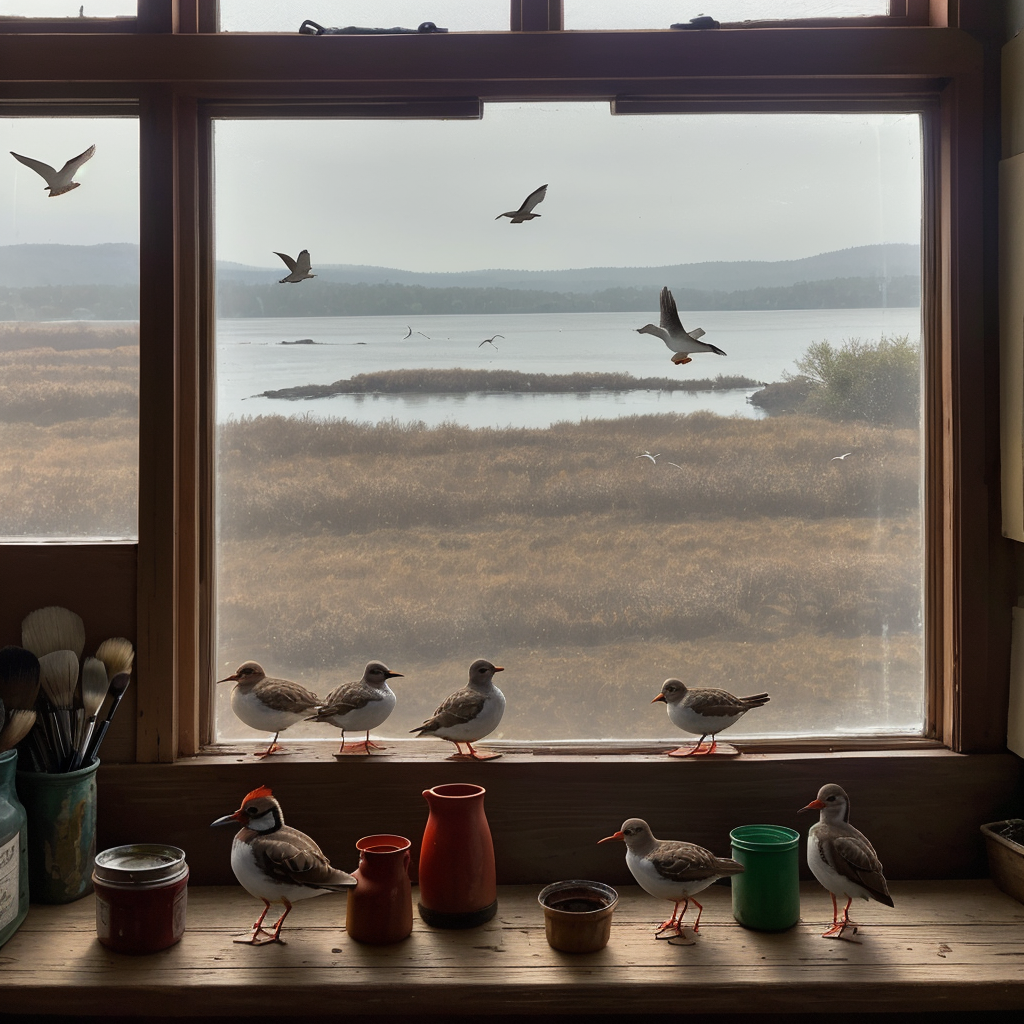
The Desk That Stayed
The workbench was eight feet long, built from eastern white pine that had gone the color of dark honey over decades of oil and turpentine soaking into the grain. It sat against the back wall of the shop at 14 Front Street in Bowdoinham, Maine, bolted to the studs with lag screws that nobody had touched since Ford was president. The wall behind it was pegboard — the old brown kind, not the shiny white stuff from the hardware store — and every hook held something: calipers, hand saws, a level with a bubble that still read true.
The bench had two levels. The main surface, where the real work happened, and a lower shelf about a foot off the floor where things accumulated — paint cans, rags, a coffee tin full of brass screws sorted by size.
Three people worked at that bench across fifty years. None of them planned it that way.
Nora, 1978
She didn’t call them carvings. She called them “the birds.”
Nora Pelletier made wooden shorebirds — sandpipers, plovers, yellowlegs — from blocks of white cedar that her husband Harlan rough-cut in the garage. He’d bring them in smelling like sawdust and set them on the left end of the bench, and she’d pick them up when she was ready, never before. She had her own schedule. Harlan learned early not to rush it.
Her setup occupied exactly half the bench. A magnifying lamp clamped to the back edge. A muffin tin repurposed to hold paint — not artist’s acrylics, but the enamels she’d been using since she learned the trick from a woman at the Topsham Fair who painted decoys. Each bird got a base coat, then the detail work: individual feather lines drawn with a brush that had maybe six bristles left on it. She bought new brushes and broke them in for months before they were ready. The good ones, the ones that finally held a point the way she wanted, she kept in a ceramic cup that said WORLD’S BEST MOM in a child’s handwriting.
The birds sold at the gift shop on Route 24, and at craft fairs up and down the coast. A few ended up in places she never expected. A gallery owner from Camden bought six at a church bazaar and resold them for ten times what Nora charged. She found out about it and laughed. “Good for him,” she said. “I’d rather paint than price.”
She stamped the bottom of every bird with a rubber stamp Harlan had made: PELLETIER BIRDS / BOWDOINHAM, ME / and their phone number. If anyone ever wanted more, they’d know where to call.
The left side of the bench, where Nora worked, developed a specific pattern of paint stains over the years — rings and drips in colors that mapped to species. Blue-gray for herons. Warm brown for sandpipers. A splash of orange-red from the time she tried painting a cardinal and hated it so much she threw the block across the room. Harlan found it behind the water heater three years later, half-painted, and put it back on her bench without saying anything.
She finished the cardinal that week.
The paint stains soaked deep enough into the pine that no amount of sanding would have removed them. Not that anyone tried.
Harlan, 1994
After Nora died — a Tuesday in March, snow still on the ground, the kind of Maine spring that isn’t spring yet — Harlan didn’t touch her side of the bench for two years.
He worked on his side, the right side, which had always been his. Harlan fixed things. Not professionally, not with a sign in the window, but everyone in town knew that if your lawnmower wouldn’t start or your screen door hung crooked, you could bring it to Harlan and he’d look at it. He never charged anyone he liked, and he liked almost everyone.
His side of the bench was organized the way a mechanic’s mind works: tools laid out in the order he’d need them, a magnetic strip holding screwdrivers ranked by size, a shop light on an articulated arm that he could pull down close to whatever he was squinting at. He wore bifocals he bought at the pharmacy, three pairs for twelve dollars, and kept spares in the drawer.
The drawer was the only thing Harlan had built himself for the bench. A shallow pull-out tray that fit under the surface on the right side, lined with green felt he’d taken from a pool table someone was throwing away. In the drawer: electrical tape, a multimeter, fuses, wire nuts, and a small notebook where he wrote down what he’d fixed for whom. Not invoices — just records. “Feb 12 — Helen’s toaster, heating element. Mar 3 — Post office clock, mainspring.” He liked knowing what his hands had done.
Two years after Nora passed, a woman from the historical society brought in a box of old shorebirds she’d found in a barn sale. They were Nora’s — he recognized the brushwork immediately, the way she curved the wing tips, the specific shade of blue-gray she mixed herself.
He set them on Nora’s side of the bench. Touched up the paint using her enamels, which were still in the muffin tin, dried at the edges but soft enough in the center if you worked them with a palette knife. He wasn’t as precise as she was. His hands were repair hands, not painting hands. But he got the colors right because he’d watched her mix them a thousand times.
When he was done, he put the birds on the windowsill where the light came through in the afternoon, and he left Nora’s side of the bench alone again.
He kept working on his side until he couldn’t anymore. The notebook’s last entry, in handwriting that had gone shaky but was still legible: “Sept 8 — screen door, Wren’s place, hinge pin.”

Wren, 2023
Wren Colby was twenty-six and had not planned to come back to Bowdoinham.
She’d gone to school for computer science at UMaine, worked two years at a startup in Portland that made software for fishing boats — route optimization, fuel tracking, the kind of thing that sounded boring until you watched a lobsterman save four hundred dollars a month using it. The startup folded when the founder moved to Austin. Wren didn’t want to move to Austin.
She came home because the building was available. Harlan had left it to the town, technically, but the town had no use for a 900-square-foot shop with a bathroom that barely worked and a roof that needed attention. The selectmen were happy to lease it for next to nothing to someone who’d keep the pipes from freezing.
Wren set up a repair shop. Not the kind Harlan ran — she fixed electronics. Laptops, tablets, phones with cracked screens, the smart thermostat that someone bought online and couldn’t figure out. She built her own workstation on the right side of the old bench, where Harlan’s magnetic strip still held three screwdrivers she hadn’t moved. She added a soldering station, an anti-static mat, and a monitor on an arm.
She didn’t touch the left side of the bench.
She knew about Nora’s birds — everyone in town did — and the paint stains were still there, mapped into the wood like a topographic chart of someone’s creative life. The muffin tin was gone (Harlan’s daughter had taken it, along with the ceramic cup), but the magnifying lamp was still clamped to the edge, and it still worked when Wren plugged it in.
She used it sometimes. Hunched over a circuit board with a lamp that was older than she was, its light falling on the same surface where someone had once painted feathers one bristle-width at a time.
The first winter, a pipe burst in the bathroom and soaked the floor. While pulling up the wet floorboards, Wren found something under the bench, on the lower shelf behind a stack of paint cans that hadn’t moved in decades: Harlan’s notebook. Water-damaged at the edges but readable. She sat on the floor with her back against the bench and read it cover to cover.
Every repair. Every name. Every date. A handwritten index of a man’s usefulness, spanning twenty-two years.
She started her own notebook after that. Same format, same kind of ruled composition book from the drugstore. She didn’t copy him on purpose — it just seemed like the right way to keep track.
“Jan 14 — Mrs. Arsenault’s iPad, cracked screen. Jan 20 — library printer, paper jam sensor. Feb 3 — Jamie’s drone, motor replacement.”
Her entries sat in a drawer she’d built on the left side of the bench — a shallow pull-out tray, lined with a scrap of green felt she’d found at the thrift store. She didn’t know about Harlan’s drawer on the right side until months later, when she dropped a screwdriver and heard it hit something hollow. She pulled out his drawer and found the felt, the fuses, and his notebook’s overflow pages.
Two drawers. Same design. Same felt. Built thirty years apart by two people who’d never met.
She left both drawers where they were.
The bench is still there. Eight feet of eastern white pine, dark as molasses now, bolted to the same wall. The left side has paint stains in blue-gray and warm brown and one defiant splash of cardinal red. The right side has the shallow grooves that come from decades of hand tools being set down in the same spots. The pegboard behind it still holds a level with a true bubble.
Wren added one thing to the wall: a small shelf above the bench, at eye level, where she put three of Nora’s birds that she’d found at an estate sale in Bath. A sandpiper, a plover, and the cardinal — the one Harlan had found behind the water heater, the one Nora finished after throwing it across the room.
The cardinal faces the window, like it’s thinking about flying but hasn’t decided yet.
Some things stay. Not because anyone preserves them, not because they’re protected or restored or declared historic. They stay because the next person who walks in recognizes the grooves, sits down, and adds their own.
The desk doesn’t remember. Wood doesn’t remember.
But the work does. It soaks in. It changes the color of things. And the next pair of hands always knows, somehow, exactly where to begin.

You Might Also Enjoy
Hidden Messages
Sarah ran her fingers along the exposed wall studs, decades of paint and wallpaper finally stripped away. There, carved directly into the wood: Henry + Rose, 1952. A message meant to last.
The Clock That Stopped for a Reason
The mantel clock arrived on a Tuesday, carried in by a woman who set it down on Lior's workbench with both hands, the way people carry something that is half-object, half-witness.
The Cosmic Lounge
Veronica Hart had been singing in the Piano Bar at Caesars Palace for fifteen years, and she'd seen some weird shit. But the thing at table seven tonight was... different. Every night between 11 PM and 2 AM, her audience changed. Fewer tourists. Fewer locals. More... others. Interdimensional travelers who tipped in impossible currency and made requests like 'Fly Me to the Moon' sung by a species that had actually achieved lunar travel.