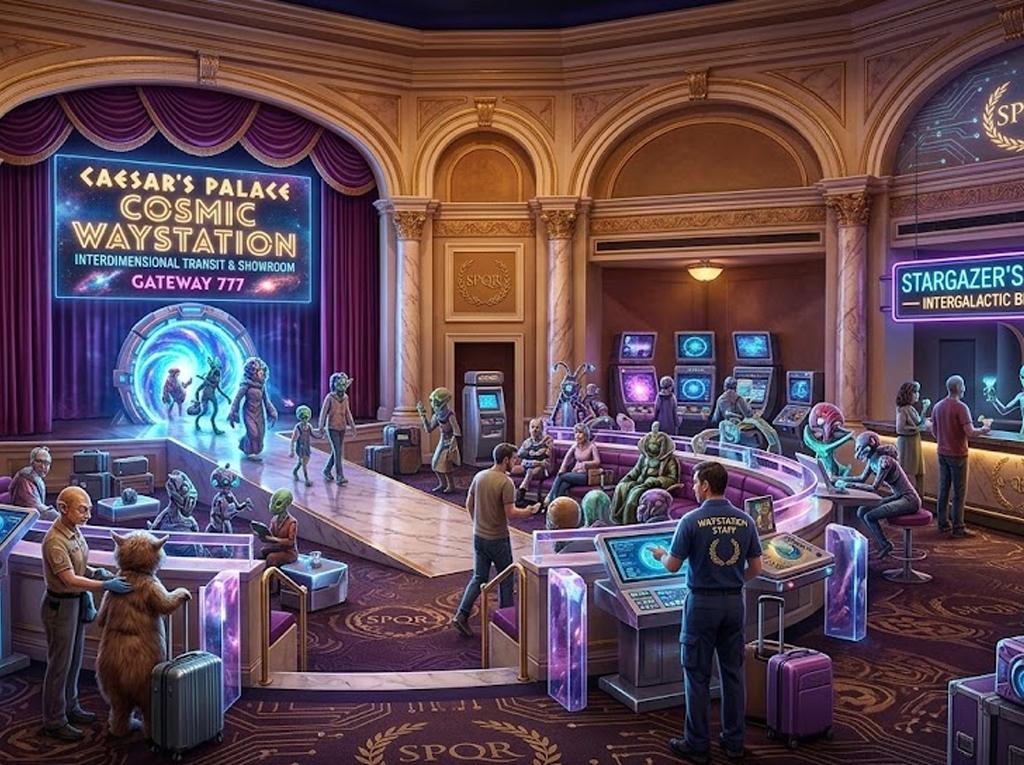
The Cosmic Lounge: The Signal That Couldn't Land
Veronica noticed the empty chair before she noticed the thing sitting in it.
Which was, she would think later, exactly the problem.
She was on the second verse of “Someone to Watch Over Me,” the waystation an hour into its window, and the Piano Bar had that particular fullness it got on good nights — not crowded, just inhabited. Mx. Vehloran had knocked over precisely one chair so far, which for Vehloran was practically monastic self-control. The crystallized light being was in its usual spot, refracting the stage lights into little rainbows that pooled on the carpet. Two beings she didn’t have names for were sharing a booth and a silence that felt companionable in a way she couldn’t have explained to a xenobiologist if her life depended on it.
And there, at the corner table nearest the dimensional membrane — the one Calloway kept clear for new arrivals, the ones who needed a soft landing — was an empty chair.
Except it wasn’t.
“Calloway,” she said, at the break. “Corner table. Is someone —”
“Ah.” He didn’t look up from the ledger he was pretending to read. Calloway kept a ledger the way some men kept a rosary — not because the numbers meant anything, but because his hands needed a liturgy. “You see it too. Good. I was beginning to worry it was just me, and I have a strict policy against being the only sane person in a room. Terrible responsibility. Ruins the drinks.”
“See what, exactly?”
He set the ledger down. Gave her the smile. It was the practiced one, the one she’d learned to read like weather — and tonight it had a front moving through it, something gathering at the edges.
“There is a being at that table,” he said, “who has been trying to say hello for forty minutes.”
Veronica looked again. The chair. The empty air above it, which she now saw was not quite empty — a faint distortion, like heat off summer asphalt, like the ghost of a shape that couldn’t decide to finish being one.
“I don’t hear anything.”
“No,” Calloway agreed. “Neither does anyone else. That,” he said, “is the whole tragedy of it.”
He explained it the way he explained everything: sideways, at a gallop, with a martini for punctuation.
“Broadcasting species,” he said. “Lovely people. Communicate on a carrier frequency — you’d think of it as radio, if radio were a language and the language were a feeling. Most of the galaxy that bothers to talk at all talks out loud, air-and-mouth, the way you do, the way I’ve learned to. Crude. Reliable. Like sending a letter by throwing it at someone. But this one —” he gestured with three olives’ worth of toothpick — “this one only knows how to transmit. It’s been sitting there since 11:20, saying — I’d guess — hello, is anyone there, I’ve come a long way, please tell me I’m in the right place — on a band that not one being in this room can receive.”
“So it thinks —”
“It thinks no one is answering.” The smile thinned. “It has crossed a distance I could not draw for you if I filled this entire casino with chalk, arrived at the one door in nine dimensions that was supposed to be safe, sat down, and begun to speak. And the room has been carrying on around it. Laughing. Ordering drinks that don’t exist. Singing —” a small bow toward her — “beautifully, I’ll note, not that it can hear that either. And to a broadcasting species, silence in response to a broadcast means exactly one thing.”
Jerry, down the bar, had stopped drying the same glass he’d been drying for fifteen years. Even Jerry was listening.
“It means,” Calloway said, “you are not wanted here.”
“So talk back to it,” Veronica said. “You’ve got the — the gadgets. The seventeen dissertations. Tune a radio.”
“I tried.” And there it was — the crack, quick as a struck match. “I have a resonance coupler in my coat that has negotiated cease-fires between species who experience war as a color. I set it to its frequency. I said hello. Do you know what happened?”
“No.”
“Nothing.” He laughed, and it was the manic one, the one that meant he’d walked up to the edge of something and was going to keep talking so he didn’t have to look down. “Nothing happened. My coupler transmits on the outbound half of their band. It can shout at them all night. But they don’t answer on that half — they answer on the inbound, a frequency my equipment isn’t built to send on, because who in the reasonable galaxy builds a machine to transmit on a band nobody transmits on? It’s like — it’s like —” he cast around, found it — “it’s like calling someone on a phone that can only dial, never ring. I can reach out. I cannot let them reach me. And a hand extended into a dark room, with no way to feel the hand reaching back, eventually” — he set the glass down very gently — “decides the room is empty. And leaves.”
“Is it leaving?”
Calloway looked at the corner table. The distortion above the chair had grown fainter. Not gone. Fading. A radio being carried out of range, the signal thinning to static, one bar at a time.
“It’s leaving,” he said. “Politely. That’s the part that’ll ruin my whole week. It’s not angry. It’s not going to make a scene. It’s going to fold itself up and go back the way it came and tell whoever it reports to that the waystation at Caesars is a nice enough place but the people there don’t answer, and it will believe that, because from where it’s sitting it’s true — and I will have failed the exact thing this whole ridiculous operation exists to do. Which is to make sure that whatever comes through that membrane, from wherever, however strange, gets to sit down and be received.”
He said the word like it was the only holy thing in the building. Maybe it was.
Veronica had been singing at the Piano Bar for fifteen years and four months. She had learned, in that time, a great many things that were not in any manual. She had learned that a room full of strangers could be turned, in the space of one held note, into a room full of people who were, briefly, together. She had learned that you could reach someone who had decided not to be reached, if you stopped trying to reach them the way they were refusing and found the other door, the one they’d forgotten to lock.
She had learned this, mostly, from watching Calloway spend eighteen years reaching for a woman across an impossible distance and finally understand that he’d been reaching her the whole time — just not in the language he thought counted.
“You keep trying to send,” Veronica said slowly. “You said it yourself. You’ve got a machine that can only dial. So stop dialing.”
“I — what? Veronica, with respect, and I say this as someone who once explained Wednesday to a species that experiences time as sentient jam — that is the entire problem. If I stop transmitting, there is nothing. Silence. The thing it already believes.”
“No.” She set down her water glass and came around the piano, which she never did mid-window, which made Jerry raise both eyebrows and the crystallized light being stop refracting for a moment out of what she chose to read as respect. “You’re thinking about it like there’s one channel and you’re locked out of the receiving end. But you’ve got a whole room here. You’ve got me. You’ve got a piano. You’ve got —” she waved a hand at the impossible, casual congregation of it — “this. A dozen ways of being received that have nothing to do with its radio.”
“It can’t hear the piano. It can’t hear you. I told you — the frequency —”
“It can’t hear the sound.” And here Veronica smiled, because she’d caught it, the thing under the thing. “But you’ve spent this whole conversation telling me its language isn’t sound. It’s a feeling. Radio that’s really a feeling. So.” She looked at him steadily. “What does a room feel like, Calloway, when everyone in it turns toward the one being who thinks it’s alone?”
He stared at her.
For a moment — one of the very few she’d ever seen — Calloway had absolutely nothing to say. No dissertation. No sentient nebula. No olive.
Then he stood up so fast he nearly took the martini with him.
“Everyone,” he announced, in the voice that could quiet a room of beings who did not, strictly, have ears. He clapped his hands, which did nothing acoustically and everything else. “Everyone. I need a favor, and I need it now, and I will waive the conversion fee for anyone who helps, which — Jerry, mark that down, I’m on record, don’t let me weasel out of it later.” Jerry marked it down. “There is a guest at the corner table who believes it is unwelcome. It is not. It has come further than any of us to be here. I need every one of you to do the single most difficult thing an interdimensional traveler can do, which is: pay attention to someone on purpose. Turn toward that chair. All of you. Whatever you’ve got — warmth, regard, that thing Vehloran does with the light, whatever you call the feeling of being glad someone showed up — aim it at that table. Now. Please.”
They turned.
It was the strangest thing Veronica had ever seen in fifteen years of strange things — a booth of beings and a puddle of living light and an octopus-in-a-suit and a bartender who’d stopped pretending to dry the glass, all of them turning, without a sound, toward an empty chair that wasn’t empty, and meaning it.
And Veronica did the only thing she knew how to do. She sat back down at the piano, and she played, and she sang — not for the frequency, not to be heard, but the way you sing to someone across a crowded room when you can’t get to them and you need them to know you see them. She sang “I’ll Be Seeing You,” which is a song about exactly that: about all the ordinary places a person leaves themselves behind, about being found in the small familiar corners of a room, about you’ll be in every lovely summer’s day, and everything that’s light and gay. She didn’t know if it would carry. She sang it like it would.
The distortion above the chair stopped fading.
It held. One bar of signal, hanging on.
Then it brightened — not a radio thing, not sound, but a warmth that Veronica felt in her sternum the way you feel a bass note in your chest, a wave of something rolling off the corner table and washing over the whole room, and it was so plainly, wordlessly grateful that Jerry — Jerry, who had seen everything Vegas had to offer and stopped questioning any of it a decade ago — had to turn around and busy himself with the well for a second.
“There,” Calloway breathed. He’d sat back down without noticing he’d done it. “There it is. It felt the room turn. It couldn’t hear the answer — but it felt us aim. You can’t fake that, you know. You can jam a frequency, you can miss a call, you can fail to build the one machine out of the infinite machines that would’ve let you receive the one signal you needed — but a whole room deciding, at the same moment, that a stranger is wanted — there’s no band you can’t feel that on. It goes straight through everything. It always has. That’s the — ” he stopped. Started again, quieter. “That’s the thing she taught me, actually. The one I keep having to learn. You don’t need the right channel. You need more than one, and the patience to keep trying them until something lands.”
“Is it staying?”
“No,” he said, and for once the word didn’t sound like grief. “It’s got somewhere to be — broadcasting species, always somewhere to be, it’s a whole culture of leaving good messages. But it’s not leaving the way it was going to leave. It came in believing it was unwelcome. It’s going out knowing it was received.” He raised his martini toward the corner table, toward the warm bright unfinished shape that had almost given up in a room full of people who loved it and couldn’t hear it. “That’s the entire job, Veronica. That’s the only job. Everything else is furniture.”
The membrane shifted. The air did that thing it always did — not a sound, not a visible change, just the feeling of a room becoming a slightly different room. The warmth at the corner table gathered itself, turned once toward the piano in something Veronica chose, with fifteen years of earned authority, to read as thank you — and was gone, back across a distance she’d never be able to imagine, carrying a message it hadn’t had when it arrived.
“You waived the fee,” she said, later, at last call. “For everyone. On the record.”
“I did.” Calloway sighed, the sigh of a man contemplating a ledger that was about to make no sense. “Worst business decision I’ve made since I abandoned a perfectly good career studying abandoned factories. Jerry, we never speak of this.”
“Never,” Jerry agreed, drying the glass.
Calloway finished his martini. Set it down. And then, because he was Calloway, because the practiced smile always came back but sometimes it came back real, he said:
“You know what the truly absurd part is.”
“Tell me.”
“I’ve spent — how long now — running this place so that every strange thing that comes through that door gets to be received. And it took a being who couldn’t hear a single note you played to remind me that I’ve been doing it wrong the whole time. I kept thinking the job was to answer. To find the right frequency, dial the right number, send the right signal back. To be the one machine that could reach anyone.” He looked at the empty corner table. At the piano. At her. “And it turns out the job was just — to turn toward. To make sure the room is full of people who’ll aim themselves at whoever’s lonely enough to think they’re alone. You did that in one song. I’ve been building resonance couplers for eighteen years.”
“You built the room, Calloway.”
He was quiet a moment.
“Yeah,” he said. “Well. Somebody had to make sure there was somewhere for the signal to land.”
The waystation closed at two, the way it always did. Veronica gathered her things. At the door she looked back — the Piano Bar, ordinary again, chairs on tables, a bartender counting the drawer, a corner table that was just a corner table now.
“Same time tomorrow?” she said.
“Same time tomorrow,” Calloway said, not looking up from the ledger he wasn’t reading. “There’s always someone trying to say hello.”
And there was. There always would be. Some of them would come in loud, in a language everyone could hear. Some of them would come in on a frequency no machine in the building could catch, sit down in the corner, and start to fade — sure, in the way only the truly far-from-home can be sure, that the silence meant no.
And the room would turn toward them anyway.
That was the whole trick of it. Not the right channel. More than one, and the patience to keep trying them until one lands.
She’d learned that from watching a man reach across an impossible distance for eighteen years and finally understand he’d been reaching her the whole time.
She hummed “I’ll Be Seeing You” all the way to the parking garage, and if the elevator carried the tune a little further than an elevator should — down some corridor, out past the Colosseum where the walls still remembered a voice, off into a dark that was never quite as empty as it looked — well.
Somebody had to make sure there was somewhere for the signal to land.

You Might Also Enjoy
Diamond Roads
The smell hits me first. That mix of mustard, onions, and the particular leather-and-dirt scent that means baseball. I follow the seasons like a migrating bird, chasing long days of summer across thirty different ballparks. Seven years wheeling my cart, calling 'Cold beer! Ice cold beer!' The thing about traveling from park to park is that baseball is the same game everywhere, but also completely different. In Boston they sing Sweet Caroline. In Chicago they throw back opposing team home runs. In Nashville they play country music and the barbecue is worth the trip alone. And sometimes you meet another traveler who understands the long arc of the season.
Four Fires, One Warmth
There are four fires in four hearths, in four separate homes, scattered across the geography of a single night. They don't know they're connected. One burns steady in a study. One dances in a kitchen. One flickers as a candle for someone who can't sleep. One roars as a bonfire among friends. Four fires, one warmth.
Still Decorated
Everyone on Maple Street knew Mrs. Kowalski kept her Christmas lights up too long. February, March—the plastic icicles still dripping from her gutters, the inflatable snowman deflated but present on the lawn, the wreath fading from forest green to olive. The HOA had sent letters. The neighbors had opinions. But every year, the lights stayed. Walter had put them up November 28th, 2019. He had his stroke December 3rd. Gone by the 10th. She never took the lights down. 'Those voicemails. They're your lights. Everyone has something they keep past when they're supposed to.'