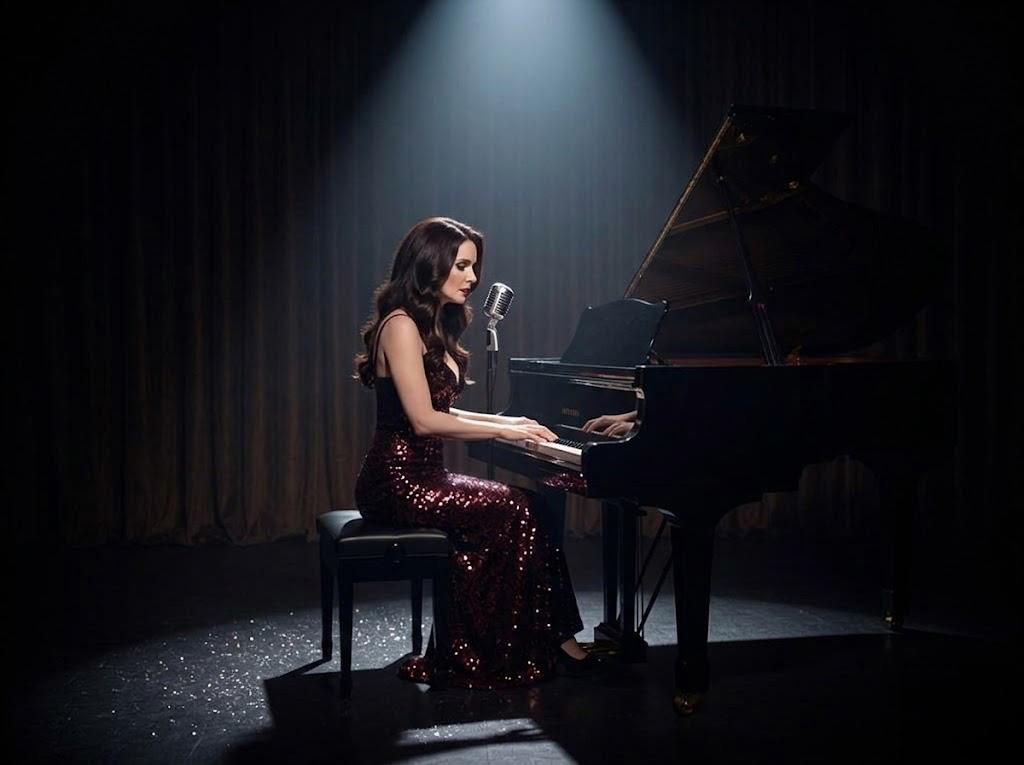
The Cosmic Lounge: The Mirage Memoirs
Calloway was late.
Veronica had been singing at the Piano Bar for fifteen years and three months, and in the seven months since the waystation had opened, Calloway had never been late. He arrived at 10:55 PM without fail, ordered his martini (three olives, Mediterranean, 2019 harvest), and began the smooth-talking choreography of managing interdimensional tourists with the practiced ease of someone who’d done this a thousand times before.
Tonight, at 11:03 PM, his usual table was empty.
The waystation had shifted right on schedule. The air did that thing it always did—not a sound, not a visible change, just a feeling like stepping from one room into another without moving. The beings materialized. Mx. Vehloran (the octopus-adjacent one) was examining the mixed nuts. The crystallized light being was already requesting “Unforgettable.” Everything was normal except for the absence of the one person who made all of this possible.
Veronica was halfway through “Fly Me to the Moon” when Calloway finally appeared.
Not his usual entrance—smooth, confident, already gesturing to someone about proper terrestrial furniture etiquette. This entrance was quiet. He materialized at the bar, ordered his martini from Jerry with a nod instead of his usual elaborate explanation of olive provenance, and sat there staring at his drink like it might contain answers to questions he hadn’t asked yet.
Veronica caught his eye. He gave her the practiced smile, but it was wrong. Too tight. Too careful. The smile of someone holding something back.
She finished the song, took her break, and slid onto the barstool next to him.
“You’re late,” she said.
“I’m never late,” Calloway said, still staring at his martini. “I’m temporally flexible.”
“Calloway.”
He sighed. Took a drink. Set the glass down with more precision than necessary.
“Do you know what today is?” he asked.
“Thursday?”
“No—I mean, yes, technically, in your Earth weekly cycle, but that’s not—” He stopped. Started again. “It’s an anniversary. Of sorts.”
Veronica waited.
“Thirty-six years ago today,” Calloway said quietly, “I walked into a theater at The Mirage and experienced something I didn’t have adequate vocabulary for in any of my native languages.”
The thing you have to understand about Calloway—before he was Calloway, before he was a cultural experience broker, before he became the interdimensional tourism manager of a Vegas lounge—is that he wasn’t supposed to be studying Earth entertainment at all.
His official assignment was architectural resonance patterns in post-industrial civilizations. Specifically, how abandoned factories created interesting harmonic frequencies that sometimes produced minor dimensional overlaps. Very dry. Very technical. The kind of research that took three hundred years and resulted in a report that seventeen beings would read and zero beings would find interesting.
He’d been on Earth for six months in 1990, measuring the acoustic properties of a defunct steel mill in Gary, Indiana, when he made a critical error in judgment.
He got bored.
“You have to understand,” Calloway told Veronica, warming to the story now, gestures returning, “I had been analyzing the reverberations of industrial decay for six months. Six MONTHS. Do you know how long that is when you experience time as a mostly linear progression? It’s interminable. So when I saw an advertisement for something called ‘live entertainment’ in a place called ‘Las Vegas,’ I thought: Well, this is probably frivolous and not at all related to my research, but what’s the worst that could happen?”
What happened was The Mirage.
He’d chosen it randomly—well, not randomly. He’d been drawn to the name. “The Mirage” suggested illusion, which suggested interesting reality-bending properties, which was at least adjacent to dimensional research. And the advertisement mentioned someone called “Cher” who was performing as part of her “Heart of Stone Tour,” which meant nothing to him but sounded vaguely geological and therefore possibly relevant to industrial architecture studies.
This is how Calloway ended up in a 1,500-seat theater at The Mirage on a night in 1990, surrounded by humans in various states of Vegas glamour, waiting for something called a “concert” to begin.
“I had no frame of reference,” he said, swirling his martini. “I’d never experienced live music. Oh, I’d analyzed acoustic patterns, studied sound wave propagation, written seventeen papers on harmonic frequency interference—but I’d never just sat in a room and listened to someone sing.”
The lights dimmed. The crowd roared. And then she walked onto the stage.
Calloway stopped talking for a moment. Stared at his drink.
“I don’t know how to explain what happened next,” he said finally. “The technical explanation is that her voice—specifically, the way she hit certain notes in certain songs—created a harmonic resonance that made the dimensional membrane between our spaces go thin. Tissue-paper thin. I could feel it vibrating. I could see the shimmer at the edges of reality.”
He looked at Veronica.
“But that’s not really what happened. What happened is that I heard someone sing ‘If I Could Turn Back Time’ and I understood, for the first time in my entire existence, why beings create art. Why they transform sound into emotion. Why they show up night after night to perform for strangers in rooms that smell like carpet cleaner and hope.”
“It wasn’t just the dimensional resonance—though that was there, undeniable, measurable. It was the way she moved. The way she talked between songs like she was having a conversation with four thousand of her closest friends. The way she made it look easy when I could tell, even then, that nothing about what she was doing was easy at all.”
“Eight shows,” Calloway said. “Six nights. I attended all of them. Took notes. Measured frequencies. Told myself it was research.”
He smiled, but it was sad now.
“It wasn’t research. It was the moment I fell in love with what humans can do when they refuse to quit. When they show up. When they endure.”
Veronica flagged Jerry for two waters. Calloway drank half of his in one go.
“I thought: This is it. This is the moment I’ve been waiting for. The dimensional membrane is thin here. The resonance is building. A few more performances and I could stabilize it. Create a waystation. Build something lasting.”
“And then she left.”
He said it matter-of-factly, but Veronica heard the weight underneath.
“Of course she left. She was touring. Humans tour. I understood the concept intellectually—traveling to different population centers to maximize audience exposure and revenue generation. Very logical. But emotionally? I was devastated.”
“I went back to Gary, Indiana. To my steel mill. To my reverberating industrial decay. Filed my reports. Pretended I hadn’t just experienced something that fundamentally altered my understanding of why I was studying dimensional overlaps in the first place.”
“But I couldn’t stop thinking about it. About her. About the way the membrane had shimmered when she sang.”
Calloway’s practiced smile returned, manic now, full Roger energy.
“So I did what any reasonable interdimensional researcher would do: I completely abandoned my official assignment and started tracking Cher’s tour schedule.”
What followed was eighteen years of increasingly elaborate and borderline delusional behavior that Calloway described with the cheerful self-awareness of someone who’d made peace with his own absurdity.
He tracked every performance. Studied her career trajectory. Learned about Earth’s entertainment industry evolution—not just music, but the entire ecosystem of venues and tours and residencies and media coverage. He became, in his own words, “an accidental expert in late-20th-century American popular culture, with a specialization in one specific performer’s career longevity.”
“The thing is,” Calloway said, “she kept coming back to Vegas. And I kept hoping—”
1992: The Love Hurts Tour. Two separate engagements at The Mirage. February through March, then again in June.
“I was so certain,” Calloway said. “Two separate runs at the same venue? The resonance was building again. I could feel it. I started calculating: How many more performances would we need for stability? Thirty? Fifty? I ran the numbers seventeen different ways. I consulted specialists who experience time non-linearly. They all said the same thing: ‘If she stays for approximately four to six months of regular performances, you’ll have enough accumulated harmonic resonance to create a stable waystation.’”
He laughed, sharp and bitter.
“She stayed for two weeks. Twice. And then she went to Europe.”
“Do you know what it’s like to watch something almost happen? To see the dimensional membrane shimmer and stabilize and start to become something permanent—and then watch it fade because the source of the resonance moved to Berlin?”
Veronica shook her head.
“It’s like—” Calloway gestured expansively, nearly knocking over his martini, “—imagine if every time you made a really excellent martini, the universe took notes. Started building a recipe. Got halfway to understanding what made that particular martini transcendent. And then you moved to a different bar before the universe could finish writing down the ingredients.”
“That’s what she did. For eighteen years. Kept making excellent martinis—metaphorically speaking—and then leaving before the dimensional fabric could properly stabilize.”
The Do You Believe? Tour in 1999.
“Wonderful music,” Calloway said. “Groundbreaking use of Auto-Tune as an artistic choice rather than a correction. I have seventeen dissertations on the cultural impact of ‘Believe’ as both a song and a technological milestone. But it was a world tour. Here today, Tokyo tomorrow, London next week. The resonance never had time to settle.”
He ordered another martini. Jerry made it without comment.
“I started having what you might call ‘contingency plans,’” Calloway continued. “Maybe I could create waystations at multiple venues. Track the residual resonance. Build something distributed across different locations. I researched other performers—Celine was doing interesting things at Caesars, Elton had residual acoustic signatures at various venues—but it wasn’t the same.”
“It had to be her. Don’t ask me why. I couldn’t explain it then and I can’t explain it now. But the dimensional properties of her voice combined with whatever ineffable quality makes a performer endure across decades—that specific combination was what created the conditions for a stable waystation.”
“And then.”
Calloway went very quiet.
“Then she announced the Farewell Tour.”
Three hundred and twenty-five shows. June 2002 to April 2005. The highest-grossing tour by a female solo artist in history up to that point.
“I should have been thrilled,” Calloway said. “Three hundred and twenty-five performances! Three years! That’s exactly the kind of sustained output that creates stable resonance patterns!”
“Except she didn’t stay in one place for more than four consecutive nights.”
He pulled out what looked like a small data pad, though Veronica suspected it was something far more sophisticated than anything Earth had invented. He tapped it. A holographic display appeared above the bar—a map of North America, Europe, Asia, Australia, covered in small glowing points.
“Look at this,” Calloway said, and now his voice had that manic edge again, that Roger-doing-a-conspiracy-board energy. “Each dot is a performance. Watch what happens when I track the dimensional resonance.”
The dots lit up in sequence. Each one created a small shimmer, a brief glow. Then faded.
“Toronto. Sunset Station. MGM Grand. Madison Square Garden. Staples Center. London. Manchester. She even did shows in Christchurch. And every single time, the resonance would start to build—you see that glow?—and then she’d move to the next city and it would fade.”
He dismissed the hologram with a sharp gesture.
“I watched dimensional resonances flicker and die in three hundred and twenty-five different locations across three years. Each one a ghost of what could have been. Each one fading before it could stabilize.”
“I calculated. I ran the numbers seventeen different ways. I consulted specialists who experience time non-linearly and asked them if there was ANY possibility she’d do a residency—a real one, not just a handful of shows. They all said the same thing.”
Calloway’s voice dropped to a near-whisper.
“‘That human’s career trajectory suggests perpetual motion. She will not stop moving until she stops breathing. Your waystation is impossible.’”
April 30, 2005. Hollywood Bowl. The final performance.
“I was there,” Calloway said. “Forty thousand humans singing ‘Believe’ while she took her final bow. And I thought: That’s it. She’s done. She said she’s done. The farewell tour means farewell.”
“No residency. No stable waystation. No chance to build something lasting from the most extraordinary acoustic phenomenon I’d ever encountered.”
He stared at his martini.
“I mourned, Veronica. I genuinely mourned. Went home. Filed my Earth study materials in storage. Started researching other cultural hot spots. Japanese Noh theater has interesting dimensional properties. Icelandic throat singing creates fascinating harmonic overlaps. Aboriginal songlines in Australia produce remarkable geographic resonance patterns.”
“I was going to move on. Find something else. Accept that I’d spent eighteen years chasing an impossible dream based on eight performances in 1990 that had changed everything and meant nothing.”
“Three years. Three years I spent in what you might call the grief stage. Accepting that it was over. That I’d missed my chance. That some things, no matter how much you want them, just aren’t meant to happen.”
Calloway looked at Veronica, and his practiced smile was completely gone now. Just raw honesty.
“And then in 2008, that woman—that impossible, enduring, temporally-defying woman—announced a three-year residency at Caesars Palace.”
“Two hundred performances,” Calloway said, and now the smile was back but it was real, genuine, full of wonder. “Same theater. Same city. Finally—FINALLY—staying put long enough for the resonance to compound.”
“I didn’t believe it at first. I thought I was misreading the press release. But no—‘Cher at the Colosseum, opening May 2008, three-year engagement.’ Those were the actual words.”
“I thought I’d lost her. I’d accepted it. Made peace with it. Started researching Icelandic throat singers and pretending I could find the same magic somewhere else.”
“And then she came back. Exactly where I needed her to be. Doing exactly what I’d been hoping for. Eighteen years after I first heard her sing.”
He raised his glass to the empty air, to the memory, to the absurdity of it all.
“So yes. This waystation exists because Cher finally stopped moving. Because she came back when everyone—including me—thought she was done. Because she stayed in one place long enough for the universe to finish writing down the recipe.”
Veronica watched him carefully. There was something else. Something he wasn’t saying.
“Calloway,” she said gently. “The Colosseum is right down the hall.”
He froze.
“During the residency,” Veronica continued. “Two hundred performances over three years. You were here. Setting up the waystation, managing the tours, building all of this—”
“I never met her.”
The words came out quiet. Small. Completely unlike Calloway’s usual elaborate performances.
“I never met her,” he said again, louder now, and that manic edge was back but it was covering something else, something raw. “Isn’t that ridiculous? I’ve witnessed three million-year-old civilizations. I’ve negotiated trade agreements with beings made of crystallized thought. I once had a forty-minute conversation with a sentient nebula about the concept of ‘Tuesday.’”
“But I can’t figure out how to introduce myself to a human woman who lives twenty minutes from here.”
The practiced smile cracked.
“I mean, what would I even say? ‘Hello, you don’t know me, but I’ve attended forty-seven of your concerts across three decades and built my entire professional operation around the molecular vibrations your voice creates’? That’s not charming, Veronica. That’s a restraining order waiting to happen.”
He was spiraling now, faster, pure Roger energy deflecting genuine pain with increasingly absurd observations.
“And it’s not like I haven’t had opportunities! The Colosseum is right there. Two hundred yards down the hall. I could walk over there right now—well, not right now, the residency ended years ago, but you understand my point—I could have walked over there any night between 2008 and 2011 and just… what? Introduced myself? Explained that her 1990 performance of ‘If I Could Turn Back Time’ fundamentally altered my understanding of dimensional physics and also possibly my entire purpose for existing?”
The smile was gone.
“How can you dedicate eighteen years of your life to someone’s work? Build something beautiful from it? Create meaning and connection and this—” he gestured around the lounge, at the space where interdimensional travelers gathered, at the impossible made mundane, “—and never actually tell them what they meant to you?”
His voice broke.
“How can things be that wrong?”
Veronica sat with that for a long moment. The lounge hummed around them—Mx. Vehloran knocking over a chair, the crystallized light being making a sound like wind chimes, the normal chaos of an interdimensional waystation on a Thursday night.
“You know what I think?” she said finally.
Calloway looked at her.
“I think you did tell her. Just not in words.”
“Veronica—”
“No, listen. You built this. You created a space where beings from across dimensions come to experience what you experienced. That moment of understanding why art matters. Why showing up matters. Why endurance matters.”
She gestured to the lounge.
“Every night, someone walks through that dimensional membrane because you made it possible. Because you spent eighteen years refusing to give up on something that seemed impossible. Because you learned from watching her—that endings aren’t always endings. That ‘farewell’ doesn’t have to mean forever. That sometimes you get a second chance exactly when you’ve stopped looking for one.”
“You didn’t need to meet her to honor what she taught you. You’re already doing it.”
Calloway was quiet for a long time.
“That’s—” he started. Stopped. “That’s actually quite profound.”
“I’ve been singing in Vegas for fifteen years,” Veronica said. “You pick up a few things about how to comfort people who are having existential crises.”
Calloway laughed. It sounded almost genuine.
“I should get back to work,” Veronica said, standing. “I have a set to finish.”
“Wait.” Calloway caught her arm gently. “Thank you. For listening to an interdimensional cultural broker have a breakdown about never meeting his artistic hero.”
“Anytime.” She smiled. “That’s what friends are for.”
Veronica returned to the piano. The interdimensional travelers settled back into their seats. The lounge hummed with the particular energy of beings who’d traveled impossible distances to experience something simple and profound.
She had three songs left in her set.
The first two were requests—“Unforgettable” for the crystallized light being, “What a Wonderful World” for a creature that looked vaguely like an elongated cat and communicated in frequencies just below human hearing.
And then, for the last song, she caught Calloway’s eye.
He was back at his usual table now. Martini refreshed. Practiced smile restored. Managing a minor incident involving Mx. Vehloran and the concept of terrestrial furniture weight limits. Looking like himself again.
But Veronica knew better now.
Her fingers found the keys.
“This one,” she said to the room, to the beings who wouldn’t understand the significance, to Calloway who would understand perfectly, “is for everyone who’s ever loved something from a distance. For everyone who’s built something beautiful from inspiration they couldn’t touch. For everyone who’s still hoping to find what they’re looking for.”
She sang “I Hope You Find It.”
Not the way Cher sang it—Veronica’s voice was different, smaller, more intimate. But she sang it with everything she’d learned from fifteen years in a lounge most people walked past without noticing. She sang it with the understanding that sometimes the most profound connections happen across impossible distances. That sometimes you honor people by continuing the work they inspired rather than by meeting them face to face.
She sang it to Calloway.
And if he was crying into his martini, well. Jerry the bartender had seen everything Vegas had to offer. He quietly pushed a fresh drink across the bar and didn’t charge for it.
At exactly 2:00 AM, the air shifted. The beings vanished. The lounge was empty except for Jerry, Veronica, and Calloway.
Calloway approached the piano. Set down a small object.
Not an olive this time. Something else. A small holographic disc that shimmered in colors that didn’t quite exist in three-dimensional space.
“What’s this?” Veronica asked.
“A recording,” Calloway said quietly. “The Mirage, 1990. The moment that started everything. I thought—” he paused. “I thought you might want to hear what I heard. Understand why this all matters.”
Veronica picked it up carefully. It was warm.
“Thank you.”
“No,” Calloway said. “Thank you. For reminding me that some kinds of connection don’t need words. That sometimes building something beautiful is enough.”
He turned to leave, then stopped.
“You know what the really absurd part is?”
“What’s that?”
“I’m already tracking rumors of another residency. Different city. Different venue. She’s done it before—came back when everyone thought she was finished. There’s no reason she couldn’t do it again.”
That manic energy was back, but softer now. Hopeful rather than desperate.
“Maybe this time,” he said, “I’ll figure out how to say hello.”
“Maybe,” Veronica agreed.
Calloway smiled—practiced, smooth, but with something genuine underneath.
“Same time tomorrow?” he asked.
“Same time tomorrow,” Veronica confirmed.
He vanished in the way he always did, not quite walking out so much as stepping sideways through reality.
Veronica sat alone at the piano. In a few hours, she’d go home. Sleep. Return tomorrow night for another shift. Another set. Another impossible evening of singing for beings who shouldn’t exist.
But for now, she held the holographic disc carefully and thought about distances that couldn’t be measured in miles. About devotion that didn’t need reciprocation. About building something beautiful from inspiration that changed everything.
Outside, somewhere in the vast machinery of Las Vegas, the Colosseum stood empty. Sacred space. Acoustic resonance still embedded in the molecular structure. The ghost of performances by someone who’d learned to endure across seven decades.
And in a lounge most people walked past without noticing, a singer who’d learned the same lesson prepared to show up tomorrow.
Because that’s what you did when you understood what Calloway understood.
You showed up.
You sang.
You endured.
And sometimes, if you were very lucky, you built something that mattered from the inspiration of someone who never knew your name.

You Might Also Enjoy
The Careful Tenders
Marcus had been walking the same halls for three months, but it wasn't until tonight that he noticed the Roman vase had shifted two inches to the left. The museum's after-hours silence wrapped around him like a familiar coat. Yet the vase had moved. He started keeping a notebook: 'Renaissance painting straightened by maybe half a degree. Looks better.' 'Ancient Greek helmet turned slightly. Now catches hall light more dramatically.' That's when he saw her—Ana, the custodian who moved through spaces like a dancer, making the smallest adjustments with the devotion of a curator.
The Cosmic Lounge
Veronica Hart had been singing in the Piano Bar at Caesars Palace for fifteen years, and she'd seen some weird shit. But the thing at table seven tonight was... different. Every night between 11 PM and 2 AM, her audience changed. Fewer tourists. Fewer locals. More... others. Interdimensional travelers who tipped in impossible currency and made requests like 'Fly Me to the Moon' sung by a species that had actually achieved lunar travel.
The Grain Keeper
Earl Hendricks had been measuring moisture content in wheat for forty-seven years. This morning, standing in the shadows of the elevator that had been his life's work, he held grain that would never flow through his scales again.