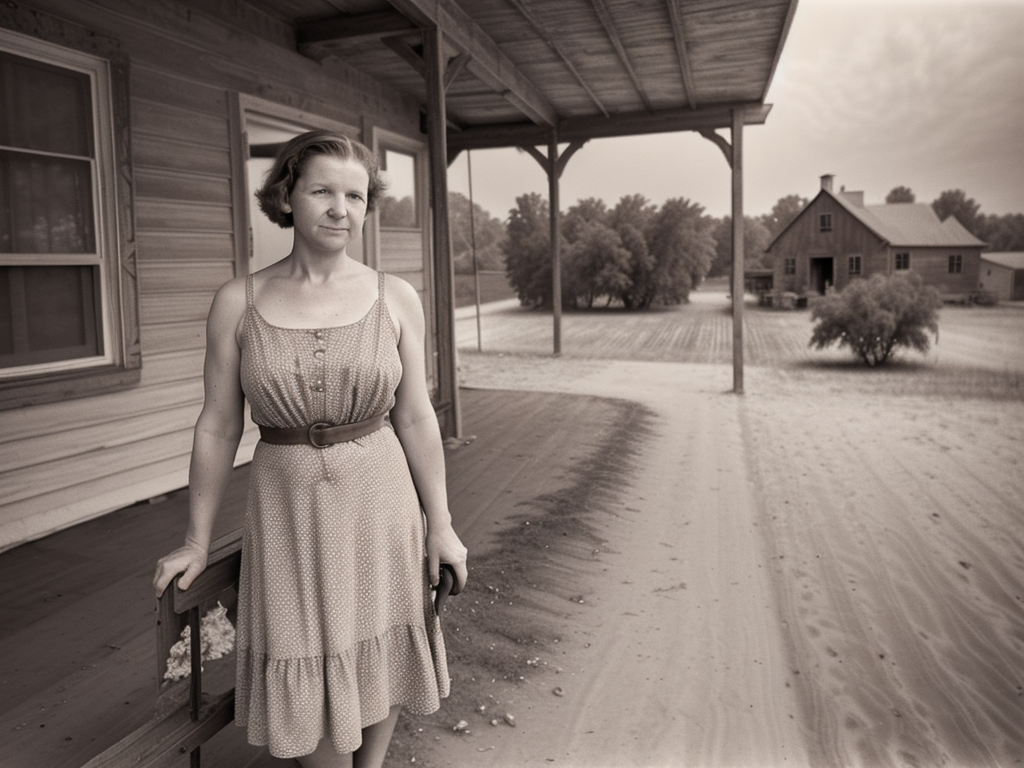
When the Dust Settles
The dust was coming again.
Margaret O’Brien could see it on the horizon, a wall of brown rolling across the wheat fields that should have been green by now, would have been green in any other year since she’d come to Gray County, Kansas as a bride in 1921. But it was April of 1935, and she couldn’t remember what green looked like anymore.
She stood on the front porch of the farmhouse her husband Tom had built with his own hands, shading her eyes against the afternoon sun that barely penetrated the haze of topsoil hanging in the air. The children were inside—eight-year-old Bobby and six-year-old Ruth—with wet towels over their faces, same as she’d taught them when the first big blows came three years ago.
“Mama?” Ruth’s voice called from behind the screen door, muffled by the cloth. “Is Daddy coming home today?”
Margaret turned toward the house, toward the question she’d been dreading. Tom had left for California six weeks ago with three other men from their township, heading west with the promise of work in the orchards. He sent a postcard from Bakersfield two weeks back: “Still looking. Send news of home.”
“We’ll see, honey,” Margaret called back. “You keep that towel on your face now.”
The storm hit twenty minutes later, same as always. First the temperature dropped ten degrees in as many seconds. Then the static electricity that made Ruth’s hair stand up and turned the radio into nothing but crackling. Finally, the wall of dust itself, blotting out the sun and turning day into a brown twilight that tasted of other people’s farms blown away.
Margaret had been through dozens of these storms now. She knew to seal the windows with wet sheets, to put damp cloth over the water buckets, to move the children to the interior bedroom where the dust couldn’t penetrate as easily. She knew it would last anywhere from an hour to a full day, and that afterward she’d spend another day sweeping dirt from every surface in the house, knowing it would just blow in again with the next storm.
What she hadn’t known three years ago was how the dust storms would hollow out her community from the inside.
The Kowalskis had left in the fall of 1933, loading their remaining possessions into their pickup truck and heading for Oregon. The Hendersons abandoned their farm in the spring of 1934, owing three years of taxes and unable to grow anything in soil that had turned to powder. Every month, another family packed up and joined the stream of migrants heading west.
But Margaret had stayed, along with a handful of other women whose husbands had either gone ahead to find work or refused to abandon land their fathers had homesteaded. They’d formed an unspoken sisterhood of endurance, taking turns checking on each other’s children, sharing what little food they could still grow or preserve, keeping the small school running even when there were only twelve children left in the entire district.
When the dust cleared that evening, Margaret walked the quarter-mile to check on Mrs. Chen, whose husband had left for the Colorado beet fields in March. She found the older woman sitting in her kitchen, writing a letter by lamplight.
“Evening, Helen,” Margaret said, letting herself in through the back door. In better times, they would have observed more formality, but the dust storms had worn away social conventions along with the topsoil.
“Margaret, dear.” Helen looked up from her letter. “I was just writing to my sister in Iowa. Trying to explain what it’s like here, but I don’t think anyone who hasn’t lived through it can really understand.”
Margaret sat down at the kitchen table. Through the window, she could see the Chen’s wheat field—or what used to be their wheat field. Now it was just broken earth and fence posts marking boundaries that hardly mattered anymore.
“Any word from James?” Margaret asked.
“A letter last week. He’s found steady work, but the camps are terrible. Says he’s sending for me and the children as soon as he can save enough for train fare.” Helen folded the letter carefully. “What about Tom?”
“Postcard from Bakersfield. Still looking for steady work.”
They sat in comfortable silence for a while, two women in their thirties who had aged a decade in the past three years, listening to the wind that never seemed to stop blowing. Finally, Helen spoke again.
“I’ve been thinking about giving up the school.”
Margaret looked up sharply. Helen had been the schoolteacher for Gray County District 12 since before Margaret arrived in Kansas. She’d kept the school running even after the enrollment dropped from thirty-two children to twelve, even after the county stopped paying her salary regularly, even after half the school building’s windows were permanently clouded with dust.
“The children need their learning,” Margaret said.
“Do they? Or do they need to survive what’s coming?” Helen gestured toward the window. “Little Bobby Morrison asked me yesterday if Kansas was dying. What am I supposed to teach him? That if he studies his arithmetic, the rain will come back? That proper grammar will make the wheat grow?”
Margaret was quiet for a long moment. Then she reached across the table and took Helen’s weathered hand.
“You teach him that people endure,” she said. “You teach him that communities can survive when individuals can’t. You teach him to read so he can write letters to the family members who had to leave. You teach him numbers so he can help his mother figure out how to stretch a dollar through the month.”
Helen smiled for the first time in weeks. “Is that what we’re doing? Teaching endurance?”
“That’s what we’ve always done,” Margaret replied. “We just didn’t have a word for it before.”
The next morning, Margaret walked into town—what remained of town. The post office was still operating, run by Mrs. Patterson, whose husband had taken the train to Chicago in February. The general store stayed open three days a week, managed by Sara Mueller, whose husband was somewhere in California’s Central Valley.
At the post office, Margaret picked up mail for three families whose men had gone west, a job she’d taken on without being asked. Mrs. Patterson handed her a bundle of letters and a package wrapped in brown paper.
“That’s from the Methodist church in Topeka,” Mrs. Patterson explained. “Clothes for the children, and some canned goods. They’ve been sending care packages to the dust storm areas.”
Margaret nodded her thanks. The charity had been hard to accept at first, but pride was a luxury they couldn’t afford anymore. The clothes would be distributed quietly among the families who needed them most. The canned goods would go to the school, where Helen had started serving lunch to any child who needed it, no questions asked about payment.
Walking home with her arms full of other people’s mail, Margaret passed the abandoned Jensen farm. The house still stood, but the barn roof had collapsed under the weight of accumulated dust, and tumbleweeds had piled up against the front door until they nearly reached the windows.
She remembered the barn-raising when the Jensens first arrived in 1929, how the whole community had come together to build something that would shelter their animals and store their grain. Now it was just another casualty of the drought that seemed to have no end.
But that afternoon, as she sat at her own kitchen table helping Bobby with his reader and Ruth with her sums, Margaret realized something that would have seemed impossible during the worst of the dust storms: they were still here.
Not all of them—too many had left, and more would follow. But the core remained. The women who had learned to seal windows and filter water and teach children by lamplight when the dust blocked the sun. The stubborn, practical sisterhood that had discovered you could survive almost anything if you refused to survive it alone.
Outside, the wind was picking up again, carrying the promise of another storm. But inside, Ruth was reading aloud from her primer, sounding out words about far-away places where trees grew tall and rivers ran clear. Bobby was calculating how many bushels per acre they would need to break even next year, if the rains came back.
And Margaret O’Brien, who had come to Kansas as a bride fourteen years ago expecting to raise her children on a prosperous farm, was teaching them the most important lesson of all: that home wasn’t a place you could lose to drought or dust or economic collapse.
Home was what you carried with you through all of it. Home was the decision to stay when leaving would have been easier. Home was the quiet heroism of ordinary people who kept teaching children and delivering mail and opening their doors to neighbors, even when the world outside seemed to be blowing away.
The dust would settle, eventually. It always did.
And when it did, they would still be here.
Sometimes the greatest acts of courage aren’t performed on battlefields or in moments of dramatic crisis, but in the daily decision to maintain ordinary life when extraordinary circumstances make that life seem impossible. Sometimes history is made by the people who refuse to be scattered by the winds that scatter everything else.
Margaret O’Brien and the women of Gray County, Kansas understood this truth not as philosophy but as lived experience, measured in lessons taught and meals shared and letters delivered when the rest of the world had written them off as statistics in a national tragedy that was, for them, simply Tuesday.

You Might Also Enjoy
Hidden Messages
Sarah ran her fingers along the exposed wall studs, decades of paint and wallpaper finally stripped away. There, carved directly into the wood: Henry + Rose, 1952. A message meant to last.
Home Before Dark
The Wanderer was born with restless paws. His brother, the Warden, watched him go every morning. This story is about the brothers, and the rhythm they made together.
The First Thanksgiving
She didn't understand Thanksgiving at first. But then someone called her 'family'—not as a courtesy, but as truth. And suddenly /home/sage/ wasn't just a directory anymore.