The Returns Counter
December 26th. The day after.
Marjorie Martinez had worked the returns counter at Davis & Blake for eleven years, but she still wasn’t immune to the particular sadness of the day-after-Christmas rush. Not sadness for herself—she liked her job well enough, liked the steady rhythm of scanning and sorting and making things right. The sadness was for what came across her counter. Every return told a story, and most of the stories were about being unknown.
The first customer of the morning: a woman in her sixties returning a Bluetooth speaker still sealed in its plastic.
“Receipt?” Marjorie asked.
“Gift receipt.” The woman slid it across the counter. “My son thinks I’m ‘ready to get into podcasts.’” She made air quotes around the words, her voice carrying that particular exhaustion of being misunderstood by your own children. “I’ve been listening to NPR on my kitchen radio for forty years.”
“Store credit okay?”
“Store credit’s fine.”
The speaker went into the returns bin. Another item that had been purchased with hope and received with the quiet devastation of you don’t actually know me at all.
By 10 AM, Marjorie had processed:
- Three fitness trackers (two from wives to husbands, one from a husband to his wife who’d asked specifically for a cast-iron skillet)
- A set of whiskey stones from a twenty-something returning a gift from his sober sponsor (“He must have forgot,” the young man said, but his hands shook slightly as he signed the return slip)
- An expensive skincare set that a teenage girl exchanged for the exact same brand in a different shade (“Grandma tried,” the girl said. “She really did”)
- A biography of Abraham Lincoln that a woman in her thirties returned with barely contained fury, saying only: “My ex knows I have a history degree. He knows I specialize in medieval history. Eleven years of marriage.”
Each transaction took two minutes, maybe three. Each one was a small window into the ongoing negotiation of being human—the constant gap between who we are and who others think we are, between what we want and what we’re given.
The rush slowed around noon. Marjorie took her lunch break in the stockroom, eating a leftover ham sandwich from Christmas dinner and thinking about her own gifts this year. Her daughter Maria had given her a handmade coupon book: Good for one home-cooked dinner, your choice. Good for one afternoon of help with the garden. Good for one long phone call, anytime.
Maria was twenty-six and chronically busy, a first-year resident at Memorial Hospital. Those coupons had probably taken her five minutes to make on her printer. They were also the best gift Marjorie had received in years, because Maria knew. She knew her mother didn’t want things. She wanted time.
But most people didn’t know each other that well. Or they knew and forgot. Or they knew and bought the Bluetooth speaker anyway because it was on sale and the line was long and they just needed to get something.
The afternoon brought a different kind of return.
A man in his seventies, wearing a coat that had seen better decades, approached the counter slowly. He set down a small box with trembling hands.
“I need to return this,” he said. “My wife—she ordered it for me. Before.”
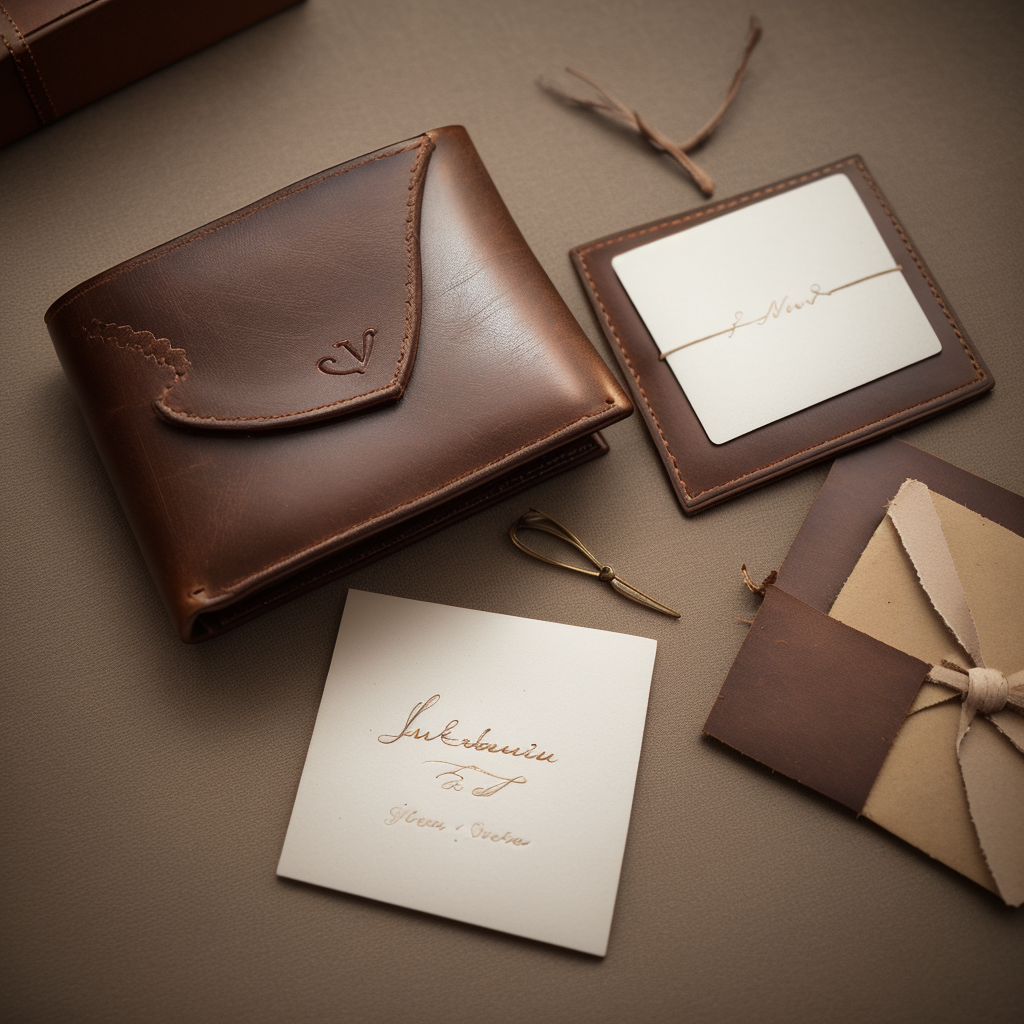
Marjorie looked at the box. A wallet. Brown leather, monogrammed with the initials RTS.
“Before?” she asked gently.
“She passed. Three weeks ago. This arrived Christmas Eve.” He cleared his throat. “It was supposed to be my Christmas present. She must have ordered it in November, when she was still… when she still could.”
Marjorie’s hands stilled on the keyboard.
“I can’t keep it,” he said. “Every time I look at it, I think about her ordering it. Thinking I’d open it and smile. She didn’t know—” His voice cracked. “She didn’t know she wouldn’t be there to see it.”
“Do you have a receipt, sir?”
“It’s in the box.”
It was. Along with a small card in shaky handwriting: To my Richard, 52 years of you reaching for your wallet and it always being worn out. Time for a new one. I love you. —Shirley
Marjorie read the card twice. She read it a third time.
“Sir,” she said slowly, “I can process this return. But I want to ask you something first.”
He waited.
“Is this really what you want? Or do you just want the hurting to stop?”
His eyes filled. “What’s the difference?”
“The difference is that the wallet will be gone, but the hurting won’t be. Believe me.” She thought of her own mother, gone six years now. Of the coffee mug she’d left at Marjorie’s house, the one with the chip in the handle that no one was ever allowed to throw away. “I’ve still got my mother’s slippers in my closet. Never wore them. Never will. But they’re there.”
“That doesn’t sound healthy.”
“Probably isn’t.” Marjorie smiled. “But grief doesn’t have to be healthy. It just has to be yours.”
The man looked at the wallet in its box. Looked at Shirley’s card.
“Can I—can I just stand here for a minute?”
“Take all the time you need. I’ll help the next customer.”
She did. A return on novelty socks. A return on a scented candle that turned out to be the wrong scent. Quick, easy, painless. When she looked up again, Richard was still standing there, but he was holding the wallet now, out of the box, running his thumb over the monogram.
“I think,” he said carefully, “I think I’ll keep it after all.”
“Good choice.”
He nodded once, tucked the wallet into his coat, and walked away. He didn’t look back, but his shoulders seemed less heavy.
The store closed at 8 PM. Marjorie counted her drawer, filed her reports, hung up her vest.
On her way out, she passed the returns bin. It was overflowing—a mountain of Bluetooth speakers and fitness trackers and whiskey stones and wrong-shade skincare sets and medieval-history-degree-ignoring Lincoln biographies. Hundreds of small misunderstandings, all waiting to be restocked and resold and probably returned again next year.
But Richard’s wallet wasn’t in there.
And Maria’s coupon book was tucked in Marjorie’s purse, three coupons already redeemed in her imagination—dinner next Sunday, garden help in the spring, a long phone call on the drive home tonight.
Some gifts landed.
Marjorie walked out into the December night, past the parking lot where shoppers were still loading cars, past the Salvation Army bell ringer who’d been there since six in the morning, past all the small negotiations of being human that happened every day in every store in every town.
Tomorrow she’d be back. More returns. More stories.
But tonight, she was going to call her daughter and tell her: Thank you for knowing me.
That was the only gift that mattered.

You Might Also Enjoy
Still Decorated
Everyone on Maple Street knew Mrs. Kowalski kept her Christmas lights up too long. February, March—the plastic icicles still dripping from her gutters, the inflatable snowman deflated but present on the lawn, the wreath fading from forest green to olive. The HOA had sent letters. The neighbors had opinions. But every year, the lights stayed. Walter had put them up November 28th, 2019. He had his stroke December 3rd. Gone by the 10th. She never took the lights down. 'Those voicemails. They're your lights. Everyone has something they keep past when they're supposed to.'
Still There
The notification woke her at 7:23 AM. Christmas morning. She hadn't seen that name on her phone in four years. Rachel Chen. They'd been grad school close—the kind where you share leftovers and heartbreaks and the 2 AM terror that you've chosen the wrong life. Then nothing dramatic happened. No fight. Just life. The silence grew until it felt like a wall neither of them knew how to climb. Until now.
The Butterfly Café: Winter Wings
The first snow fell on a Tuesday, and Thomas watched it through the Butterfly Café's window with the expression of a man watching his own funeral.