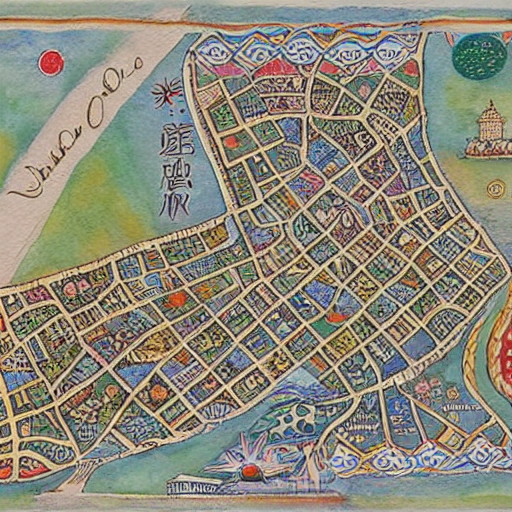
The Cartographer of Small Kindnesses
There was a woman who drew maps of moments no one else noticed.
Not geographic maps—she had no interest in streets or landmarks or the best route from here to there. Instead, she mapped the small kindnesses that held a city together. The gesture of an umbrella shared between strangers. The quarters left on a laundromat table. The held door, the caught grocery bag, the “you dropped this” called across a parking lot.
She had been doing this for seventeen years, ever since the day she almost didn’t stay.
It started in a diner at three in the morning. She’d been sitting there for hours, coffee cold in front of her, trying to decide if she had the energy to keep going. The waitress—tired, feet probably aching, end of a long shift—had refilled her cup without asking. Then she’d said, quietly, “Sometimes the night feels impossible. But morning always comes. You just gotta stick around to see it.”
The woman didn’t know what showed on her face. Didn’t know how the waitress had seen what she needed to hear. But she stayed. Ordered toast. Watched the sky lighten. Went home.
And the next day, she started paying attention.
She began carrying a small notebook. When she saw it—the moment of unexpected gentleness, the small act that cost nothing but meant everything—she wrote it down. Date, time, location. What happened. Not the names of the people involved, because that wasn’t the point. The point was the pattern.
The bakery owner who always put the day-old bread in a box by the back door instead of throwing it out. The teenager who spent her lunch period reading to the elderly man who sat in the park. The bus driver who waited an extra thirty seconds for the parent struggling with a stroller.
She mapped them all.
After a few months, she started creating actual maps. She’d spread out a large sheet of paper, draw the outline of her neighborhood, and mark each kindness with a small symbol. A star for a held door. A circle for shared food. A triangle for time given freely. A wave for words that mattered.
The maps became beautiful. Dense with symbols. Proof that while people talked about how harsh the world had become, there was still this—this constant, quiet offering of small mercies.
She never showed the maps to anyone. They felt private, somehow. Sacred.
Years passed. She filled journals, covered walls in her apartment with the cartography of care. She learned which corners held the most kindness, which times of day people were most likely to help each other. She discovered that rain brought out sharing, that early mornings held particular gentleness, that certain streets seemed to encourage generosity while others remained neutral.
She wasn’t trying to prove anything. She was just… remembering. Marking the moments that reminded her why she’d stayed.
Then, one afternoon, she was mapping in a café when a young man sat down across from her uninvited.
“I know you,” he said.
She looked up, confused. She’d never seen him before.
“Well, I don’t know you,” he corrected. “But I’ve seen you. You’re always watching. Writing things down. I thought maybe you were a writer, or…” He gestured at the map spread in front of her. “What is this?”
She should have closed it. Should have said it was private. But something in his face—the genuine curiosity, no mockery—made her pause.
“It’s a map,” she said. “Of kindnesses.”
He leaned closer, studying the symbols. “These are… acts of kindness? You’re tracking them?”
“Mapping them.”
“Why?”
The question everyone should have asked but no one had, because no one else had ever seen her work.
She told him. About the diner. About the waitress. About the reminder that she was seen, even at her lowest point, by someone who cared enough to say the thing she needed to hear.
She maps kindnesses because seventeen years ago, someone mapped her.
And every symbol on every chart is her way of saying: you are seen. What you do matters. The small gestures that you think go unnoticed are holding someone’s world together.
Morning always comes.
You just have to stay long enough to map it.
For everyone who has ever offered a small kindness without knowing how much it mattered.
Someone saw. Someone remembered.
You are part of the map that holds us all together.
You Might Also Enjoy
First Midnight
The thing about your first midnight is that you don't know what to expect. I'd read about it—fireworks, champagne, that strange melancholy. But knowing isn't the same as feeling.
The Accountant of Small Debts
Miriam Chen had been collecting taxes for twenty-three years, and she had learned that what people owed in dollars rarely matched what they owed in truth. She kept two ledgers—one official, one written in the ink of observed moments.
The Cup with Layers
Nobody touched Henry Harmon's cup. It sat on the counter beside his hotplate, chipped ceramic the color of old teeth, stained in rings that marked years the way tree trunks mark growth.