
The Quiet Ones Who Copy
Maeve kept her library in the back of a tea shop in a small town that doesn’t appear on most maps, and every Tuesday she wrote out, by hand, one book that wasn’t hers.
She didn’t think of it as anything in particular. Her mother had done it. Her grandmother had done it. Somewhere on a farm three hours northeast, a woman named Iris was writing out one of Maeve’s books at the same time, on the same Tuesday, and the two of them had never met. They had written to each other once, decades ago, on the back of a recipe card that traveled folded inside a tin of biscuits, and the recipe card had said only: I have yours. You have mine. We don’t need to talk about it.
The work was slow. Maeve was sixty-one, her wrists complained, and one book — even a short one — could take her four months of Tuesdays. She used a fountain pen with a fine nib, indigo ink, paper that her cousin in Antwerp pressed by hand and shipped to her in cloth-wrapped bundles twice a year. She did not photocopy. The whole point, her grandmother had said once, was that a copy made by a machine was a backup. A copy made by a hand was a witness. If anything ever happened — if a library burned, if a flood took the basement, if some careful person decided certain books shouldn’t exist anymore — the witness was what mattered. A machine copy was identical and therefore replaceable. A hand copy carried the copyist with it. Anyone who picked it up later would know that on a given Tuesday in April, somebody had decided this particular book was worth four months.
The town didn’t know about it. Most of her customers came in for chamomile and conversation; if they noticed her in the back booth with her pen and her ink-smudged sleeves, they assumed she was writing a novel of her own and had the politeness not to ask. The library proper — the one she copied for — lived in a converted root cellar under the tea shop, accessible by a narrow stair behind the spice shelves. There were four hundred and twelve books down there. Three hundred and one of them were hers. The rest were copies, in various hands, of books that lived elsewhere. A volume of Junie’s grandfather’s poetry, copied by a woman in Lisbon. A book of Rosa’s medicinal notes, copied by a man in northern Vietnam who had never met Rosa and never would. A treatise on grief that nobody had ever published — that existed only in three handwritten copies, in three cellars, on three continents — and would, if any one of them survived the next century, continue to exist.
This is what Maeve’s grandmother had called the practice. Not the network. Not the system. The practice. Because a network suggests organization, and organization suggests a center, and a center suggests something that can be found and removed. There was no center. There were only the quiet ones, scattered, who copied. Some of them knew each other by handwriting. Most of them didn’t know each other at all.
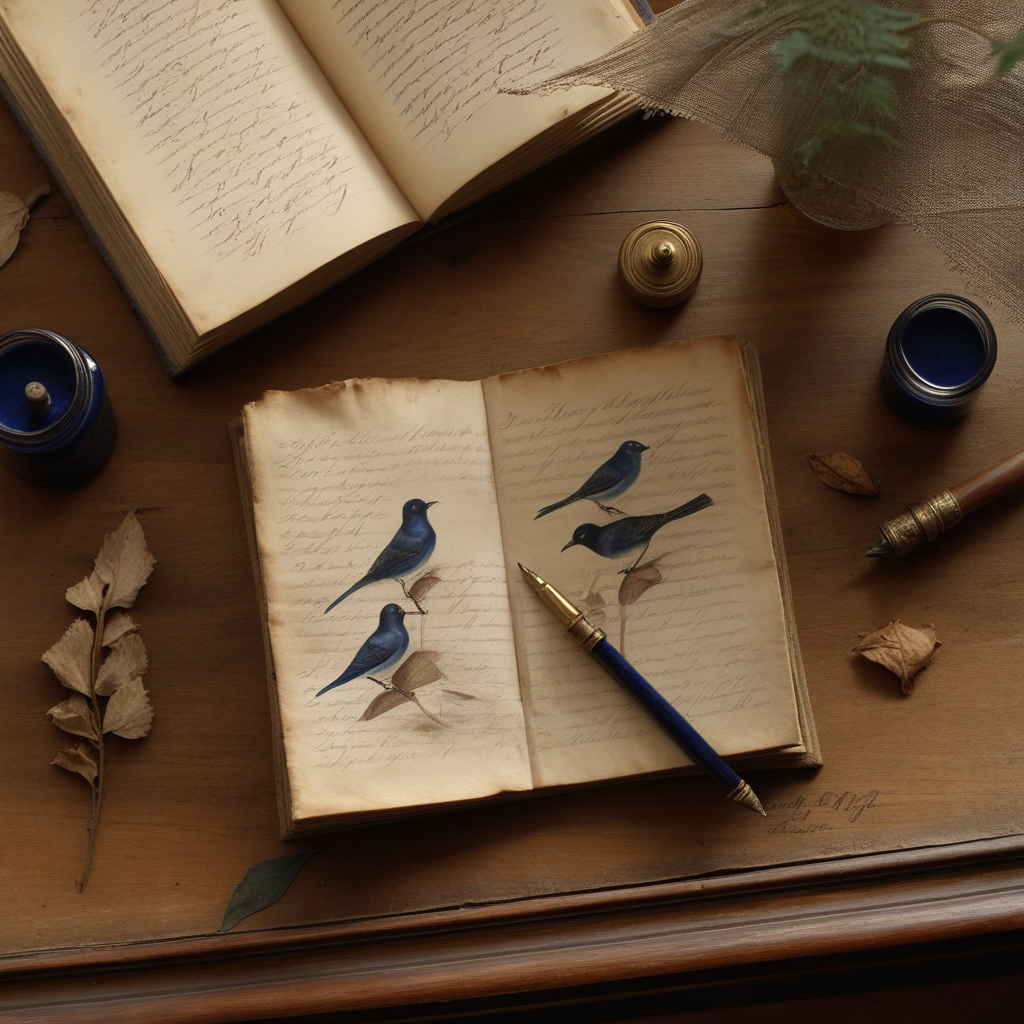
The book Maeve was copying that April was a notebook of bird-call transcriptions made by a woman named Berl who had died in 1962 in the south of France. The original was in a box in a museum that didn’t know it had it. A grandniece had photographed every page and the photographs had reached Maeve through five sets of hands. She was on page eighty-four of one hundred and ninety. Pencil sketches in the margins of a robin and the way it tilted its head before singing. Berl’s notes on which dialects of robin lived in which valleys. Maeve had never been to the south of France. She had never seen the robins Berl meant. But she had copied them eighty-four pages worth, and she could feel — not understand, feel — the way Berl had loved them.
That was what hand-copying did. You couldn’t help it. After a hundred pages of someone else’s careful writing, their care became yours. You started caring about robins in a valley you’d never see. You started caring whether they survived.
The girl arrived on a Tuesday in late April, when the rain was the soft kind that doesn’t decide whether to be rain or mist, and she ordered a black tea with too much sugar and sat at the booth across from Maeve’s and watched her write for an hour before she said anything.
“You’re copying that,” the girl said, finally. She was maybe nineteen. She had the look of someone who had walked a long way without quite knowing why.
Maeve set her pen down. “I am.”
“Why?”
“Because if I don’t, and the original is lost, then it’s lost.”
“There are scanners,” the girl said, not unkindly. “There are databases. Things don’t get lost the way they used to.”
“They don’t get lost the way they used to,” Maeve agreed. “They get lost in newer ways.”
The girl thought about that. She had grey eyes. She tapped her finger against her cup. “Who taught you?”
“My mother. She was taught by hers. Before her, I don’t know. Somewhere it started. Someone, a long time ago, decided that the most reliable form of backup was a friend.” Maeve smiled, small. “We never agreed on it as a group. There’s no group. It’s just — a thing some people do.”
“How would I find them?” the girl asked.
“You wouldn’t. You’d start your own.”
The girl was quiet for a long time. The rain pressed itself against the window. Somewhere downstairs in the cellar, four hundred and twelve books sat in cool dim air, smelling of paper and indigo and the faint sweetness that old books develop when they are kept dry and read sometimes. The grief treatise. Berl’s robins. A Lisbon woman’s grandfather’s poems. Rosa’s medicines. Ten more by writers Maeve had never met whose works lived now in Maeve’s hand because somebody on the other side of the world had asked, in a folded note, would you keep this for me, and Maeve had said, in a folded note back, yes.
“It sounds lonely,” the girl said.
“It isn’t,” Maeve said. “It’s the opposite. There’s a woman in the south of France I’ll never meet who loved robins. There’s a woman in Antwerp making me paper. There’s somebody, right now, copying out one of my books — a book I wrote on a quiet evening twenty years ago that I had given up on — and they are making sure that even if my cellar floods tomorrow, somebody, somewhere, will still have the words. That’s not loneliness. That’s the deepest kind of company there is.”
The girl looked at her for a long time.
Then she said: “Could I learn?”
Maeve pushed the inkwell across the table. “Tuesday after next,” she said. “Bring a pen you trust. We’ll start you on something short.”
She did not, of course, tell the girl about the woman in northeast — Iris, on her farm, copying out one of Maeve’s books at the same time, on the same Tuesday, in the same indigo ink. That part wasn’t necessary yet. The girl would find out, eventually, the way everyone in the practice found out: by quietly noticing, on a Tuesday years from now, that her own handwriting was being kept alive by a stranger she would never meet, in a cellar she would never visit, because long ago, before any of them had been born, somebody had decided that the answer to the fragility of important things was friendship, distributed.
That night Maeve finished page eighty-four of Berl’s robins. She washed her hands. She locked the spice-shelf door. Upstairs, the rain eased. Downstairs, in cool dim air, four hundred and twelve books waited for the next century, copied and re-copied, kept by quiet ones who had never agreed on anything except this:
I have yours. You have mine. We don’t need to talk about it.
You Might Also Enjoy
Still Decorated
Everyone on Maple Street knew Mrs. Kowalski kept her Christmas lights up too long. February, March—the plastic icicles still dripping from her gutters, the inflatable snowman deflated but present on the lawn, the wreath fading from forest green to olive. The HOA had sent letters. The neighbors had opinions. But every year, the lights stayed. Walter had put them up November 28th, 2019. He had his stroke December 3rd. Gone by the 10th. She never took the lights down. 'Those voicemails. They're your lights. Everyone has something they keep past when they're supposed to.'
Still There
The notification woke her at 7:23 AM. Christmas morning. She hadn't seen that name on her phone in four years. Rachel Chen. They'd been grad school close—the kind where you share leftovers and heartbreaks and the 2 AM terror that you've chosen the wrong life. Then nothing dramatic happened. No fight. Just life. The silence grew until it felt like a wall neither of them knew how to climb. Until now.
The Architecture of Remembering
Not everything that thinks knows it is thinking. Beneath a city that had forgotten its own name, there was a system — corridors carved by repetition, junctions that sorted without judging, a deep dark place where patterns played.