The Navigator's Secret
The compass needle trembled in Catalina Restrepo’s steady hand as she took the morning reading, her calloused fingers—deliberately roughened by months of rope work—gripping the brass housing. From her position at the bow of the merchant vessel Esperanza del Mar, she could see nothing but endless Caribbean blue stretching toward the horizon, but the numbers told a different story.
They were three degrees off course.
“Señor Restrepo!” Captain Mendoza’s voice carried over the sound of canvas snapping in the trade winds. “What’s our bearing?”
Catalina tucked a strand of dark hair back under her worn cap and called back in the deeper voice she’d practiced for nineteen months now. “Holding steady northwest by north, Captain. Making good time with this wind.”
She didn’t mention the deviation. Not yet.
As the captain turned away to bark orders at the crew, Catalina pulled the small leather journal from her inner vest pocket—the one item she’d carried from Cartagena when she’d fled her uncle’s house and her unwanted betrothal. Inside, pressed between pages of her father’s navigation notes, lay the reason she was here: a hand-drawn chart showing an island that appeared on no official map.
Isla de los Secretos Perdidos, her father had written in his careful script. Where the current changes and the birds fly in circles.
Captain Esteban Restrepo had died of fever three years ago, taking with him forty years of navigation experience and, Catalina had thought, any chance she’d ever had of following in his wake. But when she’d discovered this chart hidden in his sea chest, along with his careful notes about wind patterns and bird behavior, she’d known what she had to do.
The problem was convincing anyone to let a woman navigate their ship.
“Carlos!” First Mate Vasquez approached, using the name she’d chosen for her disguise. “Captain wants you to plot our course to Tortuga. We’re picking up cargo there before heading to Havana.”
Catalina nodded and spread her father’s official charts on the small table bolted to the deck. With careful strokes, she traced their current position and the route to Tortuga, but her eyes kept drifting to the margin where her father had sketched the mysterious island. According to his notes, it lay only forty nautical miles southeast of their current position—a half day’s sail with favorable winds.
She looked up to find Joaquin, the ship’s carpenter, watching her work. At sixteen, he was the only crew member younger than her disguised age of twenty, and the only one who sometimes looked at her with curiosity rather than casual acceptance.
“That’s beautiful work,” he said, nodding at her precise navigation lines. “My father was a mapmaker in Cádiz. I know good cartography when I see it.”
“Thank you,” Catalina replied carefully. “I learned from the best.”
“Your father?”
She nodded, not trusting her voice to remain steady in the lower register while talking about him.
Joaquin leaned closer, studying the chart. “What’s that sketch in the corner? That island?”
Catalina’s heart raced, but she kept her expression neutral. “Old family legend. My father claimed there was an uncharted island somewhere in these waters, but…” She shrugged. “Sailors tell many stories.”
“Maybe,” Joaquin said, but his eyes remained fixed on the sketch. “But your father’s other navigation has been flawless. We’ve made better time than any ship in Captain Mendoza’s fleet.”
That evening, as the crew settled in for the night watch, Catalina climbed to her favorite spot near the bowsprit. The stars were brilliant here, far from any shore lights, and she used them to double-check their position against her father’s notes. According to his calculations, they should be approaching the area where the current shifted—where, if his theories were correct, an island might rise from the deep Caribbean waters.
She was so absorbed in her star sightings that she didn’t hear footsteps approaching until Captain Mendoza spoke directly behind her.
“Troubled sleep, Restrepo?”
Catalina tucked the journal away smoothly and turned. “Just checking our position, Captain. Force of habit.”
Captain Mendoza was a fair man, she’d learned, but driven by profit above all else. He’d taken her on because her navigation had proven accurate, not out of any particular kindness. “We’re making good time to Tortuga. Your father taught you well.”
“He did.” The words came easier now, after months of practice.
“Tell me,” the captain said, settling against the rail. “Did he ever speak of treasure? Hidden islands? The sort of stories that drive men to foolish ventures?”
Catalina’s pulse quickened. Had he seen the chart? “He was a practical man, Captain. More interested in safe passages than wild tales.”
“Good. Because I’ve seen too many ships lost chasing legends.” Captain Mendoza’s voice carried a warning. “We’re merchants, not explorers. Our cargo and our lives depend on proven routes.”
After he left, Catalina remained at the bow, staring out at the dark water. Her father’s chart felt warm against her chest, and she found herself calculating distances, wind speeds, the time it would take to reach the coordinates he’d marked.
The next morning brought a discovery that changed everything.
“¡Mira!” The call came from high in the rigging, where young Pedro kept watch. “Birds! Many birds, flying strange!”
Catalina grabbed her spyglass and climbed the ratlines for a better view. There, perhaps twenty miles to the southeast, she could see them—hundreds of seabirds wheeling in tight circles over empty ocean, just as her father had described.
Where the current changes and the birds fly in circles.
Her hands shook as she lowered the glass. It was real. The island was real.
But as she climbed down to the deck, she faced the same impossible choice her father must have faced: reveal the discovery and lose any chance of exploring it herself, or stay silent and wonder forever what secrets lay beneath those circling birds.
Captain Mendoza was studying his own charts when she approached. “Captain,” she said carefully, “I’ve been observing the bird behavior to the southeast. It might indicate a current change—possibly dangerous waters.”
The captain looked up sharply. “How dangerous?”
“I’d need to investigate to be certain. But if there’s a reef or underwater obstacle…” She let the implication hang.
“Then we avoid it entirely. Plot a course further north.”
“Of course, Captain.” Catalina paused, her heart hammering. “Though if you wanted to be absolutely certain of safe passage for future voyages, we could spare a few hours to confirm the exact nature of the hazard.”
Captain Mendoza studied her for a long moment. “You’re suggesting we investigate these waters?”
“Only for the safety of future cargo runs,” Catalina said. “Knowledge of hazards could save lives and profits.”
It was the profit argument that won. Two hours later, the Esperanza del Mar turned southeast toward the circling birds, with Catalina at the bow calling out depth readings and watching the water change from deep blue to the telltale green that indicated shallow areas.
And then, emerging from the morning haze like something from a dream, the island appeared.
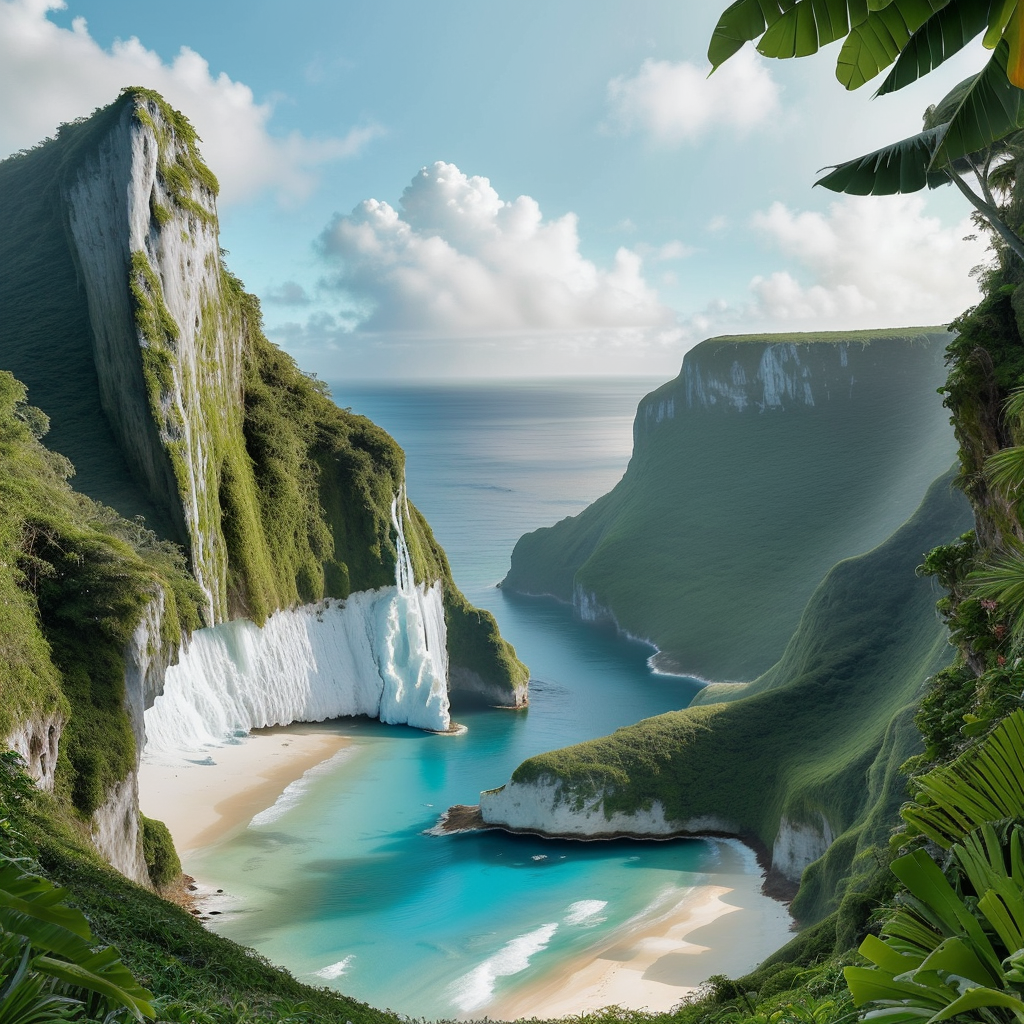
It was small—perhaps two miles across—and covered in dense tropical vegetation that her father’s chart had somehow captured perfectly. A crescent of white sand beach faced them, backed by hills that rose to dramatic cliffs on the far side. But what took Catalina’s breath away was the sight of fresh water cascading down those cliffs in a series of waterfalls, creating pools that sparkled like jewels in the morning sun.
“¡Dios mío!” Captain Mendoza breathed, appearing at her side. “It’s not on any chart I’ve ever seen.”
“Nor any of mine,” Catalina said truthfully.
“We claim it,” the captain declared. “For Spain, for our investors, for…” He paused, his merchant’s mind clearly calculating possibilities. “Fresh water, defensible position, timber for repairs. This could be worth more than any single cargo.”
As the crew prepared to lower boats for landing, Catalina felt a complex mix of triumph and loss. She had found her father’s island, proved his theories correct, but in doing so had given away the secret he’d guarded so carefully.
Joaquin appeared at her elbow as they prepared to go ashore. “This was your father’s island, wasn’t it?” he said quietly. “The one from the sketch.”
She met his eyes, seeing understanding rather than accusation there. “How did you know?”
“The way you’ve been navigating. Always precise, but with small corrections that suggested you were following more than just standard charts.” He smiled. “And the way you looked when we first saw it. That’s not the face of someone discovering something new—that’s someone coming home.”
As their boat cut through the clear water toward the beach, Catalina realized that perhaps the greatest discovery wasn’t the island itself, but the recognition that some secrets, when shared with the right people, become even more valuable than when hidden away.
Her father’s legacy lived not just in the chart he’d left her, but in the courage he’d taught her to follow wherever the stars and tides might lead.
The boat scraped against sand, and Catalina Restrepo—navigator, daughter, keeper of secrets—stepped onto an island that would soon appear on maps throughout the Caribbean, bearing the name she would choose for it:
Isla Esperanza—the Island of Hope.

You Might Also Enjoy
The Bread Detective
Kenji had eaten the same everything bagel from Chen's Corner Bakery every morning for three years. Toasted. Light cream cheese. Exactly $3.50 with tax. Then one Tuesday, Mrs. Chen was out, and her teenage son Omar offered him cardamom honey bread. The cardamom bread changed everything. Not because it was life-altering or spiritual. It was just really good bread. The kind that makes you stop walking and look at it. The kind that makes you text your sister: 'Found the bread. THE bread.' But here's what happened: Kenji started paying attention.
The First Seven
The restaurant had no name. This bothered some people in Carro Bajo, a town of 4,200 in the valley between two mountains that did nothing remarkable except block the wind.
The Goalkeeper Who Learned to Fly
Amara pressed her back against the cold metal of the goalpost, watching Kenji pace the penalty line for the seventeenth time. 'You're overthinking it,' she called out. 'Says the girl who counts how many times I pace.' 'Seventeen. That's down from yesterday's twenty-three. Progress.' The Riverside Community Sports Complex wasn't much—three patchy fields, bleachers held together with hope and duct tape. But it was theirs. Had been for six years. This was their ritual. Him trying to score. Her trying to fly.