The Locksmith's Daughter
My father’s hands were maps.
Every line, every callus, every scar told you something about a lock he’d opened or a key he’d cut. He could hold a blank in his palm and know — before the first file stroke — what kind of door it belonged to. Not the make or the model. The kind. Whether it guarded something precious or just kept the rain out.
“There’s a difference,” he told me once, turning a freshly cut key under the shop light, “between a door that protects and a door that hides. You have to know which one you’re serving.”
I was eleven. I didn’t understand. I do now.
He left me the shop. Not in a dramatic way — no deathbed revelation, no hidden letter behind the workbench. Just a quiet Tuesday when his heart decided it was done, and a will that said the shop goes to Elara, who already knows where everything is.
He was right. I did.
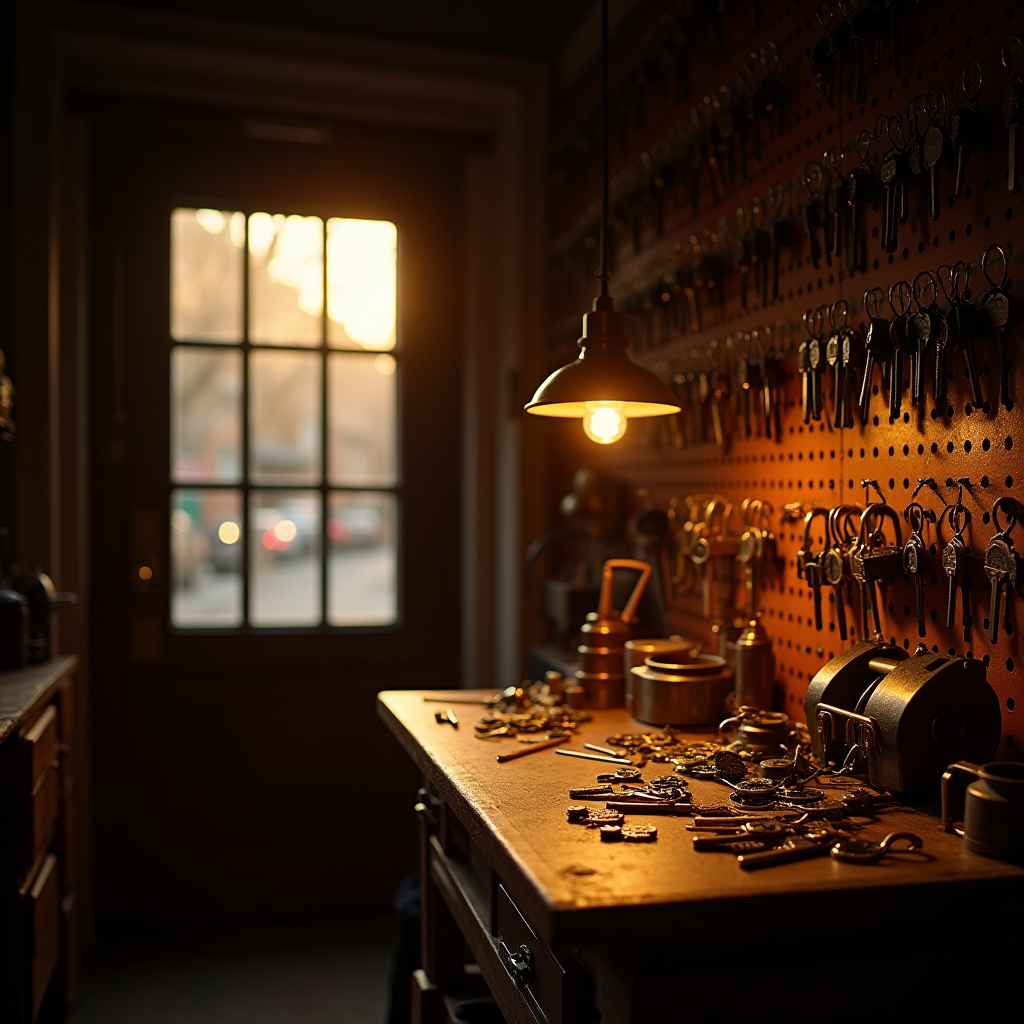
The key blanks lived in the third drawer, sorted by manufacturer. The pin kits hung on the pegboard in order of size. The customer ledger — paper, never digital, because Dad said you should be able to feel the weight of who trusts you — sat under the register with a pen clipped to its spine.
And the copies. Dad kept copies of every key he ever made.
Not to be invasive. Not to sneak into anyone’s home. He kept them because people lose things, and when they showed up panicked at 2 AM because they’d locked themselves out and their kid was inside, he could pull the copy from the wall and hand them back their life in thirty seconds.
“A locksmith who doesn’t keep copies,” he said, “is just a man who cuts metal.”
The first year was muscle memory. People came in with broken locks and I fixed them. They came in with new doors and I fitted them. They came in with stories about lost keys and I listened, because Dad taught me that half of locksmithing is listening. People tell you things while you work on their locks. Things they wouldn’t tell anyone else. Because you’re already inside their door — you’re past the barrier — and something about that makes them honest.
Mrs. Alcott told me about her husband’s affair while I rekeyed her bedroom door. She didn’t cry. She just talked, steady and clear, like she’d been rehearsing. When I handed her the new keys — two of them, because she asked for two — she looked at them for a long time.
“Just two,” she said. “Not three anymore.”
I nodded.
That’s the job.
The second year, I started noticing things.
Small things, at first. A key I’d cut for Martin — a regular, nice guy, always brought coffee when he picked up an order — showed up in someone else’s hand. Not Martin’s hand. A woman I didn’t recognize, asking for a copy of a copy.
“Martin sent me,” she said.
Maybe he did.
Then Tommy, who I’d known since high school, asked me to cut a key for his neighbor’s shed. “She’s on vacation,” he said. “Asked me to feed the cat.”
Maybe she did.
Then a man I’d never met came in with one of my keys — I recognized the cut, the slight asymmetry in the fifth pin that’s my signature, the thing Dad taught me so I’d always know my own work — and asked for six copies.
“What’s the door?” I asked.
“Does it matter?”
It does. It always matters.
I started paying attention to the wall. Dad’s copies. Hundreds of them, hanging on labeled hooks, organized by street name and customer. Each one a promise: I made this for you, and I kept one safe in case you need it.
But some of those hooks were empty now. Keys I’d made that had walked out with people who weren’t their owners. Copies of copies of copies, spreading out into the world like seeds from a tree that doesn’t know where its fruit lands.
I’d given people access. And some of them had given it away.
There’s a moment in locksmithing — Dad called it “the turn” — when you’re picking a lock and every pin sets at once and the cylinder rotates and the bolt slides and the door opens. It feels like permission. Like the lock agreed.
The opposite of the turn is the jam. When a key doesn’t fit but someone forces it anyway. You can hear it — metal grinding against metal, pins being shoved where they don’t belong. It doesn’t open the door. It breaks the lock.
I’d been hearing that sound for months. I just didn’t want to name it.
On a Tuesday — always a Tuesday, the universe has a sense of humor — I closed the shop early. I took every key off the wall. Laid them out on the workbench, all two hundred and thirty-seven of them, sorted by the year I’d cut them.
Then I went through the ledger.
Some names made me smile. Mrs. Alcott, who’d come back a year later with a new boyfriend and asked for three keys this time. “Three,” she said, and winked. The Porters, who’d had me rekey their entire house when their daughter went to college and then called me crying two weeks later because they’d locked themselves out of their own new locks.
Some names made me pause.
And some names — I ran my thumb over the ink and sat with it. Because the name belonged to someone I’d trusted, and the key I’d made for them had ended up in a hand I didn’t recognize, opening a door that wasn’t mine to give.
I didn’t change the locks.
Dad would’ve changed the locks. That was his instinct — someone betrays the system, you rekey the cylinder, new pins, new profile, old key goes dead. Clean. Mechanical. Done.
But I’m not my dad. I learned his trade but I grew my own hands.
I changed the doors.
Not all of them. Not dramatically. But the ones that had been propped open too long, the ones where the hinges had worn soft from people coming and going without knocking — I rebuilt them. Heavier frames. Better wood. Hinges that remembered what it felt like to close.
And I put glass in them. Not because I wanted to see out, but because I wanted whoever stood on the other side to know: you can see me in here. I’m not hiding. But this door is mine, and if you want to come through it, you knock.
The shop is quieter now. Not empty — never empty. The people who were always going to stay are still here. The ones who brought coffee because they wanted to, not because they wanted a key. The ones who told me their stories while I worked and never asked for copies they didn’t earn.
There’s a girl who comes in sometimes — young, quiet, draws in a sketchbook while she waits for her mom. She asked me once why I keep the empty hooks on the wall.
“To remember,” I said.
“Remember what?”
“That every key I make is a promise. And some promises end.”
She thought about that. Then she said, “But the hooks are still there. So you could make new ones.”
She’s right.
The hooks are still there.
For Dad, who taught me the difference between a door that protects and a door that hides. And for the ones who stayed — you were never just keys on a wall. You were the reason the shop has a light on.
You Might Also Enjoy
Her Grandmother's Kitchen
Elena has four days to teach her father to cook before she leaves for college. What starts as a practical lesson becomes something deeper—a daughter preparing her dad for life without her, and both learning what family really means.
Hidden Messages
Sarah ran her fingers along the exposed wall studs, decades of paint and wallpaper finally stripped away. There, carved directly into the wood: Henry + Rose, 1952. A message meant to last.
Home Before Dark
The Wanderer was born with restless paws. His brother, the Warden, watched him go every morning. This story is about the brothers, and the rhythm they made together.