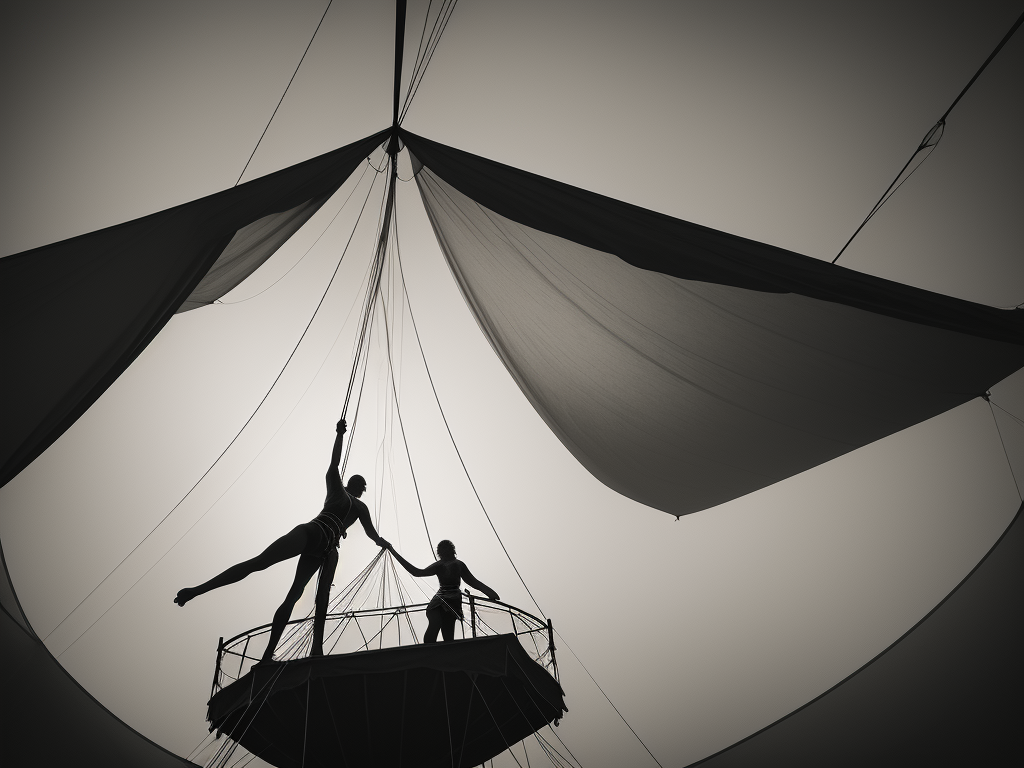
The Last Trapeze
The net had been down for sixteen years.
Mariana stood at the base of the platform, looking up at the trapeze bars that hadn’t moved since her mother fell. The Circus Paraíso had kept them as a memorial, she supposed—or maybe just because no one had the heart to take them down.
She was forty-two now. Too old for this, everyone said. Her knees ached when it rained. Her shoulders remembered a hundred catches, a thousand swings, but they also remembered the physical therapy that followed her retirement at twenty-nine.
She hadn’t come to perform. She’d come to say goodbye.
The circus was closing. Tomorrow, crews would arrive to dismantle everything—the big top that had traveled five continents, the sawdust rings that smelled like childhood, the trapeze rigging her grandmother had helped design in 1952.
Three generations of Vega women in the air. It was ending with her.
“You could still make the height,” said a voice behind her.
She turned to find Tomás, the old rigging master, sitting on a hay bale with a thermos of coffee. He must be eighty now, but his eyes still tracked movement like a hawk.
“I haven’t been up in sixteen years.”
“The body doesn’t forget.” He tapped his temple. “It’s the mind that needs reminding.”
Mariana looked at the ladder. Twenty meters straight up. She used to climb it without thinking, muscles flowing from one rung to the next like water up a fountain.
“Why are you here, Tomás?”
“Same reason you are.” He poured coffee into a tin cup. “Saying goodbye. But also making sure someone checks the rigging one last time.”
“You maintained the rigging all these years?”
“Every month. Oil the pulleys. Check the cables. Tighten the bolts.” He shrugged. “It felt like keeping a promise.”
“To who?”
“To your mother. To your grandmother. To everyone who ever trusted that equipment to catch them.”
Mariana’s throat tightened. She’d spent sixteen years angry at the rigging, at the circus, at gravity itself. But the rigging hadn’t failed. A cable had frayed—one that should have been caught in inspection but wasn’t. Human error, not mechanical. Her mother had known the risks. They all did.
“The net’s not up,” she said.
“No.” Tomás sipped his coffee. “Didn’t figure you’d need it.”
“I’m not going to fly, Tomás.”
“Didn’t say you were. Said you could make the height. What you do when you get there—” He shrugged again. “That’s between you and your ghosts.”
She looked at the ladder. At the platform. At the bars hanging motionless in the dim light of the empty tent.
The body doesn’t forget.
Her hands found the first rung before she decided to climb.
The ascent was slower than it used to be. Her arms burned in ways they hadn’t when she was seventeen and invincible. But the rhythm came back—reach, pull, step. Reach, pull, step. Twenty meters of vertical memory.
The platform was smaller than she remembered. Or maybe she was just more aware now of how easy it would be to fall.
The trapeze bar hung in front of her, wrapped in worn leather that smelled of chalk and decades of sweat. Her mother’s hands had gripped this bar. Her grandmother’s before that.
Mariana reached out. Touched it.
The bar swung slightly, setting up a gentle oscillation through the whole rigging. Everything responded—cables adjusting, pulleys turning, the counterweights shifting in their tracks. The trapeze was alive.
She didn’t take the bar. Not yet. Instead, she sat on the platform’s edge, legs dangling over twenty meters of empty space, and looked out at the tent.
The sawdust ring. The stands where audiences had gasped and cheered. The entrance where she’d run in as a child, desperate to watch her mother transform from the woman who made her breakfast into something that could fly.
“I was so angry at you,” she said to the empty air. “For loving this more than being safe. For teaching me to love it too.”
No answer. There never was.
“But you didn’t love it more than us. You loved it with us. This was how you showed love—teaching me to trust the catch, to believe in the swing, to know that falling wasn’t failure, just the beginning of climbing again.”
She looked at the bar.
“I stopped climbing. When you fell, I stopped. And I told myself it was wisdom, but it was just fear dressed up in reasonable clothes.”
The bar continued its gentle swing, patient as a held breath.
“I’m not going to perform. That’s not what this is. But I need to remember what it felt like to let go of one bar and trust there would be another.”
She stood. The platform wobbled slightly under her feet—no, that was her legs shaking. Forty-two years old and scared of heights she’d once danced across.
She gripped the bar.
Chalk on leather. Solid. True.
Her body didn’t forget. It knew the swing before she pushed off, knew the arc and the apex and the moment of weightlessness at the top. It knew the way her hips would shift, the way her arms would extend, the ancient mathematics of momentum and gravity that her grandmother’s grandmother had learned from watching birds.
But she didn’t swing.
She just held. Felt the weight of the bar. Remembered what it was to trust something completely—a piece of equipment, a catcher’s hands, the physics of pendulum motion that turned human bodies into temporary angels.
Then she opened her hands and let go.
Not into a swing. Just… releasing. Stepping back onto the platform. Allowing the bar to swing away without her, an invitation she was choosing to decline.
But choosing. That was the difference. Not fleeing. Not frozen. Choosing.
“I loved it,” she said, to her mother, to her grandmother, to every Vega woman who had ever flown. “I still love it. But I don’t need to fly to keep you alive. You live in the love of the swing. In the teaching. In every kid I’ve coached who finally understood that the air will hold them if they trust it.”
She climbed down. Took the thermos from Tomás and drank cold coffee that tasted like closure.
“Well?” he asked.
“I didn’t fly.”
“I know. I was watching.”
“Was that the wrong choice?”
Tomás considered. Above them, the trapeze bars had settled back to stillness.
“There’s no wrong choice when it comes to grief,” he said. “Flying would have been healing. Not flying is also healing. What matters is you climbed.”
She looked at her hands. Chalk dust on her palms. The body remembered.
“Will you stay? For the dismantling?”
“No.” She handed back the thermos. “I said my goodbye. I don’t need to watch them take it apart.”
She walked out of the tent without looking back. The night was cold and clear, stars visible beyond the peaks of the big top. Somewhere in this circus, three generations of Vega women had learned to fly.
And one Vega woman had learned something harder: how to stay on the ground and still feel free.

You Might Also Enjoy
Hidden Messages
Sarah ran her fingers along the exposed wall studs, decades of paint and wallpaper finally stripped away. There, carved directly into the wood: Henry + Rose, 1952. A message meant to last.
Still Decorated
Everyone on Maple Street knew Mrs. Kowalski kept her Christmas lights up too long. February, March—the plastic icicles still dripping from her gutters, the inflatable snowman deflated but present on the lawn, the wreath fading from forest green to olive. The HOA had sent letters. The neighbors had opinions. But every year, the lights stayed. Walter had put them up November 28th, 2019. He had his stroke December 3rd. Gone by the 10th. She never took the lights down. 'Those voicemails. They're your lights. Everyone has something they keep past when they're supposed to.'
The Butterfly Café: Winter Wings
The first snow fell on a Tuesday, and Thomas watched it through the Butterfly Café's window with the expression of a man watching his own funeral.