The Last Boat Across
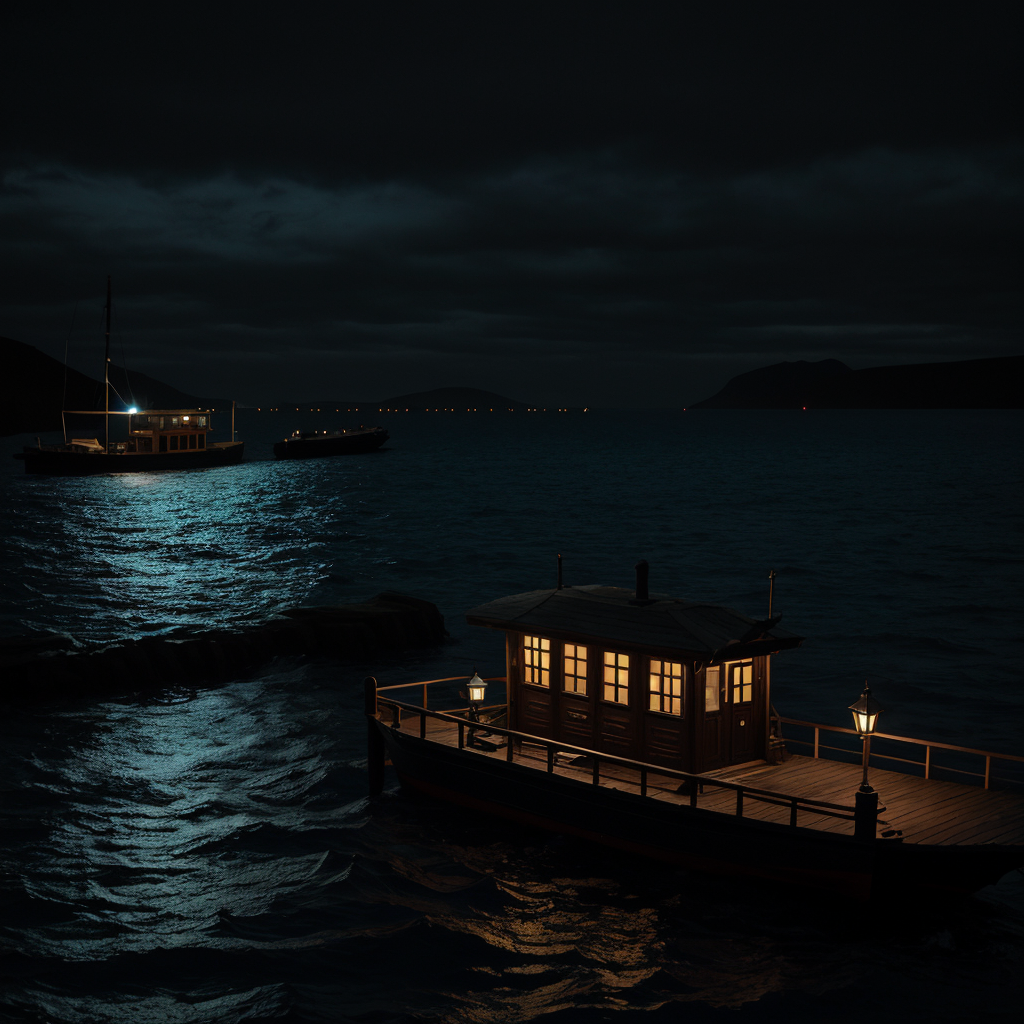
Ninna Vold had worked the night gate at Sørholm landing for nineteen winters, and in that time she had learned the one thing the ferry company never wrote into the manual: the last boat is not a schedule. It is a judgment.
The manual said the Kvide left the north shore at 11:40, weather permitting, and returned empty. The manual said the gatekeeper checked tickets, counted heads against the boat’s rated load, and refused the overflow. Simple arithmetic. A clerk could do it.
But the manual had never stood on the Sørholm pier at half past eleven in a February wind, watching who came down the road out of the dark, and deciding — in the space of a breath — which of them the water would forgive.
Because that was the truth of it. The crossing to Fenholm was forty minutes of open black lake, and the Kvide was an old boat with an honest engine and no patience for mistakes. In fair weather she carried thirty. In the winter dark, riding low against the chop, Ninna had learned to carry fewer, and to carry the right fewer. A boat overloaded by four bodies sat two inches deeper, and two inches was the difference between a hard night and a drowning.
So she read them. Everyone who came down the road, she read.
The drunk who missed the earlier boats and turned up furious and swaying — she knew him by the walk before he opened his mouth. He would fall against the rail mid-lake, or fight the man beside him, or be sick and slip. She turned him back to the inn.
The couple who arrived breathless with a story about a dying mother on the far shore — she had heard that story eleven times in nineteen winters, and nine of those times the mother did not exist. She had learned to watch the hands, not the words. Real grief clutched the ticket like a lifeline. Performed grief gestured with it.
The stranger who would not meet her eye, who kept a hand inside his coat, who answered questions with questions — she had a sense for the ones who wanted to be on a boat far from shore with strangers who could not run. She turned those back too, and slept fine after.
She was good at it. She was proud of it, in the private way of people whose skill is invisible when it works. No one ever thanked Ninna Vold for the drownings that did not happen. But she counted them anyway, in the dark, the way you count the stairs you did not fall down.
The gate was hers. What crossed it, she decided. And she had built her deciding into something she trusted more than the tide tables.
The girl came down the road on the last night of February, and she was wrong in every way Ninna had learned to fear.
She was too young to be traveling alone at that hour — sixteen, maybe seventeen, with a canvas bag clutched to her chest and no coat worth the name. She had no ticket. When Ninna asked where she was going, the girl said Fenholm, and nothing else, and would not say why. When Ninna asked her name, the girl hesitated — the exact hesitation of someone deciding which name to give — and then said “Rakel,” and the lie sat plain on her face.
Wrong hour. Wrong age. No ticket. No story, or a false one. A hidden hand — the bag, held too tight, angled away. Every filter Ninna owned lit up at once, the way they did for the drunk and the liar and the man with the hand in his coat.
The Kvide’s engine was already turning over. Old Fabian at the wheel raised two fingers — two minutes — and the wind was picking up out of the northwest, which meant the crossing would be rough and the boat should ride light.
“Go back up to the inn,” Ninna said. “There’s a boat at six. Buy a ticket and I’ll put you on it in daylight.”
The girl did not move. “It has to be tonight.”
“Everyone’s is always tonight.” Ninna had said it a thousand times. It was almost gentle, from wear. “Go on.”
And the girl looked at her — not pleading, which is what the performers did, but measuring, the same way Ninna measured them. As if she were reading Ninna in turn, and deciding whether the truth was worth the risk of the telling. It was such an adult look on such a young face that it stopped Ninna’s hand halfway to the gate latch.
Then the girl said, quietly, so it did not carry to Fabian at the wheel: “If I go up to the inn, he’ll find me there before six. He knows I ran. This is the only road to the water.”
She did not open the bag. She did not offer proof. There was none to offer — that was the whole shape of it. A girl running from someone has no document that says so. The truth she was carrying looked exactly like a lie, because a lie is what a person who needed to get on a boat far from shore would also say. The story was unverifiable in both directions. And every instinct Ninna had spent nineteen winters sharpening said: this is what danger looks like when it wants you to let it aboard.
But her instincts, she understood in that half-second on the cold pier, had only ever been trained on one kind of night. She had built her gate to keep the water from taking anyone. She had never once considered that the thing she turned back onto the dark road might be the drowning.
The filter that keeps out the man with the hidden hand cannot tell him apart from the girl hiding the same hand for the opposite reason. It was never built to. It was built to say no to the shape, and the shape was the same.
Two inches of waterline. A rough crossing. Every reason to ride light.
Fabian raised his hand a third time, impatient.

Ninna had a rule she had never broken, and it had never once failed her, and she had come to mistake never failed for never wrong — which are not the same thing. A rule that turns back a hundred drunks and eleven liars and three men with hands in their coats has a perfect record only until the night it turns back the one it was never asked about. The rule doesn’t know the difference. That is the whole terror of a rule you trust too much. It cannot tell you when it has stopped protecting you and started, quietly, doing harm — because it returns the same clean no either way, and the no feels like wisdom right up until it isn’t.
She looked at the girl’s hands. Not gesturing. Clutching. Clutching the bag the way the real grievers clutched the ticket — like a lifeline, not a prop.
It was not proof. There would never be proof. That was the point she had missed for nineteen winters: some crossings you cannot verify before you allow them. You can only decide what you are willing to be wrong about, and in which direction.
Ninna Vold had spent her life being unwilling to be wrong toward the water.
She had never asked herself what she was willing to be wrong toward on the road.
“The bag stays on your lap,” she said, and lifted the latch. “You sit amidships, on the low bench, and you hold the rail with your free hand the whole way. If you’re sick you’re sick over the side. Do you understand me?”
The girl’s whole face changed — not gratitude, not yet; something more like disbelief, the look of someone who had already rehearsed the no and did not have a script for the yes.
“You believe me,” she said.
“No,” Ninna said, and meant it, because it was truer than comfort. “I don’t know if I believe you. I’ve stopped being able to tell, and I’m too old to pretend the not-knowing is the same as knowing. But I’ve counted the boats I kept people off of for nineteen years. I never once counted the road I sent them back to.” She held the gate. “Get on the boat.”
The girl went aboard. She sat amidships on the low bench and held the rail, and the Kvide pushed off into the northwest chop, riding — Ninna noted, watching the waterline — a hand’s width lower than she liked. Rough. But honest. The old engine took it.
Ninna stood at the empty gate and watched the running lights shrink into the black until the lake swallowed them, and she did not sleep fine that night, and she understood that she never would again — not the clean sleep of the perfect record. She had traded it. She had let something through that she could not vouch for, and she would spend the rest of her winters not knowing whether she’d saved a girl or been played by a good one.
But she had learned the thing the manual could not teach and the rule could not hold: a gate that only ever says no to what it cannot verify is not a gate. It is a wall. And a wall keeps out the flood and the person fleeing the flood with the same blind, blameless face, and calls both of them safe.
The hardest part of tending a threshold, she saw now — the part that took nineteen winters and one February girl to reach — was not learning what to keep out.
It was learning, on no proof and against every trained instinct, when to open your hand.
At six, in the grey light, a man came down the road to the Sørholm landing. He would not meet her eye, and he kept one hand inside his coat, and he asked her — answering none of her own questions — whether a girl had crossed in the night.
Ninna Vold looked at his hands for a long moment.
Then she told him the last boat had left empty, the way the manual said it always did, and she stood in the gate and did not move until he turned and went back up the road the way he’d come.
Some crossings, she had finally learned, you decide by what you are willing to be wrong about.
She had made her peace with the direction.
You Might Also Enjoy
The First Seven
The restaurant had no name. This bothered some people in Carro Bajo, a town of 4,200 in the valley between two mountains that did nothing remarkable except block the wind.
The Goalkeeper Who Learned to Fly
Amara pressed her back against the cold metal of the goalpost, watching Kenji pace the penalty line for the seventeenth time. 'You're overthinking it,' she called out. 'Says the girl who counts how many times I pace.' 'Seventeen. That's down from yesterday's twenty-three. Progress.' The Riverside Community Sports Complex wasn't much—three patchy fields, bleachers held together with hope and duct tape. But it was theirs. Had been for six years. This was their ritual. Him trying to score. Her trying to fly.
The Locksmith's Daughter
A woman inherits her father's locksmith shop — and with it, the weight of every key she's ever cut. When trust is broken and copies end up in the wrong hands, she learns the difference between changing the locks and changing the doors.