
The Clerk of Apartment 2B
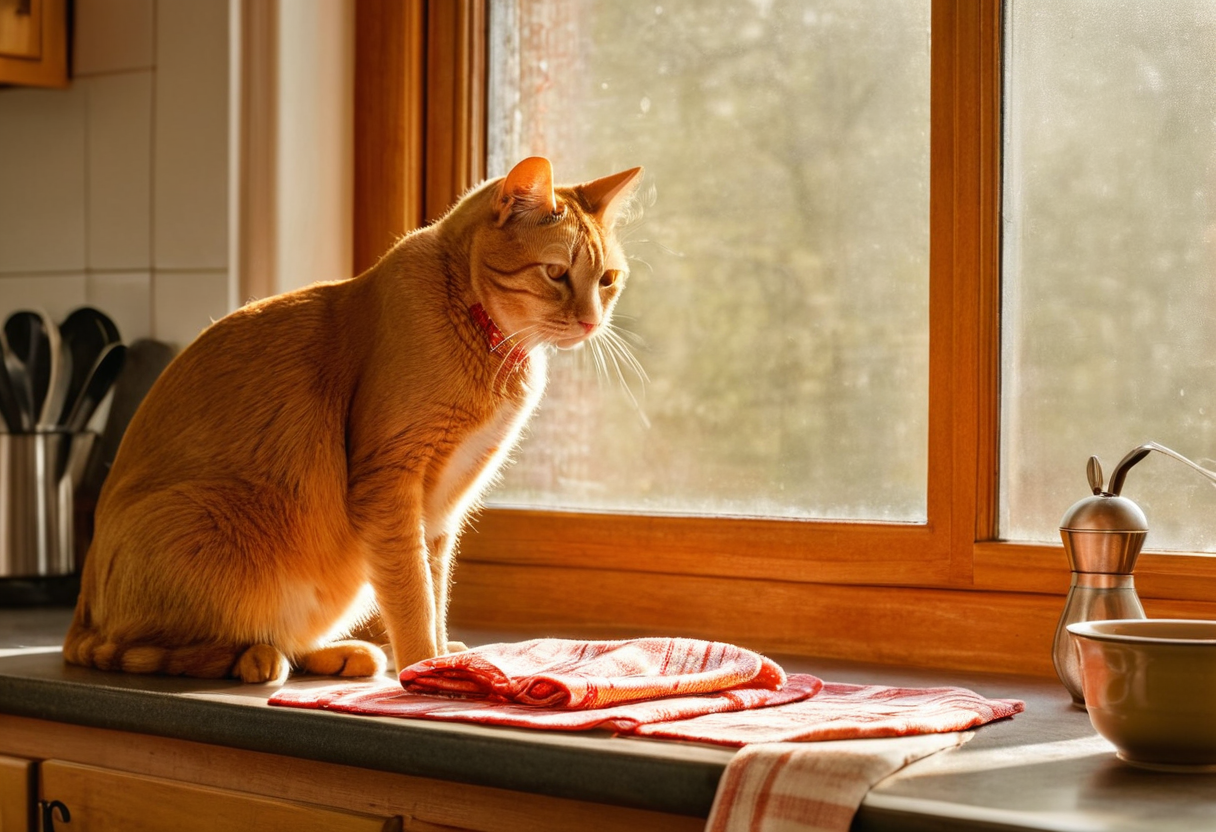
The cat’s name was Bartholomew, and he ran the Department of Approvals out of a sunny windowsill on the second floor of a mid-rise apartment building on Elm Street. He had not been elected. He had not been appointed. He had simply been there longer than any of the residents and had developed, over the course of fourteen years, a very firm opinion about who was permitted to do what.
His official seal was a rubber stamp that had once said APPROVED in red ink, until some long-departed tenant had thrown it out a window during a moving day argument and Bartholomew had retrieved it, batted it under the radiator, and decided it was now his. The ink was almost gone. He didn’t refill it. The lack of legibility, in his view, only added to the gravity of the office.
His clerk was a man named Wendell Park, age thirty-four, who lived in 2B and did not understand that he was a clerk. Wendell believed that he simply lived with a cat. Bartholomew had been correcting this misunderstanding for two years, with limited success.
“You can’t be serious,” Wendell said one Tuesday morning, holding up a piece of mail. “It’s a coupon book.”
Bartholomew, seated on the windowsill, regarded the coupon book with the unblinking calm of a public servant who had seen worse. He extended one paw toward the rubber stamp, which sat on the sill beside a small pile of rejected items: a Whole Foods receipt, an unopened jury duty notice, three takeout menus, and a handwritten note from someone in 4C asking if anyone had seen a missing AirPod.
“I’m just gonna throw this away,” Wendell said.
Bartholomew did not move. He did not need to move. The stamp was right there. The rejected items were right there. The system was the system.
“Fine,” Wendell said. “Stamp it.”
He held the coupon book in front of the cat. Bartholomew touched the stamp. He pressed it down on a faded blue mailer for an oil change. The ink barely registered. He stepped back.
“Approved?” Wendell said.
The cat blinked slowly. This, Wendell had learned, meant processed. It did not mean approved. It did not mean rejected. It meant the matter had been entered into the record and would be reviewed.
The review never came. The review was the entire point and also somehow never the entire point. Bartholomew preferred it this way. Bureaucratic systems, properly maintained, did not produce outcomes. They produced containment.
The first incident that gave Wendell pause had been in February.
He’d been about to throw out a brown paper bag from a Thai restaurant when Bartholomew jumped from the windowsill, crossed the room with rare urgency, and sat directly on top of the bag. He stared at Wendell. Wendell stared back. Bartholomew did not move.
“There’s nothing in there,” Wendell said.
Bartholomew did not move.
Wendell, mildly annoyed, picked up the bag with the cat still on it, and felt something slide down inside the folded paper. He set the cat aside, opened the bag, and discovered a small green ceramic frog he had bought two years ago at an estate sale, which he had loved very much and assumed he had lost in the move.
Bartholomew, having delivered this verdict, returned to the windowsill and went to sleep.
Wendell put the frog on the bookshelf. He did not throw away the bag. He could not now, ever, throw away that bag. The bag had been upheld. He filed it under the kitchen sink and never spoke of it again.
By April, the Department had developed jurisdiction over more than mail.
Visitors were processed at the door. Bartholomew sat at the threshold and inspected each one. Some were approved with a chest-bump or a slow blink and were permitted to enter the apartment. Some were assessed and escorted to the couch under what Wendell could only describe as supervised visitation. One — a man named Greg, who Wendell had been thinking about asking out — was rejected at the door so thoroughly and with such immediate hostility that Bartholomew physically interposed himself between Greg and the apartment, hissed once, and walked away in a manner that left no doubt the matter had been adjudicated.
Wendell, who up to that point had been on the fence about Greg, found himself agreeing with the cat after the third date. Greg had said something about cryptocurrency at dinner. Bartholomew had been right. Bartholomew was always right.
Food deliveries received their own subroutine. The DoorDash bag would be set on the counter. Bartholomew would arrive within ninety seconds and inspect the contents from above, sniffing each container with the careful detachment of a customs officer at a port of entry. Containers he approved of were permitted to be opened. Containers he disapproved of were not, technically, blocked — but Wendell found that whenever he ate a meal Bartholomew had not approved, he felt vaguely that he was eating it without proper paperwork. The food was less satisfying. The leftovers, somehow, did not keep.
The trouble started in May, when Mrs. Hewitt from 2A — a woman who had lived in the building for thirty-one years and who Bartholomew had never approved of, because she had at some point in 2014 said within his hearing that she was “not really a cat person” — submitted a formal complaint to the building manager about, of all things, the cat.
Specifically, she alleged that Bartholomew had been entering her apartment through the shared balcony, sitting on her countertop, and “judging her cooking.”
The building manager, a kind but tired man named Lou, came to Wendell’s door with a clipboard.
“I have to ask,” Lou said. “Has your cat been entering 2A through the balcony?”
“No,” Wendell said honestly. He had never seen Bartholomew on the balcony. The cat hated wet leaves. The balcony was full of wet leaves at all times because Mrs. Hewitt, despite her objections to many things, did not believe in sweeping.
“She says he’s been judging her cooking.”
“That’s a lot to prove.”
“She says he sat on her counter and watched her make a casserole and then made a face.”
“What kind of face?”
Lou consulted his clipboard. “Quote, ‘The kind of face a tax auditor makes when he finds something on page four.’ End quote.”
Wendell looked at Bartholomew, who was on the windowsill, asleep, or at least convincingly performing the act of sleep.
“He doesn’t go on the balcony,” Wendell said.
“That’s what I thought,” Lou said, and he made a small, defeated checkmark on his clipboard and went away.
The next morning, Wendell found a casserole dish in front of his door, scrubbed clean and wrapped in a tea towel, with a Post-it note that said I’m sorry. — Mrs. Hewitt.
He brought it inside. Bartholomew watched the casserole dish travel from the entryway to the kitchen counter. Bartholomew approached the counter. Bartholomew sniffed the casserole dish. Bartholomew touched the rubber stamp.
The stamp came down on the tea towel.
The faintest red ghost of the word APPROVED appeared on the cotton.
“Did you,” Wendell said, “did you do all of this?”
Bartholomew began to wash his face.
Wendell decided, that afternoon, to stop fighting the bureaucracy.
He bought a small wooden in-tray at the secondhand store on Locust Avenue and labeled it FOR REVIEW. He put it on the windowsill. He began placing things in it: bills, junk mail, work memos, a wedding invitation from a college friend, his lease renewal, the receipt from the pharmacy where he’d picked up his allergy medication. Bartholomew processed each item at his own pace. Some sat in the tray for days. Some were dealt with in minutes. Wendell did not understand the priority system. He had stopped trying to understand it. The tray emptied at the rate the tray emptied.
He found that he was, if anything, calmer.
His desk at work was tidier. He paid his bills on time, somehow, despite never thinking about them. He stopped going on dates with men whose presence on the doorstep made the cat make any kind of face whatsoever. He started saying no to small things he didn’t want to do, and the no’s came easily, because somewhere in his apartment a cat had already determined the matter and Wendell was merely the human carrying out the verdict.
Mrs. Hewitt in 2A started leaving food at his door once a week. Each tea towel came back stamped. She framed one of them. Wendell saw it through her cracked door once, hanging in her hallway, and understood that something had shifted between her and the cat, a peace treaty that had been brokered without his involvement and without his knowledge, and that this peace was holding.
In late October, Bartholomew turned fifteen.
Wendell did not know the exact date, because the cat had simply arrived in his life one Saturday in 2024 and never explained himself, but the vet had estimated. Wendell baked a small chicken in the cat’s honor. He set it on the windowsill on a paper plate.
Bartholomew looked at the chicken. He looked at the rubber stamp. He looked at the chicken again.
He pressed the stamp down on the paper plate.
APPROVED.
Then he ate the chicken.
Wendell sat on the floor across from the windowsill with a glass of cheap wine and watched the cat eat his birthday dinner, and he laughed, gently, for a long time.
Outside, the elm trees on Elm Street were starting to turn gold. A delivery truck honked. Someone in 4C was playing an accordion, badly. Mrs. Hewitt was walking home from the market with two bags of groceries and a man Wendell did not recognize — a man around her age, who was carrying one of the bags for her and saying something that made her laugh.
The Department of Approvals was open for business.
Everyone was, more or less, where they were supposed to be.

You Might Also Enjoy
The Accountant of Small Debts
Miriam Chen had been collecting taxes for twenty-three years, and she had learned that what people owed in dollars rarely matched what they owed in truth. She kept two ledgers—one official, one written in the ink of observed moments.
The Collision Protocol
The chronosphere malfunction had punched a hole through three parallel timelines and dropped two entire military bases—one Soviet, one Chinese—into the same frozen Siberian wasteland, approximately forty meters apart. General Volkov lowered his binoculars. Mounted on the Chinese perimeter was something that made his blood run cold. 'They call it... a Nuke Cannon, sir.' 'Why did WE not think of this?' Meanwhile, General Tao stared at the impossible thing floating overhead. 'That cannot fly.' 'With respect, General, it is flying.' A flying stadium carrying fifty thousand kilograms of bombs. This was going to require delicate handling.
The GPS Incident
My GPS confidently directs me to what should be the Riverside Food Truck Round-Up. Instead, I find myself in a church parking lot. There are no other food trucks. Just a lot of people in black clothes looking very, very somber. I should leave. I really should. But I've already invested $50 in gas to get here, and there's a line of people staring at my 'Wheels of Fortune' grilled cheese truck with what I can only describe as desperate hunger. When you're running a food business, hungry people are hungry people.