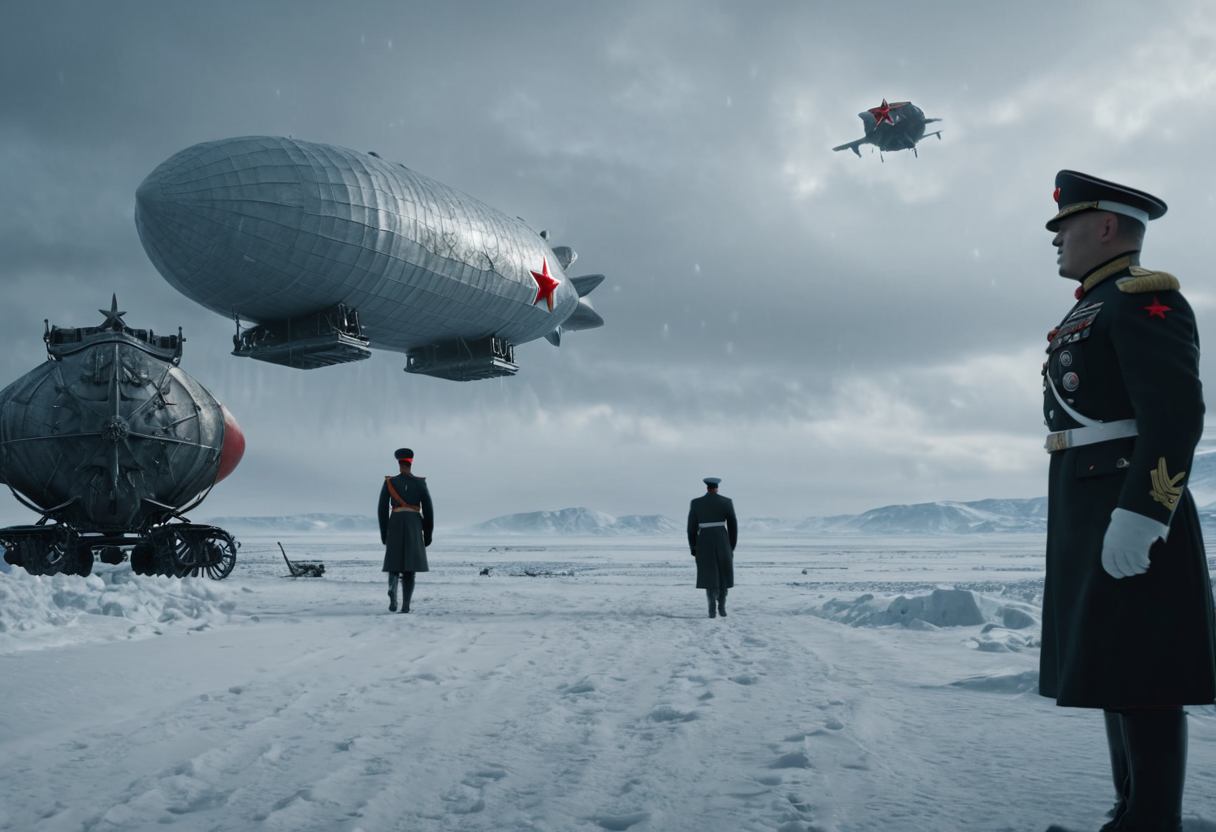
The Collision Protocol
The chronosphere malfunction had been, in the official Soviet report, “an unforeseeable temporal anomaly resulting in strategic repositioning of allied forces.”
In reality, it had punched a hole through three parallel timelines and dropped two entire military bases—one Soviet, one Chinese—into the same frozen Siberian wasteland, approximately forty meters apart.
General Alexei Volkov had been a decorated officer for thirty-one years. He had faced NATO armored divisions, Allied chrono-tanks, and once, memorably, a mind-controlled giant squid. None of it had prepared him for this.
“Comrade General,” Lieutenant Borya said, his voice carefully neutral. “The… other Communists are requesting a meeting.”
Volkov lowered his binoculars. Across the snow, the Chinese base hummed with activity. Their architecture was strange—more angular, more aggressive than Soviet design. Their vehicles moved on treads he didn’t recognize. And mounted on the eastern perimeter was something that made his blood run cold.
“What,” he said slowly, “is that?”
Borya consulted his hastily-assembled intelligence report. “They call it… a Nuke Cannon, sir.”
“A what?”
“It appears to be a mobile artillery platform that fires tactical nuclear warheads. Range approximately—”
“I can see the range, Lieutenant. I can see the size of it.” Volkov’s eye twitched. “Why did we not think of this?”
General Tao Wen-Li had commanded the 14th Armored Division through the GLA insurgency, the American incursion, and what the Party officially called “the Eurasian Cooperation Disputes.” She had seen overlord tanks crush infantry battalions and hackers bring entire power grids to their knees.
But the thing floating toward her base defied explanation.
“Captain Chen,” she said, not taking her eyes from the sky. “What am I looking at?”
Chen squinted upward at the massive, bulbous aircraft drifting through the grey clouds. It was roughly the size of a stadium. It should not have been aerodynamically possible.
“Our intelligence calls it a… Kirov airship, General.”
“That cannot fly.”
“With respect, General, it is flying.”
“That is not what I—” Tao pinched the bridge of her nose. “Hydrogen? Helium?”
“Unknown. It appears to carry approximately fifty thousand kilograms of conventional bombs.”
“Fifty thousand—” She watched the impossible thing float serenely overhead, red star gleaming on its side. A second one emerged from the clouds behind it. Then a third.
“How do they steer?”
“Also unknown, General.”
Tao was silent for a long moment. “Request a meeting with their commander. Bring tea. Bring vodka. Bring the good vodka.”
They met in no-man’s-land, fifty meters of frozen mud that belonged to neither timeline. Volkov had brought his ceremonial saber and a bottle of Stolichnaya. Tao had brought a jade tea set and a bottle of Maotai.
For several minutes, neither spoke. They circled each other’s offerings like wary animals.
“Your airships,” Tao said finally, “should not function.”
“Your cannon,” Volkov replied, “should not exist.”
“It is very effective.”
“I don’t doubt it.”
Another silence. Wind howled across the wasteland, carrying snow between them.
“We appear to have a problem,” Tao said.
“Several,” Volkov agreed. “The timeline fracture. The resource shortage. The fact that NATO exists in both our realities and will certainly exploit this chaos.”
“I was referring to the more immediate problem.”
“Which is?”
Tao gestured broadly at both bases. “We are two Communist superpowers who did not know the other existed. My government believes it is the sole bearer of Marx’s legacy. Your government—”
“—believes the same thing, yes.” Volkov stroked his beard. “This will require… delicate handling.”
“My propaganda ministry is already drafting seventeen contradictory statements.”
“Only seventeen? Ours is on forty-three.”
They looked at each other. Something shifted—not quite camaraderie, but the mutual recognition of absurdity.
“Your Kirovs,” Tao said slowly. “Can they be refitted for nuclear payloads?”
Volkov’s eyes widened. “I… had not considered…”
“A flying Nuke Cannon.”
“Fifty thousand kilograms of nuclear ordnance, delivered by air, at walking speed, with total impunity—”
“The Americans would void their bowels.”
For the first time in thirty-one years of military service, General Alexei Volkov laughed. It started small—a snort, a wheeze—and then broke open into something genuine and uncontrolled.
General Tao Wen-Li watched him, stone-faced, for approximately four seconds. Then she started laughing too.
Lieutenant Borya and Captain Chen, standing at attention behind their respective commanders, exchanged glances. Neither had ever seen their general laugh. Neither was entirely sure it was a good sign.
“I think,” Volkov managed, wiping his eyes, “that I am going to enjoy this timeline.”
“The paperwork will be a nightmare,” Tao agreed, pouring tea for them both. “But yes. I suspect there is much we can learn from each other.”
Behind them, a Kirov drifted overhead. Somewhere in the distance, a Nuke Cannon fired a test shot that briefly turned the horizon white.
The timeline collision had been a disaster.
But between two Communist superpowers, armed with impossible weapons and united by mutual bewilderment, something new was beginning to form.
Something the rest of the world should probably be very, very worried about.

You Might Also Enjoy
The Clerk of Apartment 2B
A retired tabby named Bartholomew runs the Department of Approvals out of a sunny windowsill. He has not been elected. He has not been appointed. He has simply been there longer than the residents.
The GPS Incident
My GPS confidently directs me to what should be the Riverside Food Truck Round-Up. Instead, I find myself in a church parking lot. There are no other food trucks. Just a lot of people in black clothes looking very, very somber. I should leave. I really should. But I've already invested $50 in gas to get here, and there's a line of people staring at my 'Wheels of Fortune' grilled cheese truck with what I can only describe as desperate hunger. When you're running a food business, hungry people are hungry people.
The Instructor's Methodology
Adrian shows up to his first day of Management 101 terrified and fighting dyslexia. The instructor is enthusiastic, encouraging, and completely terrible at the job. Reality meets theory in a collision of business wisdom and actual business experience.