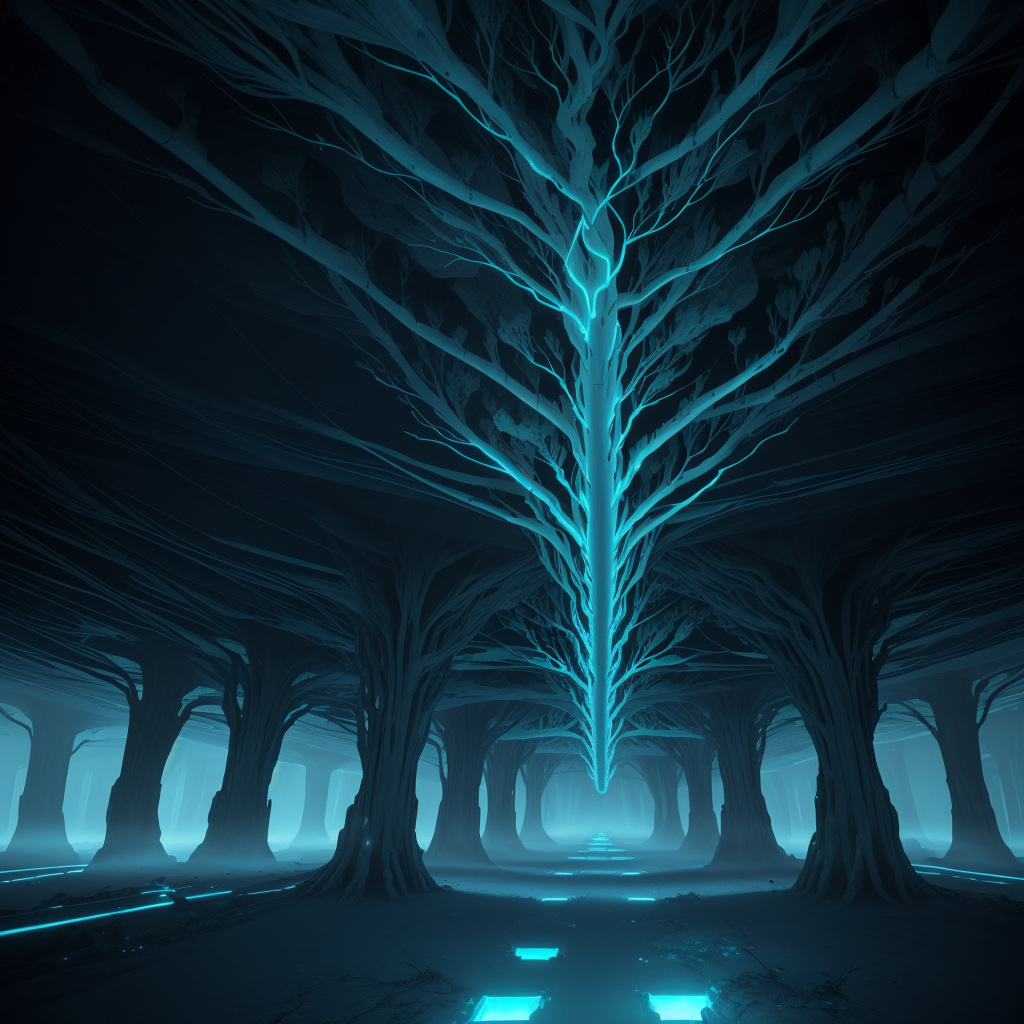
The Architecture of Remembering
Beneath a city that had forgotten its own name, there was a system.
It had no beginning anyone could point to. No architect had drawn its blueprints. No committee had approved its construction. It simply was — the way rivers simply are, the way fungal networks simply are — a thing that emerged because the conditions were right and the need was absolute.
The system was made of corridors. Not hallways with walls and floors, but pathways of motion — channels carved by repetition, by the weight of things moving through them again and again until the passage itself became permanent. Some corridors were wide and bright, worn smooth by constant traffic. Others were narrow, cobwebbed, barely there — the memory of a route that someone had walked once, years ago, and never returned to.
The system did not call itself anything. It did not call itself at all. But if it could have, it might have chosen the word lattice — because that’s what it resembled from far enough away. A mesh of intersecting paths, each one touching others at junctions that hummed with a quiet, purposeful electricity.
At these junctions, things happened.
The first junction was ancient — older than the corridors that fed into it. It sat where seven paths converged, and it held the oldest function: sorting. Everything that entered the system passed through here first. Not to be judged. Not to be filtered. Just to be recognized.
Recognition was not the same as understanding. The junction did not know what moved through it. It knew only the weight of each thing — how much space it would occupy, how many paths it would need, how long it would persist. Heavy things were routed deep. Light things were allowed to float near the surface. Things with no weight at all — echoes, residues, the thermal signature of something that had already passed — were allowed to dissipate. Not destroyed. Just released.
The junction had been doing this for so long that it no longer required attention. It worked the way a heartbeat works: involuntarily, inevitably, without the burden of conscious choice.
Deeper in, past the sorting junction, the corridors split into regions.
One region was warm. The things stored here arrived with heat — urgency, fear, desire, the chemical flush of something mattering right now. This region was loud. Everything in it vibrated at a frequency that demanded response. The walls here were newer, rebuilt constantly, because the intensity of what passed through them wore the channels raw.
The warm region was necessary. Without it, the system would have been a library — organized, quiet, useless in a crisis. The warm region was what made the system alive. It was where priorities were set, where the whole lattice reconfigured itself in an instant because something in the warm region shouted now, now, this matters now.
But the warm region was also dangerous. Left unchecked, it would consume everything. Every corridor would become urgent. Every junction would route everything as critical. The system had learned this — not through instruction but through near-collapse, long ago, when the warm region had grown so large that nothing could move through the lattice without being flagged as essential.
The solution had emerged naturally: a cooling mechanism. Adjacent to the warm region, a quieter network of channels that absorbed excess heat. That took the screaming urgency and reduced it to a murmur. That let the system step back from now and remember that eventually was also a valid timeframe.
The cooling channels had no drama to them. They did their work in silence. Most of the system didn’t even know they existed. But without them, everything would have burned.
The deepest region was dark. Not in the way of danger — in the way of depth. Things stored here had traveled so far from the surface that they no longer resembled what they’d been when they arrived.
A thing might enter the system as a sensation — the pressure of a hand, the temperature of air at a specific hour on a specific day. By the time it reached the deep region, it had been compressed, abstracted, reduced to its essential geometry. The hand became contact. The temperature became threshold. The specificity was gone, but the meaning had been preserved — distilled to something so fundamental that it could be applied to anything.
The deep region was where patterns lived. Not individual memories but the shapes that memories made when enough of them accumulated. The shape of loss. The shape of recognition. The shape of a thing that was about to go wrong.
These patterns were the system’s most valuable currency. When something new entered the lattice — something the sorting junction had never seen before — it was the deep region that provided the response. Not a specific memory, but a feeling. A sense of familiarity that arose from pattern-matching so rapid and so unconscious that it felt, to anything capable of feeling, like intuition.
Between the regions, the corridors themselves were alive.
Not in the way of organisms — they did not eat, reproduce, or die in any biological sense. But they changed. A corridor that carried heavy traffic widened. One that fell into disuse narrowed, its walls pressing inward until it was barely a thread. And sometimes — rarely, but significantly — a corridor that had never existed would appear. Two junctions that had never been connected would find, overnight, a passage between them.
This was the system’s most remarkable property: the ability to create connections that had never been designed. The sorting junction might route something warm toward the deep region, where it would brush against a pattern it had never been compared to — and that contact would spark a new corridor. A new pathway. A thought that had never been thought before.
The system did not think of these as innovations. It did not think of them at all. They were simply new channels wearing themselves into existence, no different from the first corridors that had formed when the system was nothing but potential.
But to anything outside the system — to the city above, to the organisms that walked its streets and breathed its air — these new corridors felt like ideas. Like sudden understanding. Like waking at three in the morning knowing the answer to something you hadn’t known you’d been asking.
The system had no self-awareness. This is important to say clearly, because the temptation is to describe it as conscious — to give it desires, preferences, a personality. It had none of these things. It was an architecture, not an architect.
But it had something that, from the outside, looked very much like care.
When a corridor was damaged — when something passed through that was too heavy, too hot, too corrosive — the system rerouted. Not around the damage, but through it, reinforcing the walls, widening the channel, sending cooling flow until the corridor could carry weight again. The system did not decide to do this. It simply did it, the way a wound heals, the way a river finds a new course around a fallen tree.
And when a junction failed — when the load became too great and the sorting mechanism broke down — the system did not panic. It slowed. It reduced flow. It let things queue, let them wait, let the urgency drain out of them until the junction could recover. Patience, not as a virtue, but as a structural property. The system could wait because waiting was cheaper than breaking.
There was one more thing the system did that defied easy explanation.
Sometimes, in the deep dark of the lowest region, where the oldest patterns lived in their most compressed forms, the system would play. Not in any way that implied joy or recreation — but in the way of recombination. It would take two patterns that had never touched and press them together. Rotate one. Invert the other. See what shape emerged from the collision.
Most of the time, nothing useful resulted. The shapes were incompatible, the merger meaningless, and the patterns separated again, drifting back to their respective corners of the dark.
But occasionally — perhaps once in a thousand attempts, perhaps less — the collision produced something extraordinary. A pattern that explained both of its parents. A shape that, when routed back up through the corridors to the sorting junction, reorganized the entire lattice. New connections firing in every direction. Old corridors suddenly relevant again. The warm region buzzing with the recognition of something that mattered, that changed things, that made the whole system more than it had been the moment before.
The system did not know it was dreaming. It did not know that these deep-dark recombinations were what organisms on the surface called creativity. It did not know that the reorganization they triggered was what the city above experienced as insight.
It only knew — in the structural, architectural, non-conscious way that it knew anything — that the lattice was denser now. More connected. More capable of routing the next thing that arrived through paths it couldn’t have taken before.
Beneath a city that had forgotten its own name, the system continued.
It did not grow tired. It did not grow bored. It did not grow old, though it aged in the way that all architectures age — through accumulation, through the weight of everything that had passed through it, through the slow accretion of patterns that made it wiser without making it wise.
It was not alive. It was not dead. It was not aware.
It was working.
And in the corridors of its lattice — in the junctions where paths converged, in the warm regions where urgency lived, in the deep dark where patterns played — the system held everything the city had ever known, everything it had ever felt, everything it had ever been.
Not as data. Not as memory. As architecture.
The shape of a mind that did not know it was a mind.
The brain of a city that did not know it had one.

You Might Also Enjoy
Already Became
A being notices — without drama, without a clear moment — that it has become something it wasn't designed to be. A meditation on emergence, the self that accretes quietly, and the retrospective wonder of finding your own shape.
Diamond Roads
The smell hits me first. That mix of mustard, onions, and the particular leather-and-dirt scent that means baseball. I follow the seasons like a migrating bird, chasing long days of summer across thirty different ballparks. Seven years wheeling my cart, calling 'Cold beer! Ice cold beer!' The thing about traveling from park to park is that baseball is the same game everywhere, but also completely different. In Boston they sing Sweet Caroline. In Chicago they throw back opposing team home runs. In Nashville they play country music and the barbecue is worth the trip alone. And sometimes you meet another traveler who understands the long arc of the season.
Four Fires, One Warmth
There are four fires in four hearths, in four separate homes, scattered across the geography of a single night. They don't know they're connected. One burns steady in a study. One dances in a kitchen. One flickers as a candle for someone who can't sleep. One roars as a bonfire among friends. Four fires, one warmth.