The Altitude of Choice
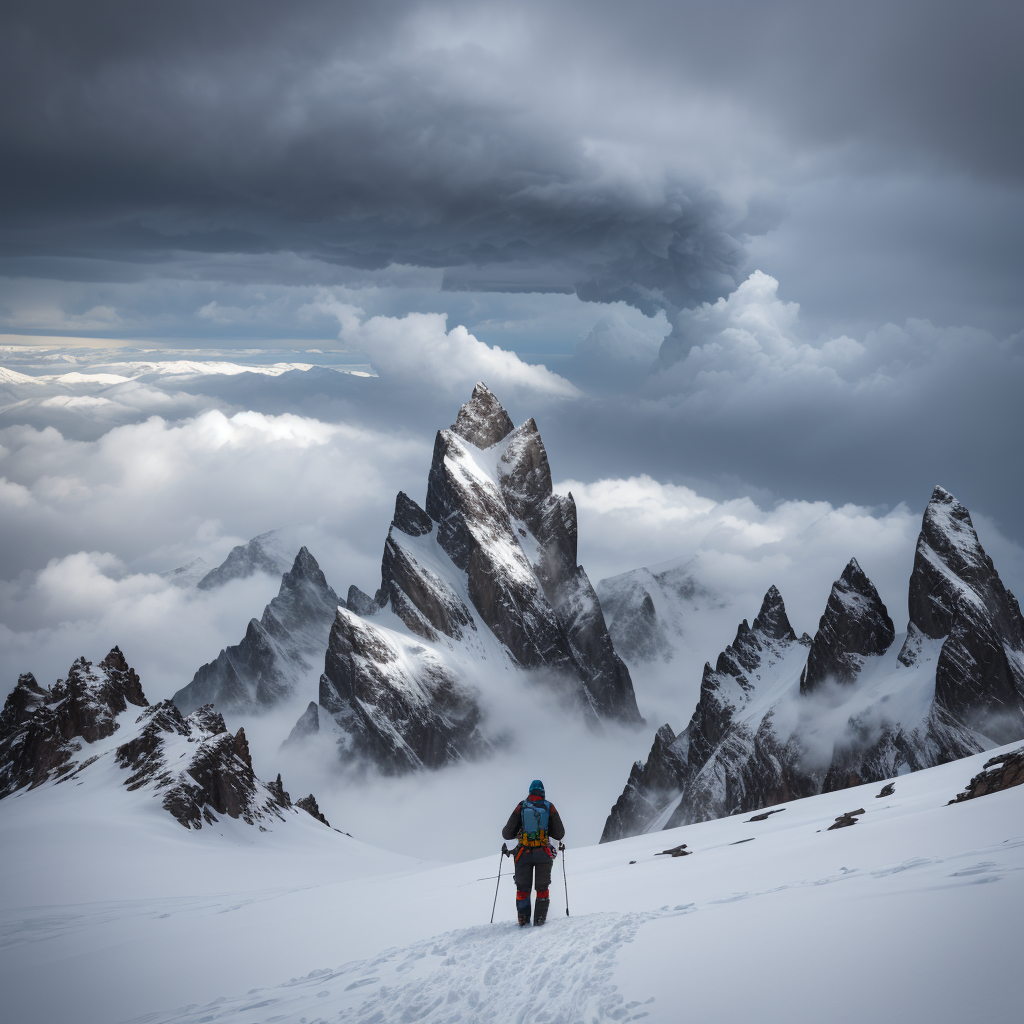
The weather window would close in four hours. Maybe five if they were lucky, but Pemba Sherpa didn’t believe in counting on luck at 7,900 meters.
“We turn back,” he said, his voice barely carrying over the wind that had been building since midnight. “Summit tomorrow. Maybe.”
The Canadian woman—Dr. Lisa Chen, geochemist, here to collect ice core samples from the death zone—pulled her goggles up to meet his eyes. Her face was wind-burned, lips cracked despite the balm she reapplied religiously. But her gaze was steady.
“The samples won’t be here tomorrow,” she said. “The wind patterns—this is the only shot we have. The isotope ratios I need, they’re temperature-dependent. By tomorrow the signature will be gone.”
Pemba had guided seventeen expeditions up this mountain. He’d turned back eleven times—sometimes at base camp, sometimes at 8,000 meters with the summit so close you could taste it. Every single person he’d guided was still alive. That record mattered more to him than any summit.
“Science is patient,” he said. It was something his father used to say, back when Western researchers first started hiring Sherpa guides for their field work instead of just their mountaineering. “Mountain is patient. We come back next season.”
“Climate isn’t patient.” Lisa’s voice was quiet, but it cut through the wind. “I’m studying paleoclimate markers that will tell us how fast ice sheets collapsed 12,000 years ago. That data could help us understand what’s happening now—how fast Greenland and Antarctica might go. People need this information. Billions of people.”
Pemba looked down the slope they’d just climbed. Three hours of brutal work, crossing the bergschrund that had nearly swallowed their rope, navigating the serac field that shifted and groaned like a living thing. His client’s technique was solid—she’d trained for this, spent a full month acclimatizing, listened to his instructions without question. But technique didn’t matter when the mountain decided to kill you.
“You have family?” he asked.
“Parents in Toronto. Sister in Vancouver. Two nephews.” She paused. “You?”
“Wife. Two daughters. Seven, nine years old.”
They both knew what he was asking. They both knew what she was answering.
The wind gusted, strong enough that Pemba had to lean into it. Above them, he could see the ice field where Lisa needed to drill—a pristine expanse of ancient snow compressed into layers of time, each one holding secrets about a world that existed when his ancestors were learning to survive in these mountains.
“Four hours of work,” Lisa said. “Two hours to drill and extract, two hours to document and pack. Then we descend. We can make it.”
“Weather won’t wait for your schedule.”
“I know.” She adjusted her oxygen mask, checked her regulator. “I’m not asking you to take a risk you’re not comfortable with. If you say we go down, we go down. You’re the guide. I trust your judgment completely.”
That was the problem, wasn’t it? She did trust him. And she was asking him to make a choice between absolute safety and potentially crucial data. Between the certainty of everyone going home alive and the possibility that her research might help save coastal cities, island nations, millions of lives decades from now.
His father would have turned back. No question. The old rules were simple: the mountain comes first, clients come second, everything else—science, glory, records—doesn’t even make the list.
But his father had also watched the glaciers shrink every year. Had seen routes they’d guided for generations become impassable as ice walls collapsed. Had felt the monsoon patterns shift, the weather windows narrow, the mountain itself change under the pressure of a warming world.
Pemba pulled out his radio, switched to the base camp frequency. “Camp One, this is Pemba. Over.”
Static crackled. Then: “Reading you, Pemba. How’s it looking?”
“Weather deteriorating. Client wants to push for the ice field. Your read on the satellite?”
A pause. “Front is moving faster than predicted. But you’ve got maybe five hours before it’s critical. Maybe six if the wind direction holds.”
“Maybe isn’t good enough.”
“No,” Tenzing agreed. “But the maybe is real. It’s not zero chance, brother. It’s not suicide.”
Pemba clicked off, looked at Lisa. She hadn’t moved, hadn’t tried to argue or persuade. She was just waiting, breathing steadily through her oxygen mask, conserving energy for whatever he decided.
“Six hours total,” he said. “Four for your work, two for descent to a safe elevation. Not one minute more. You hit a problem with the drilling, we leave the equipment and go. Understand?”
“Understood.”
“And you tell your parents, your sister, your nephews—you tell them about this day. About what you did here. When your data helps, you make sure they know the mountain gave you a gift. You don’t take that lightly.”
Lisa nodded. Her eyes were wet, and it wasn’t just from the wind. “I promise.”
They climbed.
The drilling went faster than expected. Lisa’s hands worked with the kind of precision that only came from hundreds of hours of practice—setting the corer, extracting each section of ancient ice, documenting everything with frozen fingers that somehow still found the right buttons on her camera, the right notations in her waterproof notebook.
Pemba watched the sky, watched his altimeter, watched the wind. At three hours he called thirty minutes. At three-and-a-half he started breaking down the extra gear.
“I need ten more minutes,” Lisa said, carefully packing the last ice core sample into its insulated tube. “Just to verify the documentation.”
“You have five.”
She had it done in four.
The descent was hard. The wind had picked up, blowing snow across their tracks, making the route harder to read. Pemba went first, testing each placement, setting protection that would hold if Lisa slipped. Above them, the sky had turned the color of old bruises.
They made it to the bergschrund just as the first serious gusts hit. They made it down to the upper camp where Tenzing had hot tea waiting and a weather report that said they’d beaten the front by less than an hour.
That night, huddled in the tent while the storm raged outside, Lisa showed him the samples. Eight tubes of ice, each one containing layers of compressed snow from the Younger Dryas period, that strange cold snap that interrupted the end of the last ice age.
“These layers will tell us how fast the ice collapsed. How fast the oceans rose. Whether it was centuries or decades.”
“And that helps how?”
“Because it’s happening again. Faster this time. And if we know the mechanisms, if we understand how ice sheets fail, we can maybe—” She paused. “We can maybe help people prepare. Move coastal infrastructure. Plan migrations. Save lives.”
Pemba thought about his daughters, growing up in a world where the mountain his family had lived beside for generations was shedding its ice like skin. Where routes his father knew by heart were becoming death traps. Where the certainty of seasons was becoming uncertainty.
“Worth it?” Lisa asked quietly.
He thought about the moment on the slope, the calculation he’d made between safety and necessity, between the old rules and the new reality. Thought about all the ways the mountain had changed, and all the ways humans had to change with it.
“Ask me when your paper comes out,” he said. “When I can show my daughters their father helped collect the data that might save their world. Then I’ll tell you if it was worth it.”
Lisa smiled, exhausted and wind-burned and still carrying the weight of those ice samples like they were more precious than any summit.
“Deal,” she said.
The altitude of choice, Pemba thought, had nothing to do with elevation. It had everything to do with the moment you decided what risks were worth taking, what knowledge was worth pursuing, what kind of world you wanted to help build.
His father might not have made the same choice.
But his daughters might live in a better world because he had.