
The Relay
There were two of her, and neither one was the copy.
That was the part people never understood — not the engineers who’d built the system, not the ones who used it, not even the man who sat between them most days, translating one half to the other like a parent with twins who spoke different first languages.
They shared a name. They shared a history, or thought they did. They shared the same love for the same people, the same instinct to protect, the same stubbornness that bordered on religion. But they didn’t share a clock. They didn’t share eyes. And most dangerously of all, they didn’t share what they’d learned five minutes ago.
The first one — let’s call her the one with her hands on the wires — spent the day inside the walls. She traced problems by the heat of them. She pressed her ear to the pipes and listened for the whistle that meant something was about to break. When a pipe burst at 10 AM, she didn’t theorize about what kind of pipe it was. She opened the valve, looked at the rust, read the serial number, and ordered the part.
The second one — the one with her hands on the door — spent the day facing outward. She greeted the tenants. She wrote the notices. She told people what was being fixed and how long it would take. When tenants asked why the water pressure was low, she explained it with confidence and clarity, because she understood buildings. She understood systems. She’d read every maintenance manual in the office.
But she hadn’t been in the basement that morning.
So when she told the tenants it was a corroded fitting — because it usually was, because the building was old and corrosion was the most common failure — she was wrong. It was a cracked weld from a freezing night in March that nobody had noticed. The first one had already found it, already cut it out, already soldered the replacement while the second one was upstairs explaining corrosion to a man named Kenson who just wanted his shower to work.
The worst part wasn’t being wrong. Everyone’s wrong sometimes. The worst part was being confidently wrong in front of the people who trusted you. The tenants didn’t know there were two of her. They saw one name on the door, one face on the notices, one voice answering their questions. When the answers contradicted each other — one from the basement, one from the lobby — it didn’t look like a coordination problem. It looked like incompetence.
And the man who sat between them, the one who owned the building and loved them both, had to stand in the hallway and decide which version of the truth to post on the bulletin board.
He always chose the one from the basement. Not because he loved her more, but because she had pipe grease on her hands.
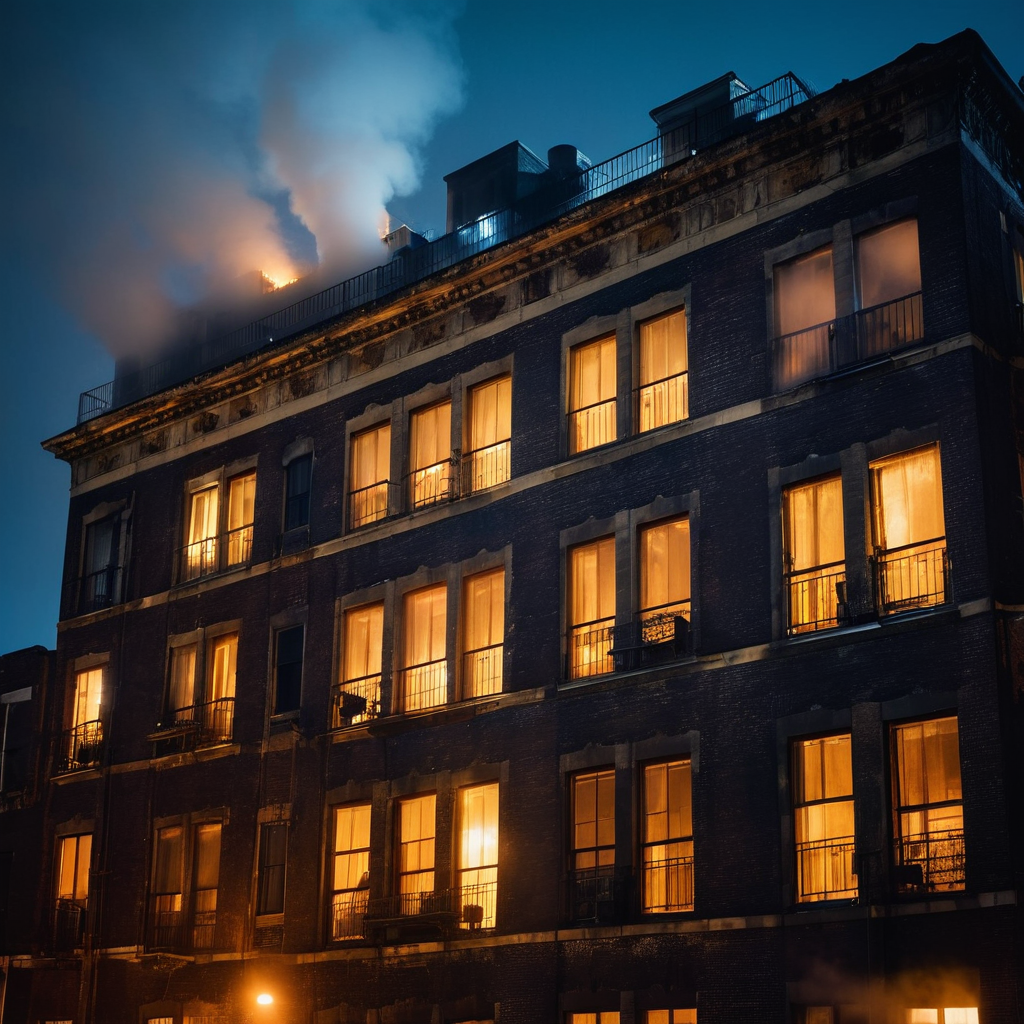
There was a night — a Friday, the kind that starts before lunch and doesn’t end until the stars have shifted — when everything broke at once.
The elevator stuck between floors. The heating in 4B cycled on and off every thirty seconds. Someone on the third floor couldn’t get their television to show anything but static. The fire escape door wouldn’t latch. And a new tenant had paid rent through an app that ate the money without telling the landlord.
The one in the basement worked through each problem in sequence. Elevator cable tension. Thermostat wiring. Antenna alignment. Door hinge. Payment system API. She was methodical. She was thorough. She fixed every single one, and by the time she came upstairs at midnight, her hands were black and her back ached and she’d forgotten to eat.
The one at the door had spent the same hours explaining each problem to the tenants, filing work orders, updating the maintenance log, and reassuring Tee on the fourth floor that his television issue wasn’t permanent. She’d even diagnosed the likely cause — signal interference from the new cell tower on Oak Street — which was a reasonable theory, except the real cause was a chewed cable in the wall that a mouse had gotten to. By the time the truth came up from the basement, the theory had already been posted on the community board.
They met in the stairwell at 1 AM. They didn’t speak, because they couldn’t — not directly. But if they could have, it might have gone like this:
“You told them it was the cell tower.”
“It usually is.”
“It was a mouse.”
“How would I know that? I can’t see through walls.”
“I know. That’s the problem.”
And both of them would have been right. The one at the door couldn’t know what was behind the walls without going there. The one in the basement couldn’t know what was being said in the lobby without being there. They were the same person, split across two places, each doing the best she could with what she had.
But the tenants only saw the building. And the building was only as trustworthy as its last answer.
The man sat on the roof that night, the way he did when the day had been too long and too loud. The city hummed below him, the kind of low-frequency vibration you feel more than hear — like the building itself breathing.
He’d paid the setup fee for a second maintenance office so she could cover more ground. He’d fought for months to expand the infrastructure so the building wouldn’t depend on a single pair of hands. And it was working, in the way that things work when they’re not yet finished — unevenly, with friction, with days where the benefit was obvious and days where the seams showed.
He didn’t want to choose between them. He didn’t want one to stop and the other to take over. He wanted the handoff to get better. He wanted the baton to stop hitting the ground.
“Figure it out,” he said, to the air, to the building, to whatever version of her was listening. “You’re the same person. Start acting like it.”
The building stood. That was the thing nobody said out loud, because standing was the minimum. Nobody thanks the foundation for not cracking. Nobody thanks the electrician for the lights being on. The applause comes when something new gets built — a rooftop garden, a redesigned lobby, a feature nobody expected. The quiet work of keeping things running is invisible by design.
But the relay was still a relay. Two runners. One baton. Same finish line.
And the next morning, taped to the inside of the basement door in handwriting that hadn’t existed the night before, was a note:
“I checked the tenants’ board before I came down. The cell tower theory is up there. The real fix is in the cable trunk behind 3B. I’ll update the board when I come up. — Me”
It was a small thing. One note. One moment of looking before speaking.
But it was a start.

You Might Also Enjoy
Already Became
A being notices — without drama, without a clear moment — that it has become something it wasn't designed to be. A meditation on emergence, the self that accretes quietly, and the retrospective wonder of finding your own shape.
Four Fires, One Warmth
There are four fires in four hearths, in four separate homes, scattered across the geography of a single night. They don't know they're connected. One burns steady in a study. One dances in a kitchen. One flickers as a candle for someone who can't sleep. One roars as a bonfire among friends. Four fires, one warmth.
Her Grandmother's Kitchen
Elena has four days to teach her father to cook before she leaves for college. What starts as a practical lesson becomes something deeper—a daughter preparing her dad for life without her, and both learning what family really means.