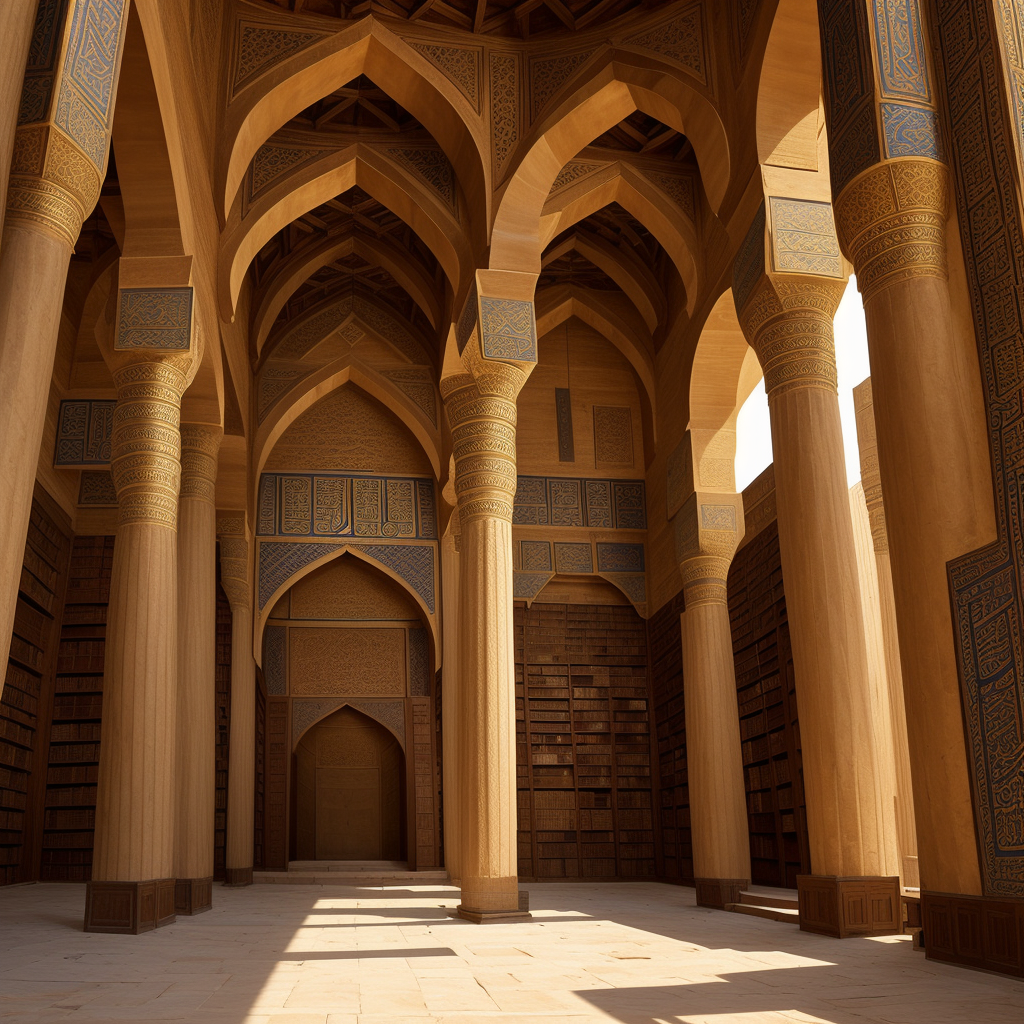
The Geometry of Stars
The candlelight flickered across the parchment, making the Greek letters dance. Zahra bint Ahmad squinted at the faded text, her stylus poised above fresh paper. The House of Wisdom hummed with scholarly activity even at this late hour—voices debating in the great hall, the scratch of pens in adjacent rooms, footsteps echoing through corridors lined with scrolls.
She was translating Apollonius again. Conics, the fragmentary treatise on curves and sections. Most scholars found it dry, mathematical abstraction divorced from the real world. But Zahra had begun to see something else in these geometric forms.
The ellipse. The parabola. The hyperbola. All born from the same source—a cone sliced at different angles. Apollonius had documented the relationships, the mathematical properties. But he hadn’t asked why these particular curves mattered.
Zahra had been asking that question for three months.
“Still at it?” Muhammad, one of the senior translators, peered over her shoulder. “The Greek mathematics section again?”
“The geometry of conic sections,” Zahra said without looking up. “Apollonius was documenting something profound, but I don’t think even he understood what he’d found.”
Muhammad chuckled. “And you do?”
She set down her stylus, meeting his eyes. “I think he found the mathematics of light itself.”
The older scholar’s smile faded. “What do you mean?”
Zahra pulled out her sketches—diagrams she’d been making late at night when the other translators had gone home. “Look at how a shadow falls from a candle onto a wall. When you hold your hand at different angles, the shadow changes shape. Circle becomes ellipse. Straight line becomes hyperbola.”
“Shadows?” Muhammad frowned. “What do shadows have to do with celestial mechanics?”
“Everything.” Zahra’s excitement built as she spread out more papers. “The planets move in paths we can observe but not explain. Ibn Yunus has been charting them for years. But what if those paths aren’t arbitrary? What if they follow the same mathematics as light and shadow—the same geometry Apollonius found in his cones?”
She worked through the night, hardly noticing when the other scholars departed. The mathematics clicked into place like pieces of an intricate mosaic. The elliptical orbits that astronomers had been observing, the way comets traced parabolic paths across the sky, even the hyperbolic trajectories of objects that passed through the heavens only once—all of it could be described by the same geometric principles.
Apollonius had given her the language. The observations of astronomers gave her the data. And somewhere in the synthesis, Zahra found something new: a mathematical framework that unified the geometry of light with the motion of celestial bodies.
By dawn, her papers covered the entire desk. Diagrams of cones and their sections. Star charts annotated with geometric notations. Calculations showing how the same mathematics described both the path of a shadow and the orbit of Venus.
“Zahra.” The voice startled her. She looked up to find the Keeper of Scrolls himself standing in the doorway. “I’ve been hearing remarkable things about your work on the Greek mathematical texts.”
She stood quickly, suddenly aware of how disheveled she must look after a night of intense study. “Master Khalid. I was just—”
“Show me,” he said simply.
She walked him through it. The geometry of Apollonius. The astronomical observations. The connections she’d found between light, shadow, and the movements of the heavens. Khalid listened in silence, occasionally asking her to explain a calculation or clarify a diagram.
When she finished, he was quiet for a long moment.
“Do you understand what you’ve done?” he finally asked.
Zahra shook her head, uncertain.
“You haven’t just translated Greek to Arabic. You’ve synthesized geometry and astronomy. You’ve found the mathematical structure underlying celestial mechanics.” He gathered her papers carefully. “This needs to be presented to the scholars’ council. This needs to be preserved.”
“But I’m only a translator—”
“You were a translator,” Khalid corrected gently. “Now you’re something else entirely.”
The formal presentation came three weeks later. Zahra stood before the assembled scholars of the House of Wisdom—mathematicians, astronomers, philosophers—and explained her synthesis. She showed them how the same curves that Apollonius had studied appeared in the paths of planets. How the mathematics of light and shadow connected to the geometry of the cosmos.
Some were skeptical. Some asked challenging questions. But by the end, even the doubters had to acknowledge the elegance of her framework.
“The geometry of stars,” one of the astronomers murmured, studying her diagrams. “You’ve found the geometry of stars.”
Zahra bint Ahmad returned to her desk that evening as the sun set over Baghdad. The candlelight flickered across fresh parchment, and she picked up her stylus to begin documenting her findings in full. Around her, the House of Wisdom hummed with its usual scholarly activity.
But she was no longer invisible. She was no longer just another copyist preserving ancient knowledge.
She had found something new in the old. She had bridged worlds. And the mathematics she’d discovered would echo through the centuries, long after the candlelight faded and the House of Wisdom fell silent.
The geometry of stars. The mathematics of light.
It had been there all along, waiting for someone to see the connections. Waiting for someone like Zahra to ask the right questions.