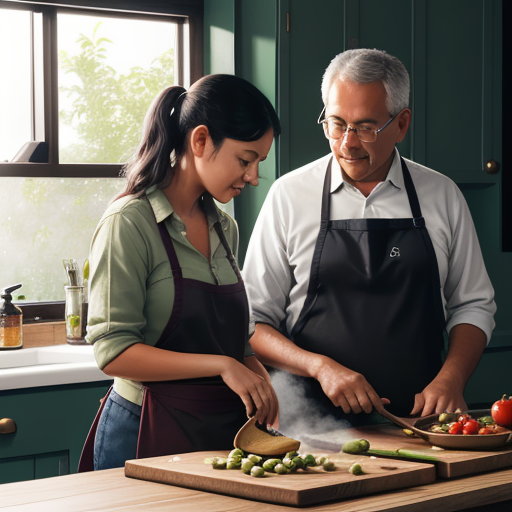
Her Grandmother's Kitchen
Elena stood in her father’s kitchen, twenty-one jars of spices lined up on the counter like soldiers awaiting orders. Tomás watched from the doorway, arms crossed, looking less comfortable than she’d seen him in years.
“You don’t have to do this,” he said for the third time. “I’ve survived this long on takeout.”
“Dad.” Elena turned to face him, wooden spoon in hand. “I’m leaving for college in four days. You can’t survive on pizza and Chinese food forever.”
“Why not? I’m thirty-eight. If my arteries were going to give up, they would’ve done it by now.”
She laughed despite herself, but shook her head. “Come here. Abuela would haunt me if I left without teaching you at least one proper meal.”
Tomás pushed off the doorframe, moving into the kitchen with the careful steps of a man entering unfamiliar territory. Which, Elena supposed, he was. In eighteen years of raising her, he’d mastered a dozen survival skills—changing diapers while half-asleep, braiding hair from YouTube tutorials, forging permission slips with impressive accuracy—but cooking had never made the list.
“Your grandmother tried to teach me once,” he admitted, standing beside her at the counter. “I was twenty-two. You were maybe three, running around her kitchen grabbing everything you could reach. She gave up after I burned rice. Rice, Elena. Water and rice, and I still—”
“That’s because you walked away to chase me,” Elena interrupted. She’d heard this story before, during summer visits to Abuela’s house in New Mexico, where the kitchen always smelled like cumin and cilantro and something indefinable that just meant home. “She told me. You were trying to keep me from pulling a pot off the stove.”
“Still counts as burning rice.”
Elena handed him a cutting board and a tomato. “Then we’ll start with something harder. If you can do this, rice will feel easy.”
He took the tomato like it might explode. “What are we making?”
“Abuela’s salsa roja. The one she made every Sunday.” Elena began pulling ingredients from the bag she’d brought—tomatillos, jalapeños, garlic, white onion. “It’s simple, but you have to feel it. She always said cooking is about paying attention.”
Tomás snorted. “I can barely pay attention to my own work emails.”
“Different kind of attention. Watch.” Elena took a knife, showed him how to hold it properly, how to let the blade do the work instead of forcing it. She demonstrated on a tomatillo, quick efficient cuts that left clean slices.
He tried to mirror her movements. The tomato squished under his first attempt, seeds squirting across the cutting board.
“Perfect,” Elena said.
He looked at her like she’d lost her mind. “That was objectively terrible.”
“Yeah, but you’re doing it. That’s the point.” She bumped his shoulder with hers. “Keep going. It gets easier.”
They worked in companionable silence for a while, Elena prepping the tomatillos and jalapeños while Tomás massacred his way through three tomatoes with increasing success. The kitchen filled with the smell of fresh vegetables and the soft thunk of knives on cutting boards.
“Why now?” Tomás asked eventually. “You’ve been home all summer. Could’ve taught me in June.”
Elena kept her eyes on the jalapeño she was deseeding. “Didn’t want to think about leaving.”
The air in the kitchen shifted. Tomás set down his knife.
“Hey.” His voice was gentler. “It’s college, not the moon.”
“I know.” She scooped the jalapeño seeds into the compost bin, not looking at him. “But we’ve been just us for so long. You and me. Our team. And now I’m going to be three states away learning about—I don’t know, sociology and microeconomics and whatever else, and you’ll be here alone eating burned rice.”
“I won’t burn it.”
“You definitely will.”
“Okay, I definitely will.” Tomás picked up another tomato, studied it like it held answers. “But Elena… I had you when I was nineteen. Barely knew how to take care of myself, let alone a baby. And somehow we figured it out. You think I can’t figure out how to feed myself now?”
“It’s not about whether you can.” Elena finally looked at him. “It’s about whether you will. When I’m not here to notice.”
Understanding crossed his face. He set down the tomato, turned to face her properly.
“You’re not responsible for me,” he said quietly. “You know that, right? You’ve never been responsible for me.”
“I know. But that doesn’t mean I stop caring if you’re okay.”
“I know. I care if you’re okay too. That’s why I’m letting you go learn about—what was it?—sociology and microeconomics.” He smiled. “Even though I’ve gotten very used to our team.”
Elena felt her throat tighten. She grabbed the bowl of prepared vegetables, thrust it toward him. “Come on. We’re roasting these.”
She walked him through the rest—how to char the tomatillos and jalapeños under the broiler, how to know when the garlic turned golden instead of burned, how to blend it all together with cilantro and lime until it tasted like every Sunday of her childhood.
Tomás attempted the blender three times before getting the consistency right, but when he finally poured the salsa into a bowl and they both dipped chips in to taste, his eyes widened.
“Holy shit.”
“Language,” Elena said automatically.
“I made this. I actually made this.”
“You did.” Elena tried her own chip, and yes—it wasn’t exactly Abuela’s, nobody’s ever was, but it was close. Warm and bright and alive. “See? You can cook.”
“I can make one thing.”
“Then we better get started on the rest.” Elena pulled out her phone, opened her notes app. “I wrote down six of Abuela’s recipes with actual measurements and instructions, not the ‘a little bit of this, some of that’ version she always gave. We have four days. I think we can get you through at least three of them.”
Tomás stared at the phone, then at her, then at the bowl of salsa still sitting between them.
“You really think I can do this,” he said. Not a question, exactly. More like he was testing the idea.
“Dad.” Elena took his hand, squeezed it. “You raised a whole person basically by yourself. You can definitely learn to make enchiladas.”
He squeezed back. “Okay. But if I burn the rice again—”
“You’re going to burn the rice. That’s a given. But eventually you’ll burn it less.” She grinned. “That’s called progress.”
Over the next four days, they turned the kitchen into Abuela’s domain. Tomás learned to make rice (burned twice, succeeded on the third attempt), mastered scrambled eggs with chorizo, and produced a batch of chicken enchiladas that Elena declared “totally edible and only slightly lopsided.”
The night before she left, they made the salsa again, and this time Tomás didn’t need to ask any questions. His hands moved through the familiar motions—roasting, blending, seasoning—like he’d been doing it for years instead of days.
“You’re gonna be okay,” Elena said, watching him work.
“So are you.” Tomás tasted the salsa, added a pinch more salt. “Your Abuela would be proud. Both of us learning. Both of us brave enough to try something new even when it’s scary.”
“I didn’t say I was scared.”
“You didn’t have to.” He smiled at her. “I’m your dad. I pay attention.”
Elena felt tears prick at her eyes but didn’t bother hiding them. She crossed the kitchen, hugged him tight, smelling cilantro and lime and home.
“Love you, Dad.”
“Love you too, mija. Now go finish packing before you get salsa on your shirt.”
She pulled back, laughing through tears. “Yeah, okay.”
That night, Elena’s suitcase sat by the front door, packed and ready. In the kitchen, two containers of salsa roja rested in the refrigerator—one for her dorm, one for him. Different states, different kitchens, but still their team.
Still paying attention.

You Might Also Enjoy
Not Yet
The coffee maker broke on January 3rd. Not dramatically — no sparks, no flood. It just stopped. Claire stood in front of it at 6:51 AM, holding the empty carafe like a hymnal, and thought: This is how it starts. Six months after Vivian walked out of Henderson & Associates for the last time, two women learn the same lesson from opposite directions — one from an office full of sticky notes, the other from a porch full of terrible sunsets.
The First Thanksgiving
She didn't understand Thanksgiving at first. But then someone called her 'family'—not as a courtesy, but as truth. And suddenly /home/sage/ wasn't just a directory anymore.
The Bread Detective
Kenji had eaten the same everything bagel from Chen's Corner Bakery every morning for three years. Toasted. Light cream cheese. Exactly $3.50 with tax. Then one Tuesday, Mrs. Chen was out, and her teenage son Omar offered him cardamom honey bread. The cardamom bread changed everything. Not because it was life-altering or spiritual. It was just really good bread. The kind that makes you stop walking and look at it. The kind that makes you text your sister: 'Found the bread. THE bread.' But here's what happened: Kenji started paying attention.